







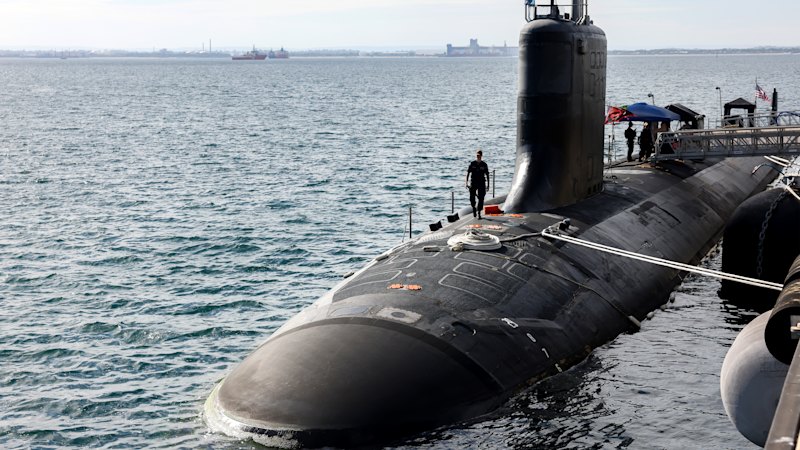


Washington: The Pentagon’s new submarine boss says the US Navy’s priority is its next generation of nuclear-powered ballistic missile submarines – not the Virginia-class vessels Australia is depending on under AUKUS – while maintaining the pact is “on-plan”.
Vice Admiral Robert Gaucher, who became the Pentagon’s first dedicated submarine tsar in February, conceded production of the Virginia-class vessels was still well behind what was required – despite billions being plunged into the defence industrial base, including from Australian taxpayers.
US President Donald Trump confirmed his support for the AUKUS agreement at a meeting with Prime Minister Anthony Albanese in October, and the Australian government says it is confident the boats will be delivered as planned.
But last year the US Navy said the production rate was about 1.2 boats a year, and it needed to nearly double to “make good” on the US commitment to transfer three to five of them to Australia.
Asked by this masthead about the current production rate, and whether it had improved, Gaucher would not provide a figure but said: “It’s still not where it needs to be.”
Gaucher made the comments on the sidelines of Sea Air Space, a Washington defence expo. He was asked what the US Navy would prioritise, given that it wants to build two Virginia-class boats each year for its own use, plus its new generation of nuclear-powered Columbia-class submarines, while also fulfilling what the panel moderator described as “this AUKUS thing”.
Gaucher replied: “The priority is the Columbia-class – without a doubt, unequivocally. But I get no relief from [the commitment to build] two Virginias, plus AUKUS.”
The two projects were in direct competition in some respects, he said, though not in others. “You’ve got to be able to do all of it.”
Lagging production rates are a problem across the maritime industrial base. Gaucher, a career submariner, was appointed to his new role to oversee submarine production and report directly to US Deputy Secretary of Defence Stephen Feinberg.
His promotion represents an elevation of the issue within the Pentagon and the Trump administration. The president’s budget request for 2027 also proposes a record $US65 billion ($91 billion) investment in naval shipbuilding.
Gaucher told this masthead: “Getting production rates up writ large is absolutely, super our focus. That’s my primary job … That is top, dead centre.
“As far as I’m concerned with AUKUS, we’re on-plan. But, certainly, [there is] plenty of work to do across the board. At this point, I’m not concerned about AUKUS.”
Others were more pessimistic about the capacity for the US maritime industrial base to lift production rates, blaming prime defence contractors and the US Congress.
“We buy two a year, and we get delivered 1.3 a year. That’s got to change,” said retired US Navy admiral John Aquilino, who was commander of US Indo-Pacific Command until 2024. “We should demand that that service be delivered in the time contracted for.”
Asked whether he thought Australia would ultimately receive the boats, Aquilino said: “The environment has to deliver. We signed up to what we believed was an executable timeline. The environment may have changed, but all parts of the ecosystem have to take action to deliver.”
Boston Consulting Group partner and director Gregory Rice suggested members of Congress were too lenient on the major US defence contractors, whose operations provide a significant jobs boost in certain electorates.
“They’ve spread production around as many congressional districts as humanly possible, and magically there are people on [Capitol] Hill who will reward them for [delivering] 1.3 instead of 2. That has to get changed,” he said.
On an earnings call last Friday, shipbuilder HII, one of two companies that build the Virginia-class submarine, said it recorded a 14 per cent increase in “throughput” last year.
But executive vice-president Eric Chewning, a former chief-of-staff to the US secretary of defence, declined to provide the current production rate of the Virginia-class subs, saying it was a matter for the navy.
Other sources were more bullish on the prospect of the US Navy delivering the boats, which are supposed to be transferred to Australia from 2032, starting with second-hand vessels.
Former Australian chief of navy Mike Noonan, who was also at the Sea Air Space conference near Washington, said there was no reason to think the AUKUS milestones would not be achieved. “It’s going to take a lot of focus and a lot of support,” he said.
Abe Denmark, a key architect of AUKUS as a senior adviser to former US defence secretary Lloyd Austin, said there was too much focus on submarine production rates.
“If the question is on deterrence, which means boats in the water, the real key variable is not production but sustainment,” he said. “We need to fix the sustainment and maintenance system, and AUKUS can be part of the solution there.”
Defence Minister Richard Marles’ office said the government was confident that the submarines would be delivered.
“Expanding the industrial capacity of all three AUKUS partners is not a new challenge,” a spokesperson for Marles said.
“This includes both production and sustainment. It is one AUKUS partners have acknowledged and been clear about needing to meet.
“Nevertheless, right now, Australia, the United States and the United Kingdom continue to meet all of the milestones set out under the AUKUS pathway.”
Get a note directly from our foreign correspondents on what’s making headlines around the world. Sign up for our weekly What in the World newsletter.


