









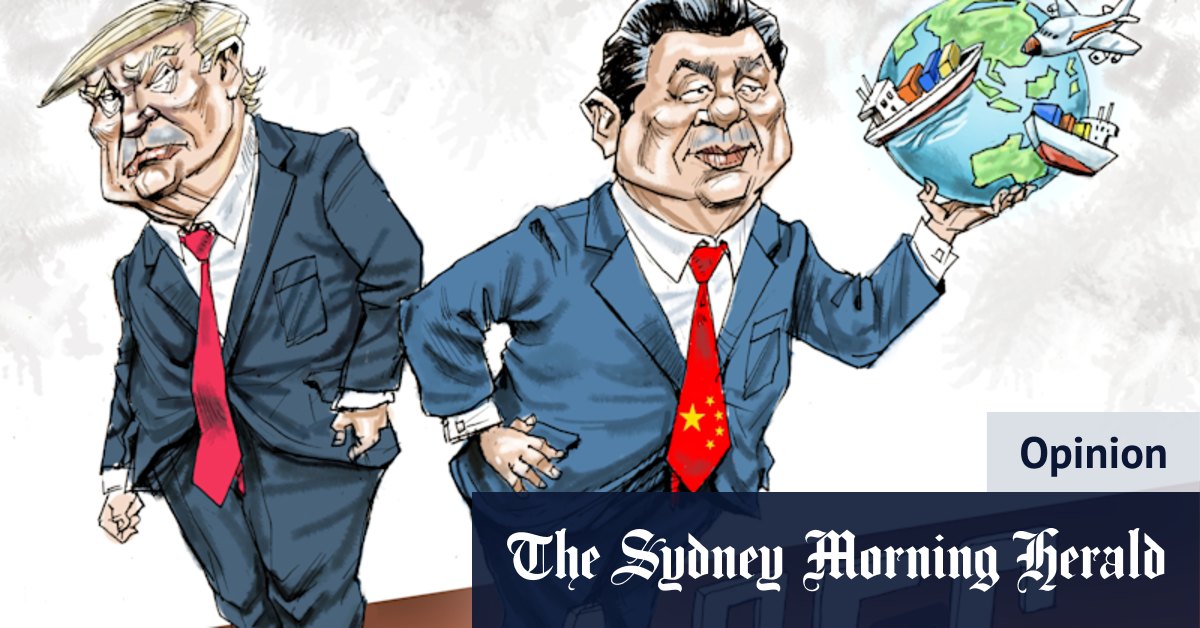
In playing this card, China copied America’s playbook used to stifle its access to chips and semiconductors, but it also surrendered the moral high ground to preach on free trade.
Loading
The spectacle of the world’s two superpowers bargaining over the principles of the international trading system underscores the increasingly fraught position facing Australia and other Asia-Pacific countries, wedged between security dependency on America and economic dependency on China.
Even as Trump erodes America’s standing on the global stage, the vacuum is not one Xi easily steps into.
“Despite Xi’s emphasis on free and open trade, all major Asian powers know that it is backed up by the most ruthless and powerful 100 million-strong Chinese Communist Party,” says Chung Min Lee, a former South Korean diplomat and a fellow at the Carnegie Endowment for International Peace.
The question is: where do US-China relations go from here as both sides settle into an uneasy equilibrium? The longer game is fundamentally a battle for tech supremacy. Whoever has the best chips and semiconductors needed for modern industry and societal progress — and for the advanced weapons system to defend these gains — controls the future.
Loading
Now that Beijing has successfully played its rare earths card, few see it abandoning this leverage in the longer run as it races to close the tech gap by pushing the US for greater access to its advanced chips.
“This is one of the big wins for Beijing,” says Neil Thomas, a China expert at the Asia Society Policy Institute. “Previously, export controls were not up for discussion in Washington. Now, on both sides, it’s going to be in play.”
China can expand its leverage, he says, to all sorts of industries where it dominates supply chains.
It’s a sign of how fast Trump’s trade war has shifted out from under him that words like samarium and scandium – the rare earth metals used to build fighter jets and weapons systems – have jumped from the obscure end of the periodic table to centre stage in the trade talks.
The “12-out-of-10 meeting” with Xi, as Trump saw it, didn’t just achieve a Pyrrhic ceasefire in a trade war of his own making, it put up in lights America’s rare earths Achilles heel, confirming a weakness that Beijing had not been willing to test before Trump’s return to office.
Seven months ago, Trump bet the house of US economic dominance on tariffs, only to last week wind up negotiating away some of his own national security controls on technology exports in exchange for Beijing’s backdown on rare earths.


President Donald Trump with Japan’s Prime Minister Sanae Takaichi at Akasaka Palace in Tokyo on October 28.Credit: AP
This is why Trump used his six-day blitz across Asia to sign critical minerals pacts with Japan, Malaysia, and Thailand, adding to the $13 billion deal Trump had inked with Anthony Albanese in Washington last month. But it will be years before these come close to making a dent in China’s stranglehold.
Trump’s tour of duty in Asia also helped drive home the message that the US hasn’t walked away from the region. He was feted like a king and was showered with gifts that cater to his ego – a replica royal crown from South Korea’s president Lee Jae-myung and a Nobel Peace Prize nomination from Japan’s Sanae Takaichi.
Loading
But at each leg of his whistle-stop tour, the cudgel of his America-first transactionalism hung over the red carpet treatment. Coercively, the US has extracted a combined $US900 billion in investments from Japan and South Korea in exchange for lower tariffs and the ongoing US security guarantee.
As Gavekal Research’s Tom Miller put it in a recent note to clients: “As Asia tires of paying US protection money, it will begin to look for alternatives.”
With the rare earths play, Xi has undercut China’s message as a reliable trading partner at a time when Beijing’s economy is sputtering, and it is trying to drum up much-needed foreign investment. But Trump has the additional domestic challenge that Xi will never face: voters.
In 2026, Americans will cast their judgment on Trump’s tariff agenda at the midterm elections, where Republicans will be fighting to hold on to their majority in both houses. And in 2028, if the norms of the US Constitution hold, Trump will not be running for re-election.
Trump plans to make an official visit to China in April, but Xi is in no rush for a deal. As he likes to tell his Communist Party cadres: “Time and momentum are on our side.”
Lisa Visentin is the North Asia correspondent for The Sydney Morning Herald and The Age.
Get a note directly from our foreign correspondents on what’s making headlines around the world. Sign up for our weekly What in the World newsletter.


