



Updated ,first published
Washington: Anthony Albanese has rejected Donald Trump’s suggestion that Australia refused his request to assist with the war in Iran, with the prime minister arguing Australia has “done what we have been asked to do” in relation to the conflict.
The disagreement came as the US temporarily lifted sanctions on about 140 million barrels of Iranian oil already at sea – its latest bid to boost global energy supplies amid surging prices.
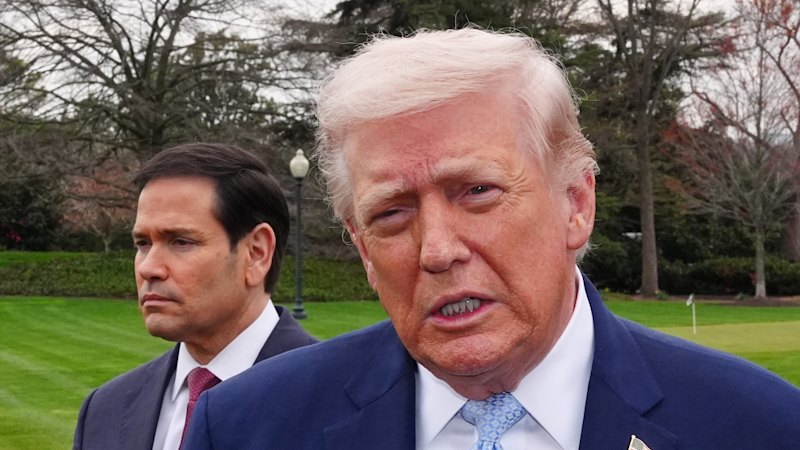
Earlier, Trump told reporters in Washington that he was surprised Australia “said no” to his request to help with the war in Iran, and called on Canberra to “get involved”.
Asked what he wanted Australia to do, Trump said: “They should get involved … I was a little bit surprised that they said ‘no’ because we always say yes to them.”
The president was responding to a question from Sky News Australia as he boarded a US military helicopter to leave the White House, bound for Florida. He did not respond to further shouted questions.
It was not immediately clear what Trump was referring to when he said Australia had refused a request to help. However, Deputy Prime Minister and Defence Minister Richard Marles has previously acknowledged US requests for help with the Iran operation, without offering specifics.
Australia has agreed to provide defensive assistance to the United Arab Emirates by deploying an E-7 Wedgetail surveillance aircraft to the Gulf, following a request from the UAE.
But on Saturday, following Trump’s remarks, Albanese denied there had been any US request for Australia to assist with the war effort.
“I’m not conscious of that at all,” he said. “The truth is that we have said ‘yes’ to the request of the UAE for the E-7 Wedgetail aircraft. That’s operating there, with personnel. We continue to provide the support that we have been asked to provide.”
Pressed on Trump’s comments, Albanese said: “He hasn’t asked. So, I’m not going to go through hypotheticals. We have done what we have been asked to do. I don’t intend to comment on all of what someone else says.”
Marles, also appearing on Saturday, reiterated that there had been no request from Washington for Australia to assist with unblocking the Strait of Hormuz.
Trump has spent weeks pressing allies – particularly North Atlantic Treaty Organisation members – to support the war or assist in reopening the strait, through which a fifth of the world’s oil supply ordinarily moves.
On Monday (US time), Trump called out Australia, Japan and South Korea for not assisting in the operation, at the same time as he said the US did not need their help. “WE NEVER DID!” he said in that post.
However, on Thursday, the leaders of the UK, France, Germany, Italy, the Netherlands and Japan said they were ready to contribute to “appropriate efforts” to help unblock the crucial shipping passage.
The British government has now also signed off on allowing the US to use UK military bases for “defensive operations” to degrade Iranian missile sites and capabilities that are being used to attack ships in the Strait of Hormuz.
The choking of global oil supplies has sent the price of Brent crude above $US110 a barrel, placing pressure on consumers and governments around the world.
US Treasury Secretary Scott Bessent announced late on Friday (US time) that he would temporarily lift long-standing sanctions on Iranian oil to boost supply and calm markets.
“At present, sanctioned Iranian oil is being hoarded by China on the cheap,” Bessent said on X.
“By temporarily unlocking this existing supply for the world, the United States will quickly bring approximately 140 million barrels of oil to global markets, expanding the amount of worldwide energy and helping to relieve the temporary pressures on supply caused by Iran.
“In essence, we will be using the Iranian barrels against Tehran to keep the price down as we continue Operation Epic Fury. This temporary, short-term authorisation is strictly limited to oil that is already in transit and does not allow new purchases or production.
“Further, Iran will have difficulty accessing any revenue generated, and the United States will continue to maintain maximum pressure on Iran and its ability to access the international financial system.”
The move to contain oil prices came as Trump said the US was getting close to achieving its objectives in Iran and that he was considering “winding down” military operations.
He listed those objectives as: degrading Iran’s missile capability, destroying its industrial base, eliminating its navy and air force, preventing it from getting close to developing nuclear weapons, and protecting the US’ Middle Eastern allies such as Israel, Saudi Arabia, Qatar and others.
Trump suggested the US might withdraw and leave policing the strait to allies that were more dependent on oil exports from the Middle East.
“The Hormuz Strait will have to be guarded and policed, as necessary, by other Nations who use it – The United States does not!” Trump wrote on Truth Social.
“If asked, we will help these Countries in their Hormuz efforts, but it shouldn’t be necessary once Iran’s threat is eradicated. Importantly, it will be an easy Military Operation for them.”
But Trump’s statement seemed at odds with his administration’s move to send more troops and warships to the region and request another $US200 billion ($284 billion) from Congress to fund the war.
The president also rejected the idea of declaring a ceasefire in Iran for now, and expressed confidence that the Strait of Hormuz would “open itself” despite allies’ reluctance to offer assistance.
“It’s a simple military manoeuvre. It’s relatively safe,” he said. “But you need a lot of help, in the sense of: you need ships. You need volume. NATO could help us, but they, so far, haven’t had the courage to do so. And others could help us.”
with Ellie Busby
Get a note directly from our foreign correspondents on what’s making headlines around the world. Sign up for the weekly What in the World newsletter here.
 Michael Koziol is the North America correspondent for The Age and Sydney Morning Herald. He is a former Sydney editor, Sun-Herald deputy editor and a federal political reporter in Canberra.Connect via X or email.