


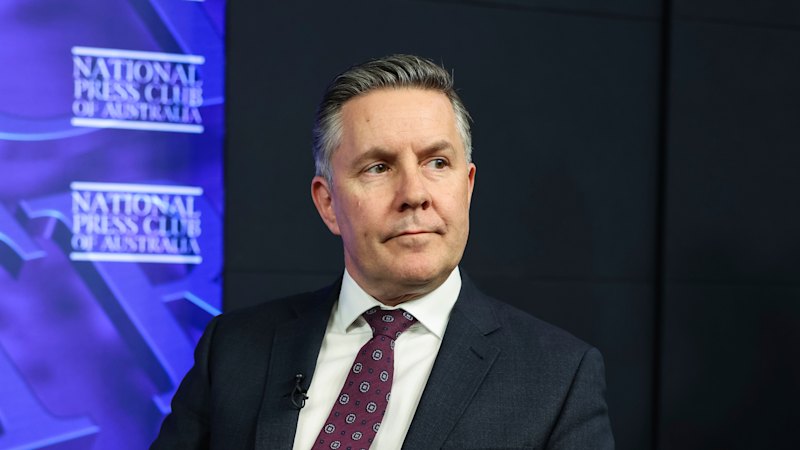
Health and Disability Minister Mark Butler says a person’s diagnosis will play almost no part in determining whether they qualify for access to the National Disability Insurance Scheme, while predicting an army of health workers who have flocked to the NDIS will move to other care sectors.
Butler said the new eligibility assessment – which is yet to be designed, but will determine access to the NDIS from January 2028 – will be “relatively blind” to whether people had clinical diagnoses for particular conditions, so that families would no longer seek out medical diagnoses to get support.
“I think that has been a real lottery for people, particularly parents of children who might have difficulty finding the right specialist to see, sometimes waiting very long periods of time… and then having to pay thousands of dollars to get the report,” Butler said in an interview with this masthead’s Inside Politics podcast to be published later this week.
“Up until now, if you have a particular diagnosis, say level two autism, then you’re pretty much on the scheme … [This will] look instead at your functional capacity and whether you have quite high support needs or substantially reduced functional capacity or not,” he said.
“[It will] be relatively blind to whether you bring a diagnosis of autism or down syndrome or a more physical quadriplegia or paraplegia, for example, and instead look at how your daily living needs are assessed.”
Butler said the new tool would be designed over the next 18 months with the disability community and state governments. One of their tasks will be determining whether the new assessment should include a “light touch” first stage to detect people who have unambiguous functional impairments and will stay on the scheme for the rest of their lives.
“There will obviously be some people for whom there’s really no question about their ability to stay on the scheme, and others who will be at the edges,” he said. The concept has panicked some people with so-called invisible disabilities, such as autism, who fear the new tool may not detect highly variable support needs.
Butler has been seeking to explain Labor’s overhaul of the $50 billion NDIS since announcing last Wednesday that he wanted to restore the scheme to its original purpose and recoup $35 billion over the forward estimates, turning it into one of the largest budget cuts in recent history.
Asked if Labor should apologise for allowing NDIS costs to spiral, which now means thousands of families could be removed, Butler declined. “I tried to be pretty frank last week,” he said, referring to both Labor and Coalition failures in designing and implementing the scheme.
“I certainly acknowledge change is really confronting, and significant change particularly is confronting, and this is going to involve significant change,” he said.
Butler’s overhaul will ultimately remove up to 300,000 people from the scheme by the end of the decade, while curtailing plan budgets for many that remain. Many of those removed are expected to be autistic participants with mild or moderate support needs, given that autism is the primary diagnosis of 43 per cent of people on the scheme.
Butler cited ongoing debate over the rising rates of autism in Australia and other Western countries as one reason why allocating access to the disability insurance scheme based on diagnosis was not suitable.
“There’s no question there’s been a very big increase in autism diagnoses. That, to some degree, reflects a change in the diagnostic manual,” Butler said, referring to an expansion in clinical definitions of the autism spectrum that occurred in 2013.
“Whether there’s been any inflation in the diagnosis beyond that is still the subject, frankly, of debate. And I think trying to unpack that is part of the reason why we want to get rid of the diagnosis lists and really focus on functional capacity.”
Butler said another consequence of Labor’s changes would be a redistribution of the allied health workforce, which had become skewed towards serving the NDIS over the last decade. He said it had become difficult for Australians in aged care, veterans’ care or hospitals to see occupational therapists, speech therapists, psychologists and physiotherapists.
“There’s been this very big gravitational pull in this market, that pays relatively well for all of those health professionals to shift to the NDIS scheme,” Butler said.
“It’s not just those who might have 20 years of experience in this area, but new graduates are often simply setting up a business immediately upon graduation, operating in the NDIS.”
The hourly price limit for most allied health professionals under the NDIS is $194, while they may receive a rebate of just $62 for services through Medicare. That price difference is intended to reflect the complexity of servicing NDIS participants, and cover the full fee for people with long-term needs.
But as thousands more children have joined the scheme than anticipated, it has also meant more professionals are choosing work in the NDIS, exacerbating wait lists and worker shortages outside the scheme. Health department officials have said the NDIS pricing system has distorted the geographic spread of allied health workers and the time families are forced to wait for support.
“Now this [reboot] will have an impact on the way in which that market works,” Butler said.
“There’s still going to be plenty of work for those people, but that might mean that they’re doing a little bit more of their work in those other parts of the health and social care system, which have found it very hard to get those allied health professionals.”
He said many may find themselves working through both the NDIS and Thriving Kids, the new disability system for children with more moderate support needs that will be run by states and territories.
 Natassia Chrysanthos is Federal Political Correspondent. She has previously reported on immigration, health, social issues and the NDIS from Parliament House in Canberra.Connect via X or email.
 Paul Sakkal is Chief Political Correspondent. He previously covered Victorian politics and won a Walkley award and the 2025 Press Gallery Journalist of the Year. Contact him securely on Signal @paulsakkal.14.Connect via X or email.