







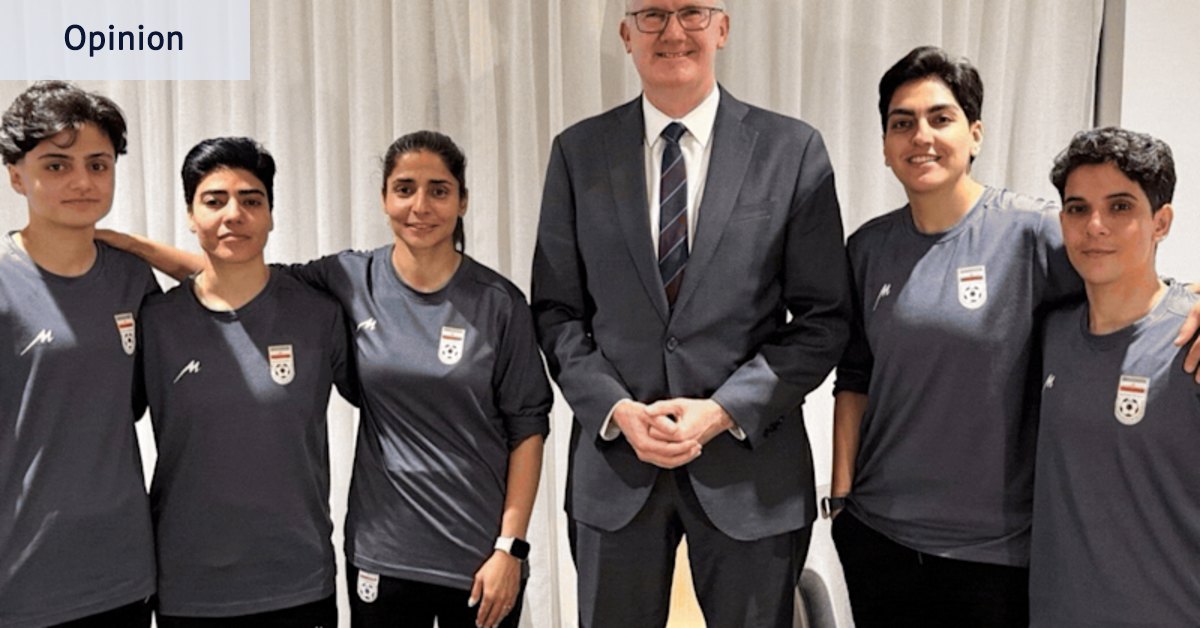
From the first, former Socceroo Craig Foster – a long-time human rights activist – has been one of the most outspoken advocates for the Iranian women football players. I spoke to him on Thursday.
Fitz: Craig, you came to fame as a Socceroo, but are now even better known as an outspoken activist for many political causes. Did you have an “awakening” somewhere, you woke bastard, you?
CF: Happy to be so. The causes I’m associated with are based on an underlying belief in human rights, and I think playing for so long in a team-based sport helped me develop strong views on collectivity and solidarity with other people. Sport ideally provides an environment where everyone has an equal chance, where there are objective rules, where everyone should look after each other. I also believe these are the key principles of Aussie life that should be protected and promoted. Doing your utmost while looking after the least [privileged] and never genuflecting to the powerful.
Fitz: Sport, by its very nature, is inherently left of centre?
CF: Well, team sport has collective values. And when teammates were being mistreated, older ones discarded, younger ones exploited, I was always very focused on their welfare, justice, rights, conditions. World football contains all forms of political systems; democratic, authoritarian, theocratic, so we have players who are persecuted, incarcerated, tortured and sometimes executed. It’s not new to us. In fact, we can expect it from time to time. The rest of us, particularly former players of profile and leverage, must do all we can to protect them. As a former chair of our players’ association, an outstanding organisation well versed in this field, there are periodic issues athletes face where I try to help through human rights knowledge, professional football understanding and contacts, media experience, government contacts and some good Aussie spirit of taking on any challenge, I would say, when it’s needed. Nothing more.
Fitz: You most famously did that in the 2018 case of Hakeem al-Araibi, the Bahrainian playing club football in Melbourne who was arrested in Thailand, while on his honeymoon, and threatened with extradition to Bahrain for having once protested against his home regime. He would have faced long-term imprisonment if you hadn’t whipped up the Australian football community, flown to Thailand, and even flown to Zurich to harangue FIFA. Because of you and yours, he’s now safe in Australia and an Australian citizen.
CF: There’s a very long list of people and organisations who did a fantastic job then. It’s not more complicated than a fellow player and young bloke caught in grave trouble. I’ve got kids. It’s always someone’s child, brother, sister. And if I was in his situation, or the Iranian women, I’d want help. We teach our kids never to walk away from harm, to step up whatever the cost; it’d be pretty gutless if we didn’t do the same. If I played in another country and this happened to our team, I would be hoping that those locals with a voice, with power, with leverage and influence would help. We can’t ask for that which we won’t do. Pretty simple.
Fitz: Speaking of FIFA, what did you make of it when they gave Donald Trump their – no, really – “International Peace Prize”?
CF: Crazed. It’s against every basic principle that sport says it stands for. You’re giving a prize for peace to a guy who’s attacking the very systems that underlie any hope of global peace. But FIFA is a power system like any other.
Fitz: Which brings us to the current situation. We both know that the regime in Iran is absolutely appalling on every front. But my position, if you care, is that as appalling as that regime is, the notion that dropping bombs on the Middle East powder-keg is going to make the world a safer place, or better for the people of Iran, is absurd. Is that yours?
CF: Exactly. I’ve fought numerous campaigns to stop the executions of Iranian athletes, so I’m acutely aware of the brutality, religious persecution of minorities and oppression by its government. In fact, many refugees who fled Iran are my close friends, but all attacks on international law, all violations that go unchecked only make world less safe. Australia should hold Iran accountable, as well as the US and Israel, which we’ve utterly failed to do.
Fitz: That’s strong – how come you’re so much wiser than me? Did you do a degree in human rights or the like?
CF: A law degree doesn’t hurt, but it’s not needed to work out that Trump and Netanyahu are a threat to the rest of us.
Fitz: So now we get to the entire Iranian women’s football team up on the Gold Coast, refusing to sing the Iranian national anthem before their opening match of the Women’s Asian Cup, which was interpreted as a protest against their repressive regime at home, yes?
CF: Yes, that was the interpretation. The male team did likewise so it wasn’t a surprise but afterwards they were coerced into silence and, we understand, reportedly threatened. The Iranian Federation had them surrounded, surveilled and silenced. What we didn’t expect was that in following days, they would be publicly threatened on state TV, accused as wartime traitors, which escalated the risks dramatically.
Fitz: So when the threats came, you thought we need to get the football community behind getting them asylum? You started banging the drum and working every platform, just as you successfully did in 2021, to get members of the Afghan women’s football team safely out of Kabul and to Australia, when the Taliban took back control. For this campaign, you appeared on the BBC, CNN, CBS, ABC, SBS and in the New York Times among other places, calling for their protection, even as you worked the phones to the usual suspects?
CF: Not exactly. I called for their right to personal agency, to access independent, trusted sources of advice including players rights’ groups and for their safety to be guaranteed by both the football authorities and government. And let’s remember that it’s not over. In human rights, there is no such thing as a victory lap, as we think in sport. Lives are impacted, often destroyed, tragic choices made to leave others behind, sometimes even children. These women are caught in a political net they can’t escape, being pressured from all angles, we’ve already seen one choose to return and others may do so. They were extremely brave, and this fundamentally changed their lives. This is the reality of seeking asylum that Australia hopefully understands a little better now. And, yes, the drums are still being banged, as they still need help even while the media cycle moves on, hence this conversation. Plus I’m always keen for young athletes to think about playing the role that us oldies are doing, for now.
Fitz: So beyond the women themselves, who else deserves credit?
CF: Credit is a bad word in human rights cases because there’s always someone left behind, someone needing help that didn’t get it. And plenty of politicians trying to claim it. But any positive resolution needs a number of things – bravery, which the players have. Political influence and organisation, which the Iranian community, thankfully, has. They have been the critical link between the group and the Australian media and community awareness by interpreting each moment through their direct experiences of the Iranian government. This personal testimony created the platform for action. And the political context is always determinative.
Fitz: Why?
CF: The Albanese government moved quickly to help this group for obvious political reasons, as the remaining women have become a powerful part of the public narrative in support of war, unfortunately. This is the cold reality that must be capitalised on for lives to be protected, and sometimes saved. Australia directly supports the violations of international law by the US and Israel who attacked Iran, and are now actively involved in the escalation. War requires the consent of the population because it’s costly, hasn’t gone too well on most occasions, and most people must be convinced that the other needs to be bombed and slaughtered. This is where propaganda, narrative control, media framing are critical. Helping a group of high-profile Iranian sporting women escape the very country you’re helping to bomb is a good look. Immigration ministers don’t usually pose for photos in the middle of the night with asylum seekers, I can assure you. Only very limited and particular types. In the end, the government did the right thing for this group and I thank them for that. Until I criticise them for doing something stupid, again.
Fitz: Geez, Louise. You’re not saying that the whole thing was well under way, even before Trump’s Tuesday 2.30am phone call to the PM?
CF: The Albanese government was already involved, and the PM later stated that publicly. Having said that, getting Trump involved would have been a powerful card to introduce to put greater public pressure on the Australian government, definitely. Sadly, we are in lockstep with the US and appear eager to please the Donald at every step. Sometimes, the political context will help the situation, other times not. The Australian Federal Police and Home Affairs were also involved very early, for which I commend them. As to Trump, he’s nothing if not a master of claiming credit when not due.
Fitz: All up, Australia moved fast and did well to get them asylum, but is there a whiff of hypocrisy at play?
CF: Yes, we should also consider the broader factors so that they’re not able to be adversely used, by thinking through the context, being critical of the motives where necessary, and always putting people first. At the same time as helping these women, the government has moved to ban over 7000 visa holders from Iran from entering the country. As someone with many refugee colleagues and friends, I see the same patterns of war, displacement, closed borders and death. Australia usually gets very upset about asylum-seekers, even while we support illegal wars that create them. It’s great to have given protection to seven Iranian women, but at the same time the government is supporting the action which saw the bombing and the killing of more than 160 girls in a Tehran school. It doesn’t make any sense whatsoever. Equally, we support the protests against the Iranian government, and I marched and spoke out, but we demonise those walking the Sydney Harbour Bridge so that children are not forcibly starved. Crazy stuff. We need to get a grip on ourselves, quick smart. It’s not good for anyone.
Fitz: As ever, while being public on things like this, you seem to attract even more trolls on social media than me, which puts you in post-war record territory. For some reason, they never particularly bother me. Do they bother you?
CF: You are a helpful shield … just kidding. When the Bahrain government sees you as a threat, that’s a whole lot scarier than a few tweets, I can assure you. These are fiercely contested areas, with mass disinformation, hundreds of millions of dollars spent to create consent, silence, coerce, dehumanise and discredit. My advice is, do what you can, but never do nothing.
Fitz: You must have been gratified, this time, to get so much support from the Australian football community.
CF: Our football community is marvellous. We value our diversity, have had numerous human rights campaigns, and the players are educated through their association. The Matildas were involved from the first with the Iranian players. They didn’t just say “this is bad, and we feel sorry for them”. They understood it was a violation of their rights, and expect their player’s union to act immediately. If anyone is in danger and the football community can help, they will. And they don’t back down. I’m always proud of them.
Fitz: Thank you, Craig. Allow me to say I think you’re a very wise man, for a football player.


