









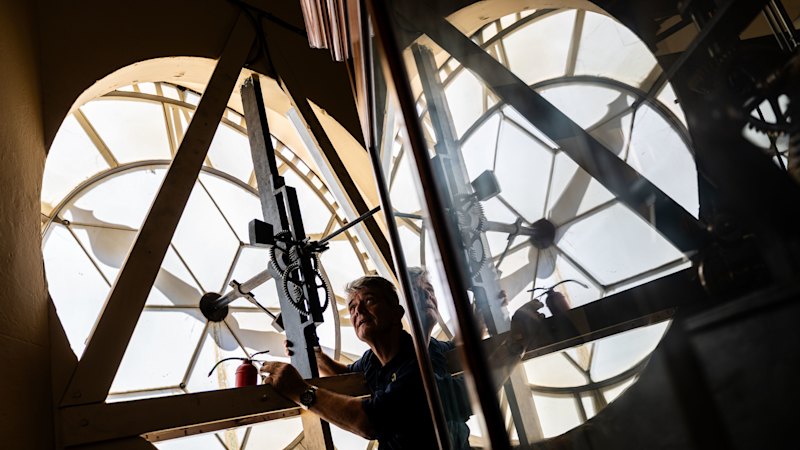


In the middle of the night on 363 days of the year, it is dead silent inside the 55-metre turret overlooking George Street in Sydney’s CBD.
But there will be sounds of shuffling footsteps and a pair of deft hands tinkering inside the Town Hall clocktower at 3am on Sunday, when daylight saving ends and clocks turn back to 2am.
The lone figure will be horologist Andrew Markerink, who twice a year for 15 years has meticulously turned the hands on the clock face manually. Once forward, once back.
The secret to his success lies inside a metre-long glass cabinet at the top of the tower, containing clock parts made in England that are more than a century old. It’s a tricky task, but it doesn’t need anyone else’s help, Markerink says.
Winding back time involves unscrewing fasteners, which releases the brake on palm-sized gears connected to metal rods that directly turn the minute and hour hands outside.
“The City [of Sydney] is quite pedantic about it. They want it done at exactly 3am on Sunday morning,” Markerink says, with a laugh. Sometimes small crowds gather outside to cheer him on.
Pressure comes with adjusting important clocks. As Markerink says: “Everyone knows very quickly when something goes wrong.“
The clock functions smoothly, needs little babysitting, and requires only about a tablespoon of oil each month. Every clock part, save for two wheels, is original from 1883.
Markerink estimates it would take another 400 years before any parts needed changing.
“It’s exactly the same now,” he says. “You could have walked up there with the [clockmakers] and they would have been seeing the same thing that we’re seeing.
“It has character and its own life. There’s a bit of soul in these things – you can’t have something be part of a building for so long and not actually have some sort of essence of it.”
Markerink’s passion for what he does is evident. His voice lowers and his tone softens when he speaks about the clock, affectionately referring to it as if it had a life of its own.
“It’s got a heartbeat, and it’s still doing its thing. It keeps going because you’re actually looking after it,” he says.
“If it’s looked after, this will be doing what it should be doing for a very long time. It will be around for another thousand years.”
It will be a busy night for Markerink and his crew. After the Town Hall clocktower, there are seven others in the city to adjust: Central Station, Paddington Town Hall, Customs House, Glebe Town Hall, then out to Camden, Mittagong and Moss Vale.
Daylight saving will end on Sunday for NSW, Victoria, South Australia, Tasmania and the ACT. Residents will get an extra hour’s sleep and farewell long summer days as the sun rises and sets earlier.
Tasmania was the first in Australia to observe daylight saving permanently, in 1967, after it was introduced as early as 1917 as a wartime cost-cutting, fuel-saving measure.
It was introduced in NSW, Queensland, SA, Victoria and the ACT in 1971, before Queensland ditched it the following year. There have been renewed calls for it to follow in the footsteps of other eastern states.
This year marks 50 years since NSW passed a referendum on May 1, 1976, making daylight saving permanent.
Sydney’s clocktower is also home to the best-sounding set of Westminster bells in the world, Markerink says.
Fine-tuning the bells is a temperamental undertaking, involving listening to chimes not only in isolation but in comparison with other bells that will form the entire set, a process Markerink likens to tuning a violin. “Sometimes you just get a better one, sometimes it’s hard to explain,” he says.
Daily from 7am to 7pm on the hour, heavy “sledgehammer” metal strikers hit the lips of the copper alloy bells, creating a 16-note chorus of chimes that can be heard in Rozelle.
‘There’s a bit of soul in these things – you can’t have something be part of a building for so long and not actually have some sort of essence of it.’
Horologist Andrew Markerink
“There is a decent amount of noise that comes out of here,” Markerink says. But he is underselling the sheer volume. For the seconds when the bells ring, the sound is earsplitting and can be felt pulsing and reverberating through your ribcage.
He doesn’t flinch or reach to cover his ears, an instinctual action for most – it is routine for Markerink, who hails from a line of clockmakers dating back to the 18th century.
Markerink says Sydney’s clocktower is hardly Big Ben’s shabbier little sibling. It is highly accurate, with barely any lag time, and the last time it needed adjustment was nine months ago.
“It is a genius performance,” he says. “We’re just running a little bit off by about a second a month, and they [London] get excited by a second in a day.”
1976 NSW referendum on daylight saving
Electors were then asked to answer “yes” or “no” to the question:
At present there is a period commonly called “daylight saving” by which time is advanced by one hour for the period commencing on the last Sunday in October in each year and ending on the first Sunday in March in the following year.
Are you in favour of daylight saving?
It was carried with a comfortable majority. 1,882,770 electors were in favour; 868,900 were against and 35,507 votes were informal.
Start the day with a summary of the day’s most important and interesting stories, analysis and insights. Sign up for our Morning Edition newsletter.


