









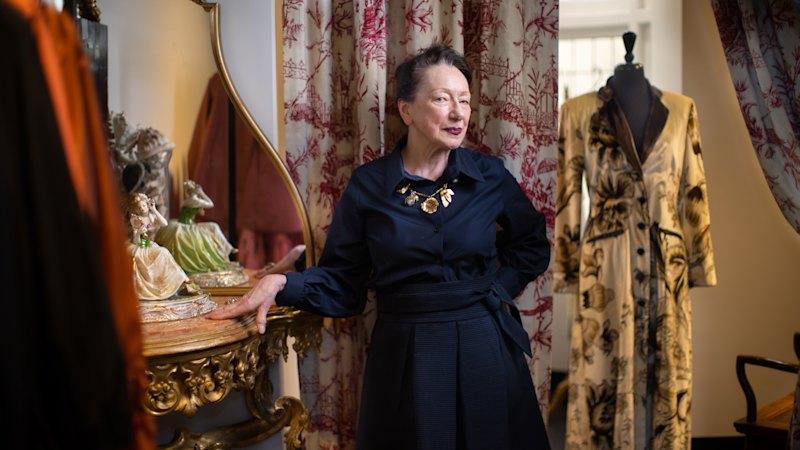


Dressed in Melbourne black and accessorised with a slick of her signature red lipstick, Christine Barro sits in her renowned Collins Street boutique ready to explain why, after 27 years, she has decided to call it a day.
Around her, customers are shopping the closing down sale, browsing racks of clothing in jewel-like colours by designer Martin Grant and trying on millinery by Philip Treacy.
“It’s the end of an era”, one customer says as she tries on shoes in the small space at the Paris End of Collins Street overflowing with accessories and clothes, and decorated with gilt-edged mirrors and chandeliers adorned with cherubs.
Through her eponymous boutique, Christine, Barro has been responsible for introducing designers including Prada and Fendi to the Australian market. She is also the only local stockist for many smaller international brands, like Fox Umbrellas.
Barro says that at the age of 76 she has other projects she wants to pursue, and which are hard to find time for in a business that relies on the personal style and experience brought by her and her sister, Jane-Anne Davoren.
“I am ready to smell the roses and break from bricks-and-mortar retail in readiness for some new life discoveries,” she says.
Barro got her start in the fashion industry as a teenager working at David Jones in Sydney. When she moved to Melbourne at the age of 19, she already had references from clients including ballet dancer Robert Helpmann.
At the department store Georges, Barro worked on the shop floor before becoming a buyer and travelling to France and Italy to meet with the world’s top fashion houses and select stock.
It was during a buying trip in Florence in the mid-1990s that she learnt by fax that Georges had been bought by David Jones and was closing down.
In hindsight, Barro says, it was clear David Jones wanted the fashion houses that Georges stocked, such as Sonia Rykiel and Valentino.
It was during this same era that Barro witnessed the beginning of what’s become one of Melbourne’s most enduring love affairs.
“We had the Gulf War, AIDS, the stock market crashed,” she says. “That’s when the high-end woman in Melbourne didn’t want to be flashy; they wanted something beautiful. And that’s when Melbourne went into black, and we never got out of it.”
Though Melburnians are often mocked for their monochromatic obsession, Barro says it enables them to be understated and “have something beautiful, but not be a show pony”.
After Georges’ closure, Barro decided it was time to start her own business. Christine on Flinders Lane opened in 1999, stocking her favourite designers and brands, and all curated impeccably.
“Melbourne women are not victims,” Barro says. “We ooze our own style. We see the look, but then we make it work in our style and our wardrobe.”
She counts many of the designers she stocks as her friends, including Martin Grant, whom she met on the dance floor at the King Street nightclub Inflation.
“Melbourne was a club,” she says. “We were all out having mischief by night, and the gay bars were the best place to be for us girls; we were safe.”
Barro married her husband, Peter, in 1992, and was 43 when she had their only child.
While half of her life was spent in the world of high fashion, the other was spent caring for her son, David, who was born with a rare degenerative disease, Hunter syndrome, which affects roughly one in 136,000 children.
David died at the age of 15 in 2008, and Peter died in 2018 from amyloidosis – a rare disease caused by abnormal protein build-up.
“I think the amazing thing is how much David taught us,” Barro says. “Because special needs children are so innocent and precious. We had lots of special times.”
Since the news broke of Christine’s closing, Barro has been inundated with letters, emails and phone calls from long-term clients.
“Clients come in here and say, ‘I can’t believe your edit’, and ‘I’ve never seen another store like this in the world’. Fashion is a language, and you’ve got to understand how to read it and then localise it.”
The closure follows that of boutique Miss Louise last year, and Le Louvre earlier this year. The latter operated for more than 100 years and dressed celebrities such as Dame Nellie Melba, Anna Pavlova and Vivien Leigh.
Barro laments the closure of these small independent fashion boutiques and the rise of luxury-brand factories such as LVMH, which she likens to the “McDonald’s or Coca-Cola” of fashion.
“I wouldn’t call them luxury any more,” Barro says. “Sixty-five per cent of the price is the marketing. The value isn’t there any more; it used to be in the craftsmanship.”
Despite her plans to move on to new projects, Barro will continue to work with Grant, offering trunk shows of his designs.
Melbourne Fashion Festival chief executive Caroline Ralphsmith says she is sad to see Christine closing.
“The market is changing and buyers are changing and working out what the new face of retail is going to be,” she says.
“To have Christine closed and to lose the individuality of what she stocks and how she stocks it and the magic of her store is a real loss. There is something about that retail experience that is really unique.”


