








Opinion


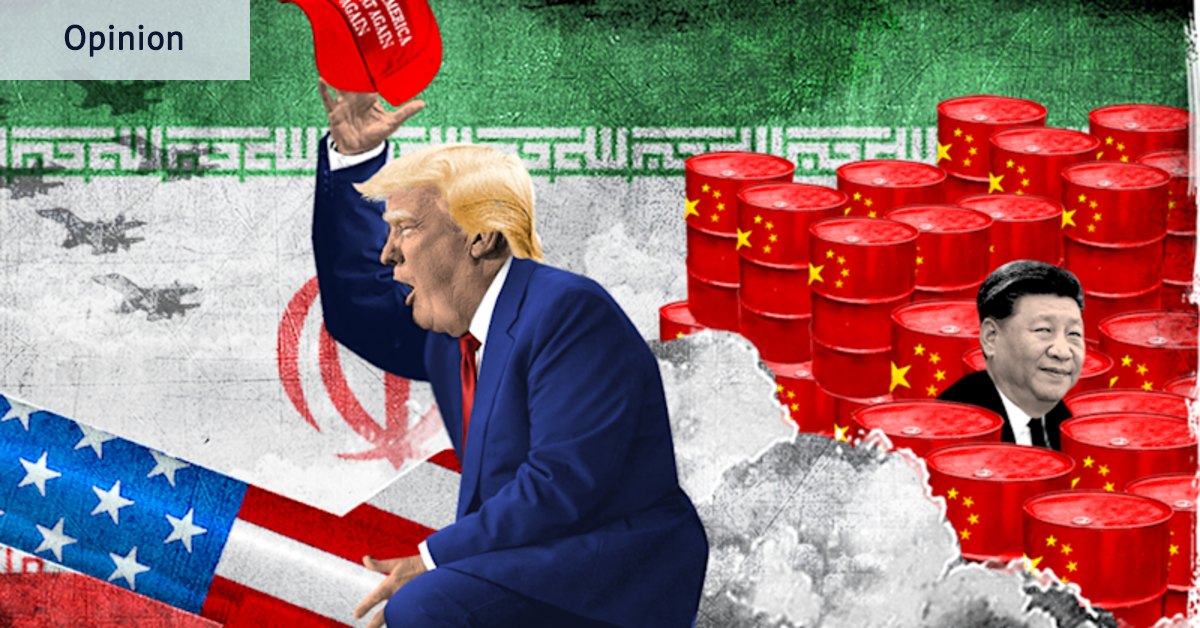
America went to war against Iran. And the winner is? China.
“If you’re looking out at this from Beijing, what’s not to like about it?” poses Steve Biegun, US deputy secretary of state in Donald Trump’s first administration. “The US is distracted. It’s depleting its military capabilities, at least in the short term.”
South Korea’s President Lee Jae Myung last month publicly expressed concern at how many US air defence systems were being transferred to the Middle East for Trump’s war, leaving its South Korean ally exposed. Similarly, the US has shipped air defence systems and Marines out of Japan to the Middle East. Aircraft carriers have been diverted and missile stockpiles spent at an astonishing pace.
For instance, at normal production rates, it will take the US five years to replenish the supply of long-range air-to-surface cruise missiles that it is using against Iran, reports Bloomberg.
The more the US is entangled in Iran, the better for China. While Trump is neglecting the main theatre of global power – the Indo-Pacific – China is focused. While Trump is destroying, China is building. It’s building credibility, building goodwill, building its military stocks, building power as an energy supplier to its neighbours.
“The US could get bogged down in a war in the Persian Gulf, and that’s not going to help us send a convincing message of deterrence [to China] in the western Pacific, especially if we’re depleting our capabilities in order to try to force Iran to capitulate,” says Biegun. He’s neither a Trump critic nor a fan but a long-standing expert on Indo-Pacific security visiting Australia as a Lowy Institute fellow.
Beijing has been unusually quiet during the war. Why?
The current cover of The Economist magazine carries a photo of a loudmouth Donald Trump holding forth to the media in the foreground while a smug-looking Xi Jinping watches on in the background. The caption is a quote famously attributed to Napoleon: “Never interrupt your enemy when he’s making a mistake.”
This is exactly why Shingo Yamagami, formerly Japan’s ambassador to Australia and today a popular commentator on foreign affairs and an informal adviser to Prime Minister Senae Takaichi, advises that “it’s important for the US to get out of Iran as soon as possible”.
“When the US gets bogged down in the Middle East – like it did in Afghanistan and Iraq – it creates a power vacuum in the Pacific,” he tells me. “We don’t want to create a power vacuum because China may take advantage.
“Compared to China and Russia, US power is overwhelming. At the same time, it’s getting more and more difficult for the US to conduct a two-front war,” says Yamagami, a career diplomat and former head of intelligence in Japan’s foreign ministry.
Steve Biegun, speaking separately, agrees: “I think Beijing could be tempted to take a gamble,” and make a play to take full control of Taiwan. “We need to ensure that we have an effective deterrence against an action like this in the western Pacific. And I think we still do, but I think it’s eroded over time, as Chinese capacities have increased and as we have failed to match those in the region.”
China positioned itself cannily for this crisis. It is not only benefiting passively from America’s misjudgments. It is already actively exploiting them.
“China was not caught off guard,” says the Hong Kong-based chief economist for the French investment bank Natixis, Alicia Garcia Herrero.
“Beijing had been watching the US-Iran stand-off with the calm focus of a chess player who had already seen the next several moves. By the time the oil shock hit, China was not scrambling for supply. It was ready.”
Some academic commentators thought they’d discovered a hidden genius in Trump’s strike on Iran. By dominating the oil exporting Middle East, Trump would starve China of energy and bring it to its knees.
Evidence of any such genius is not yet obvious. Trump hadn’t even bothered to refill America’s own strategic oil reserves. And, in the sixth week of the war, Trump has failed to establish any control over the Strait of Hormuz or the global oil price.
By contrast, Beijing amassed extraordinary reserves. Xi Jinping has built an economy to withstand wartime conditions, or, in his words, “worst-case and extreme scenarios … ready to withstand the major test of high winds, choppy waters and even dangerous storms”. This includes a robust energy system.
While the Chinese Communist Party keeps its reserves secret, Standard & Poors Global Commodity Insight estimated that China stockpiled an average of over half a million barrels of oil per day last year, about half of 1 per cent of total worldwide daily consumption.
Reuters reported last week: “No one knows exactly how big the reserves are, but combined with stocks held by commercial refiners, China has enough oil in storage to replace imports via the Strait of Hormuz for perhaps seven months by some estimates.” Iran is continuing to export its oil through the Strait even as it blocks other nations’, and guess where most of Iran’s oil is ending up? In China.
China has as many EVs on its roads as the rest of the world combined. Its electricity system is almost entirely self-reliant thanks to a breakneck-paced rollout of renewable energy backed by domestic coal. Its oil supplies are widely diversified.
“The current situation is really close to what Chinese planners have had in mind for decades,” Lauri Myllyvirta of the Centre for Research on Energy and Clean Air in Finland told Reuters. Or, as party-owned media puts it, China holds its own “energy rice bowl”.
While other countries scramble to find energy, Beijing has turned benefactor. Last month it offered Taiwan a reliable energy supply if it agrees to annexation by Beijing. And China dispatched 19 LNG shipments to its neighbours – 10 to South Korea, five to Thailand and four for Japan, India and the Philippines, according to energy data firm Kpler.
Some analysts point out that Beijing had invested heavily in Iran as its main ally in the Middle East, and that it’ll be weaker and less useful after the war. True. But Trump is busy pushing NATO to breaking point, an entire constellation of wealthy allies alienated.
The Iran war has some possible advantages for the US. “The US is slightly more dangerous in some ways,” says Biegun. “[It has] a president who is willing to use power in a way that his predecessor was not. So it’s not all upside for the Chinese, but I think in general, I think probably the overwhelming sense in Beijing is that time is on their side.”
Peter Hartcher is international editor.


