








Since the September 11 attacks in 2001, the United States and its allies have greatly diminished the abilities of terrorist organisations to carry out sophisticated plots by taking the fight to their redoubts in such countries as Syria, Afghanistan and Libya, and by deploying superior firepower and technology.
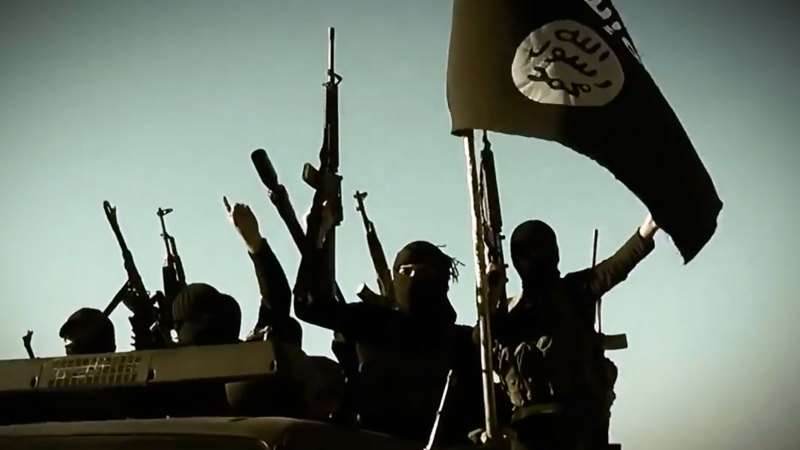
Islamic State traces its beginnings to Iraq. After local militias and US troops defeated al-Qaeda fighters, a branch of the group rebranded itself as Islamic State. It exploited the chaos of Syria’s civil war and the subsequent breakdown of governance in Iraq’s north to seize vast areas of territory in the two neighbouring nations.

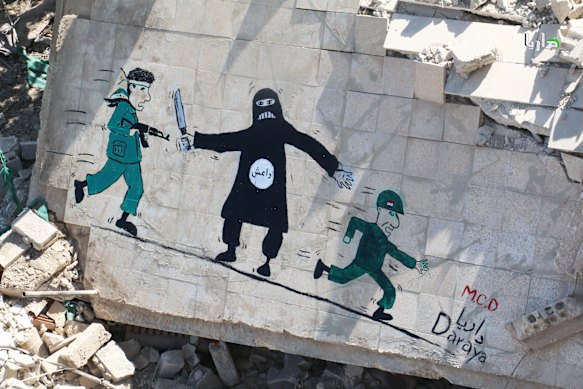
A mural in the Syrian city of Daraya shows rebels (left) having to confront Islamic State militants (centre) as government forces flee (right). The chaos of Syria’s civil war enabled the rise of IS there and in neighbouring Iraq.
The group gained notoriety for kidnappings, sexual enslavement and public executions in its self-proclaimed “caliphate”. It orchestrated or inspired terrorist attacks across Europe, including coordinated assaults in France in November 2015 that killed 130 people and suicide bombings in Belgium a year later in which nearly three dozen were killed.
But it was largely routed nearly seven years ago by US troops and the Kurdish-led Syrian Democratic Forces based in north-eastern Syria.
Because it no longer holds much territory, IS relies even more on its long-standing playbook of spreading its radical ideology online and through clandestine cells and regional affiliates. Last year, Islamic State’s Khorasan branch, based in Afghanistan, claimed responsibility for major attacks in Iran, Russia and Pakistan.
Islamic State’s propaganda urges followers to target gatherings of non-Muslims and provides detailed advice on using guns, bombs, vehicles, knives or a combination of methods to increase casualties. It is “essential to leave some kind of evidence or insignia identifying the motive and allegiance”, the group has told followers.
Loading
British investigators said that the assailant in the synagogue attack that took place on October 2 in Manchester pledged allegiance to IS in a phone call to emergency services while the assault was under way. After the Bondi attack, Australian police found two homemade IS flags in a car the gunmen drove to the scene – evidence that the group’s messages were getting through to people vulnerable to radicalisation, experts said.
“Terrorism breeds in squalid corners of the internet where poisonous ideologies, of whatever sort, meet volatile, often chaotic individual lives,” Ken McCallum, head of Britain’s domestic intelligence agency MI5, warned in October.
On Wednesday, authorities announced charges against the surviving suspect in the Bondi shooting, including murder and terrorism offences.
The attacks on Jewish communities in England and Australia were part of a measurable increase in antisemitic attacks since Israel’s invasion of the Gaza Strip in response to the Hamas attacks of October 7, 2023, that left about 1200 people dead and another 250 taken hostage. Israeli attacks on Gaza have killed more than 70,000 people, according to health authorities there, who don’t distinguish between civilians and Palestinian fighters.
In her analysis, Katz wrote that Islamic State launched a media campaign after October 7, triggering lone-wolf activity in the West. She pointed to attacks in Belgium, Germany, Serbia and Switzerland, among others. In addition, investigators foiled a plot against a Taylor Swift concert in Vienna that the CIA said could have resulted in massive casualties.
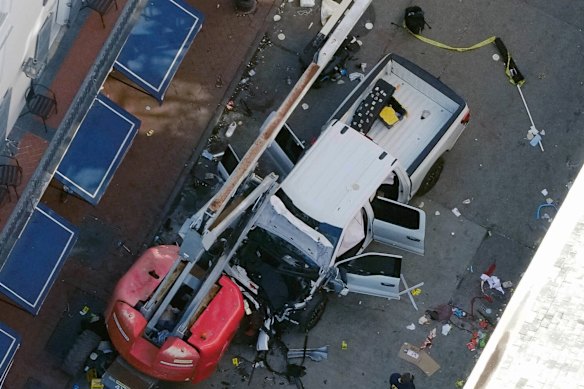
A black flag lies on the ground behind the ute US military veteran Shamsud-Din Jabbar drove into a crowd in New Orleans on New Year’s Day, killing 14 people.Credit: AP
The arrest of the student in Poland came on the heels of another potential attack in Germany, where five men were detained after authorities said they learned about a plot to crash a vehicle into people at a Christmas market.
In the US, Islamic State remains a threat, but the number of people charged in connection with the group remains low compared with previous years, according to researchers. Despite robust US law enforcement capabilities, a man rammed a truck into revellers on a New Orleans street early on New Year’s Day, killing 14 people. The man had an Islamic State flag in his truck, and officials said the group had inspired him.
Loading
While Islamic State’s official English-language propaganda output has diminished since the height of its power, its past publications remain available online, and supporters are translating its ongoing Arabic work into multiple languages, said Aaron Y. Zelin, a senior fellow at the Washington Institute for Near East Policy.
“They put out content every day; they continue to call for attacks against Jews,” Zelin said. “Pretty much every single Islamist plot and attack in the West is still [Islamic State]-related. It still remains preeminent within the global jihadi world.”
Still, while noting the number of global IS attacks has dwindled over the years, Zelin added: “People underestimate it at their own risk. They are still very active.”
The status of IS reflects the shifting dynamics of counterterrorism, experts said. In Syria, for example, US personnel and the security forces of Syria’s new government have collaborated to thwart more than a dozen suspected IS plots since the fall of Bashar al-Assad’s government a year ago, US officials said.
“One of the most challenging aspects of countering a global network like [Islamic State] is that even when counterterrorism authorities make significant progress in weakening some of the organisation’s affiliates, the group is never truly defeated, and even small remnants can remain potent enough to help facilitate terrorist attacks,” Clarke said.
This article originally appeared in The New York Times.
Get a note directly from our foreign correspondents on what’s making headlines around the world. Sign up for our weekly What in the World newsletter.


