








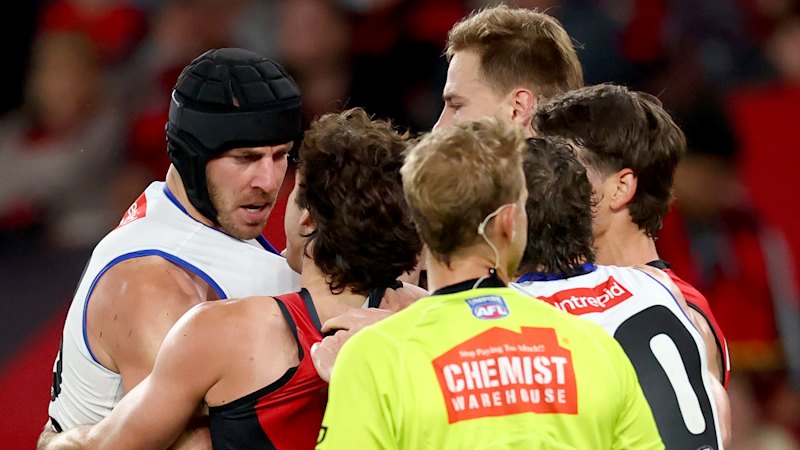
North Melbourne ruckman Tristan Xerri has copped a three-match ban for wiping blood on the face of Essendon skipper Andrew McGrath – behaviour the AFL tribunal described as “disgraceful”.
Tribunal chairman Jeff Gleeson KC was heavily critical of Xerri’s actions and said “the blood could quite easily have made contact with McGrath’s mouth”.
A remorseful Xerri fronted the tribunal on Monday night, and immediately pleaded guilty to the charge of serious misconduct.
AFL counsel Andrew Woods, SC, called for a three-match ban, while North Melbourne player advocate Justin Graham, KC, said a two-match suspension was appropriate.
Xerri had called McGrath on Sunday to apologise, with McGrath accepting the apology, while Xerri – a member of the Kangaroos’ leadership group – had also apologised to his club.
After deliberating for about 30 minutes, Gleeson ruled that Xerri was guilty of “disgraceful behaviour” and would miss matches against Carlton, Brisbane and Richmond.
“The matters we have taken into consideration are as follows, the intentional act of wiping blood from your nose onto the face of another player is disgraceful behaviour,” Gleeson said.
“Xerri’s hand was quite close to McGrath’s open mouth. In circumstances where numerous players were pushing and shoving, the blood could quite easily have made contact with McGrath’s mouth.”
Gleeson said the incident met a serious misconduct charge, but praised Xerri for his “impressive, candid and remorseful evidence” which potentially saved him from a longer penalty.
Xerri’s moment of madness came minutes after he had given away a 100-metre penalty for remonstrating with the umpire over a ruck infringement free kick and being slow to return the ball to Lachlan Blakiston. He was then felled after being shoved by McGrath and crashed into an oncoming Archie Roberts, leaving him with a bloodied nose.
The matters we have taken into consideration are as follows, the intentional act of wiping blood from your nose onto the face of another player is disgraceful behaviour… Xerri’s hand was quite close to McGrath’s open mouth. In circumstances where numerous players were pushing and shoving, the blood could quite easily have made contact with McGrath’s mouth.”
– Jeff Gleeson KC
Amid the drama, Xerri was left unguarded in North’s forward 50 as he recovered from the hit. He marked and goaled from a turnover by the Bombers, and it was from the push and shove after this goal where Xerri made contact with McGrath.
Xerri said his emotions were heightened after he had been verbally abused and called a “flopper” by the Bombers when lining up for goal.
He alleged he was called a “weak c … word” for flopping.
“I was being accused of flopping, the c… word, obviously the next situation unfolded, which I am completely owning. It’s not right what I did, and I sincerely apologise for that,” he said.
“I had a brain fade. It wasn’t my intention to put blood on his face. I did what I did, I know what I did, I should have done better.”
Xerri said there were 100 moments in games which were heated “but that’s no excuse for what I did”.
“I am incredibly remorseful,” he said.
“I reflected on the night of the game. I reached out and gave Andy a call. To Andy’s credit, he took it well.”
Gleeson said one reason for the introduction of the blood rule was to prevent the spreading of infectious disease. When told about this, Xerri replied: “I actually spoke to my doctor earlier today, and she sort of educated me around that and around fluids in sport,” Xerri said.
Woods argued Xerri had brought the game into disrepute.
“The AFL’s position is that the tribunal should determine a sanction of three matches and that would be appropriate for conduct of this kind,” Woods said.
“The AFL’s position is that this conduct comfortably meets the definition of serious misconduct. It’s more severe than just simple misconduct, and there are two types of misconduct.
“This is a deliberate act. It’s something the player has chosen to do. He chose to wipe his hand on McGrath’s face, rather than say, wipe it on perhaps his own jersey, or even on McGrath’s jersey or something like that.”
Woods said Xerri’s actions were a poor example for youngsters.
“It is a family-friendly game. It has dedicated spectators, from little kids to the elderly. And, at weekends, our ovals are full of kids playing footy, and they watch and love watching elite level of footy being played,” Woods said.
Graham said Xerri had “no intent” to harm McGrath, and a two-game suspension was applicable.
“He [McGrath] was not sent from the field, so his play was not interrupted. But, more importantly, the medical report, the form 31 that’s been filed by his club confirms that there was no further investigation required in respect of the matter, and no ongoing treatment required,” Graham said.
Graham pointed to previous cases of players having wiped blood on an opponent.
He said Collingwood skipper Nathan Buckley was given a one-match ban for wiping blood on the jumper of Geelong tagger Cameron Ling in 2002.
He also referred to the Jeremy Howe incident of 2012 when the then Melbourne player wiped blood from a graze on his knee on to shorts of Port Adelaide’s Tom Jonas. Howe pleaded guilty and was given a one-match ban.
However, Gleeson said those cases were “quite significantly less serious, those players wiped blood on to the jumper and shorts, respectively, of their opponents”.


