


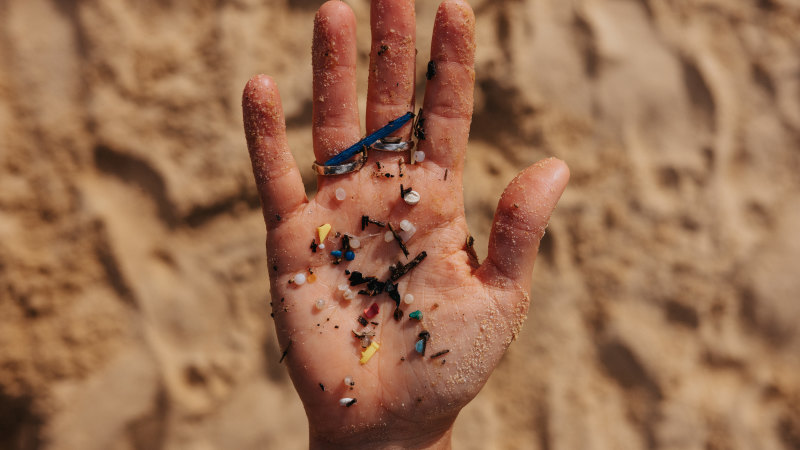

The year was 1966. The Soviets landed on the moon, the Beatles were more popular than Jesus, and plastic was still a miracle.
On the golden sands of Hawaii, Karl Kenyon and Eugene Kridler began the long unwinding of that view.
That year, hundreds of native Laysan albatrosses had died, their remains scattered across the sand. Kenyon and Kridler surveyed their stomaches. There, among the leftover squid, they found plastic. Lots of plastic. Caps, bags, fragments of toys.
In the ’60s, perhaps 10 million tonnes of plastic a year was produced globally. By 2010, that number was past 300 million and growing.
Plastic is strong, and over the intervening decades scientists discovered it breaks down but rarely vanishes completely. In 2004, researchers studying archived plankton discovered microscopic plastics – microplastics, they called them – alongside the tiny creatures as far back as the ’60s. Every decade, concentrations increased.
Microplastics are everywhere, from the deep sea to the Arctic, from plankton to apex predators, in dirt and at the summit of Mount Everest and up in the atmosphere.
“The quantities of plastics we’re talking about are vast. Beyond any normal exposure to anything we would expect,” says Professor David Hamilton, the director of the Australian Rivers Institute who has studied microplastics in Australia’s waterways.
And now, in a series of papers that have attracted global headlines, scientists have started finding them inside us. Headlines warn the “Human Brain May Contain as Much as a Spoon’s Worth of Microplastics”, or that we are consuming “the equivalent of a credit card worth of plastic every week”.
It is tempting to panic. But a survey of microplastics researchers reveals a more nuanced picture. Many are concerned about the health impacts, but they are also concerned about the rigour of the science.
“They are not very robust findings at all, to be blunt,” says Oliver Jones, a professor of analytical chemistry at RMIT, who has published on measuring microplastics. “Some of it is biologically implausible. There’s no way you eat a credit card of plastic a week. Or a plastic spoon in your brain.”
Let’s start with a study that appears to closely link microplastics with bad health outcomes.
In 2024, researchers looked at 304 patients undergoing surgery to clear the plaque out of clogged arteries in the neck. In 150 of those patients, the researchers found polyethylene in the plaque; some also had polyvinyl chloride. Those with plastic-contaminated plaques were 4.5 times more likely to have a stroke or die.
But if microplastics are everywhere, it means they are in hospitals. They are in surgeries. The devices used to do delicate work inside the arteries are often coated in plastic, which is known to shed. How much plastic in the study was from the environment, and how much was accidental contamination?
“There are plastics everywhere, essentially. That’s a challenge in keeping your blank measurements clean,” says Professor Kevin Thomas, the director of the Queensland Alliance for Environmental Health Sciences who studies ways to measure microplastics.
Counting large plastics – like fragments in the belly of an albatross – can be done manually. But the microplastics scientists are now trying to study are so small, measured in nanometres, they are beginning to reach the absolute limits of detection.
“Hypothetically, they are the ones we should be worried about, because they have the ability to cross the gut-blood barrier, or the air-blood barrier if we breathe them in,” says Thomas. But as particles get smaller, detection gets dramatically harder. “This is where I think we have maybe underestimated the challenge.”
Many of these detections rely, for now, on an approach called pyrolysis-gas-chromatography-mass-spectrometry.
Scientists start with a sample of plastic, which is placed in a furnace. The heat vaporises the sample, before the mass-spectrometer tries to identify each molecule.
Unfortunately polyethylene, the world’s most commonly produced plastic, just so happens to break down after pyrolysis into compounds that are identical to the compounds you get after breaking down human fat.
Recall the suggestion we may have as much as a plastic spoon’s worth of plastic in our brains. The brain also happens to be about 60 per cent fat, higher than any other organ.
“If you have any residual fat in your sample, it can produce the same triplet of hydrocarbons,” says Thomas. “For samples that are high fat, even the most robust filtration measure may not eliminate all the fat.”
Let’s assume, for a moment, microplastics are penetrating our bodies. What are they doing to us?
A 2025 review led by Dr Nicholas Chartres, senior research fellow at the University of Sydney, found harms to reproductive, respiratory and digestive health, with a possible link to colon and gut cancer.
“Unless we turn the tap off now and we ban all single-use, non-essential plastic … we are going to have one of the great human crises in the next 20 or 30 years,” Chartres told this masthead.
But the field is nascent. Looking at those three areas, the review found 28 animal studies to include, and just three human studies (one from Iran, another from Turkey) covering 163 people.
If we aren’t confident of the exact levels of microplastic exposure, it is harder to make sense of the animal data. Some studies use concentrations of microplastics “higher than anything you’d be exposed to unless you went and ground up a bunch of plastic and breathed in the dust,” says Hayden Gillings, a PhD candidate in nanoplastics and health at Flinders University. “It’s definitely something that needs to be taken with a grain of salt.”
And how do we disentangle any signal of microplastic-harms from all the other negative effects from environmental exposures we face every day, like air pollution or junk food?
“It’s really tricky to measure what people are exposed to, and then to link that to health effects, because people are exposed to lots of stuff. If someone gets liver disease, is that because they were exposed to a lot of plastic, or because they drank a lot of alcohol?” says Oliver Jones. “I don’t think we can say with any certainty what the health impacts are.”
The study of microplastics is a new field, behaving in the way new fields do: first comes excitement, then comes scepticism. The challenge now is rigour. Most experts who spoke to this masthead were confident the problems with measurement could, eventually, be surmounted.
The question for now is: how worried should we be, and what should we do?
“Do you want to wait a few more decades to see if these things made from oil or gas and 16,000 chemicals harm us?” Chartres asks. Mark Green, an associate professor in reproductive biology at the University of Melbourne, agrees. “We are better to have a precautionary approach, than to wait 20 or 50 years time for damaging evidence.”
Even Kevin Thomas, whose work has raised important questions about the accuracy of microplastic measurements, tries to minimise his exposure. He does not use plastic containers or a plastic chopping board.
“You are definitely being exposed to plastics. The key thing we’re trying to find out in the work we do here is, of that proportion of plastics, what happens to them when we inhale them,” he says. “That’s where the uncertainty is at the moment.”
The Examine newsletter explains and analyses science with a rigorous focus on the evidence. Sign up to get it each week.
 Liam Mannix is The Age and The Sydney Morning Herald’s national science reporter.Connect via X or email.