






As well as researching travel activity, Beck is himself a long-distance commuter; it takes him about 70 minutes to travel from his home in the Blue Mountains suburb of Warrimoo to the Sydney University campus in Camperdown.
Beck says the HILDA findings about the decline in commute times show how all regular travellers – including many who cannot work from home – have benefited from greater workplace flexibility since COVID-19.

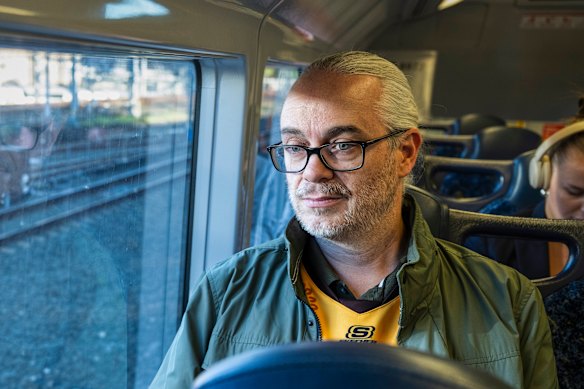
Commuter and academic Matthew Beck on the train home on Thursday evening.Credit: Janie Barrett
“People who can’t work from home benefit from the people who do, in terms of their ability to find a seat on a train or move a little more freely through traffic,” he said.
Beck has noticed improvements in his own commute from the Blue Mountains.
“Before COVID, the mountains trains were usually quite full and a lot of people had to stand, but now pretty much everyone gets a seat,” he said.
The HILDA survey shows it now takes less time to get to and from work in Sydney than two decades ago. The average daily commute time in 2002 was 60 minutes, one minute longer than in 2023.
Beck says those in government and business making blanket calls for workers to return to the office risked “destroying a powerful transport lever” that has the potential to improve the efficiency of transport systems and save billions of dollars in infrastructure spending.
“You can get real traffic flow and congestion benefits simply by allowing people to work more flexibly,” he said.
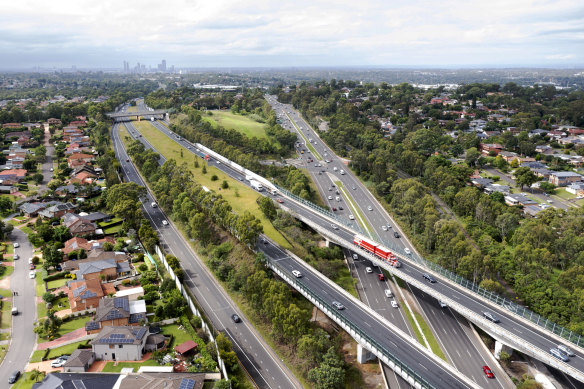
Motorists on Sydney’s M7. Average daily commute times in the city have fallen since the pandemic.Credit: Janie Barrett
The survey found 35 per cent of workers did some work from home in 2023, while 15 per cent worked most of their hours from home. That compares with about 25 per cent of employees doing at least some work from home before the pandemic and only 5 per cent who did most of their work remotely.
Loading
Hybrid employment, whereby two, three or four days are done remotely, is “significantly more common in the mainland state capital cities than in other locations,” the report said.
Commute times vary considerably across Australia; workers in the five mainland capitals spent an average of 56 minutes travelling to and from work each day, compared to 44 minutes for those outside the big urban centres.
The share of workers with very long commutes (two hours or more) declined from a peak of 18 per cent in 2019 to 13 per cent in 2021, and has remained at that lower level since.
Inga Lass, a Melbourne University researcher who co-authored the HILDA report, said this trend was also linked to the growing prevalence of remote work.
“The drop in long commutes since 2019 can again be attributed to the spread of working from home, which benefits particularly those workers with very long commutes because they save the most time from working a few days per week from home,” she said.
Partnered mothers have a lower probability than single women of having long commutes, while fathers – both single and partnered – are most likely to have long commutes.
Start the day with a summary of the day’s most important and interesting stories, analysis and insights. Sign up for our Morning Edition newsletter.


