









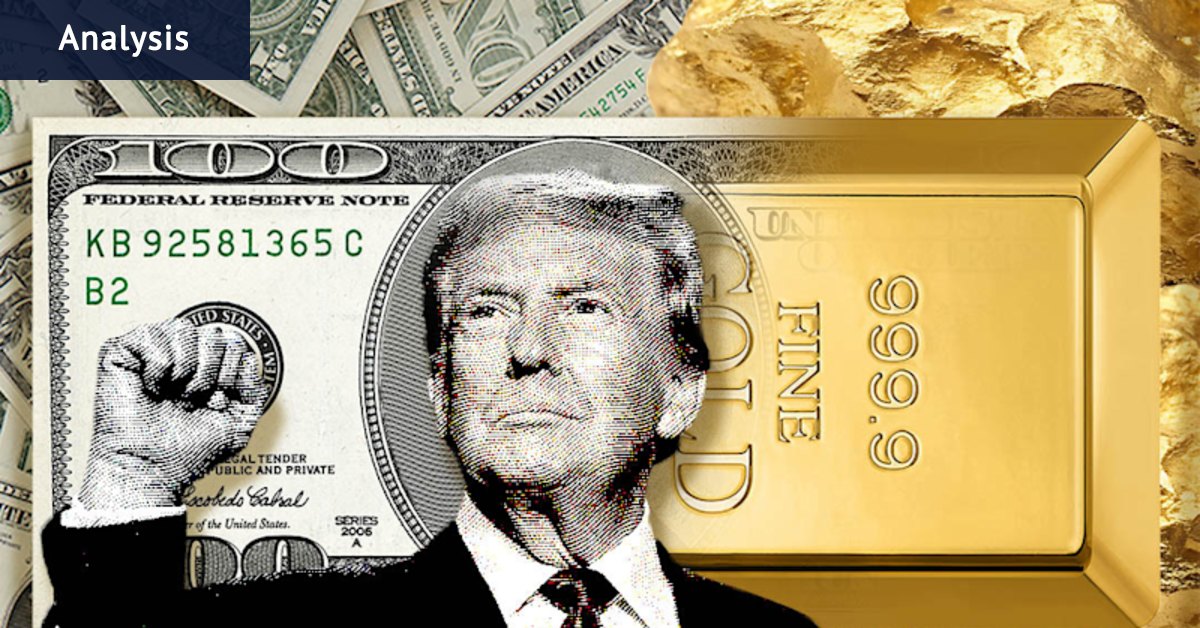
By October, gold had topped $US4000 an ounce for the first time – soaring 60 per cent for the year and outperforming both the US sharemarket and a woeful bitcoin.
UBS notes that market analysts have struggled to keep up with gold’s parabolic ascent and says the precious metal could top $US4750 in the second half of next year.


People line up to buy gold and silver bullion at ABC Bullion in Sydney’s Martin Place.Credit: Dominic Lorrimer
“We continue to see a supportive market backdrop for gold, noting that the foundations of gold’s ascent – particularly the structural shift in private and official sector demand – suggest that price risks remain skewed to the upside over the next 12 months,” UBS analysts say.
There may be more to the soaring gold price than Trump, but it would certainly not have achieved its current trajectory without him.
While the public focus has been on the sight of Australians literally queuing up to buy gold as the precious metal topped fresh highs, the real action has been from sovereign nations, their reserve banks and wealthy buyers.
China and Russia have joined the buying frenzy to avoid the risk of investing in US financial assets in the age of Trump.
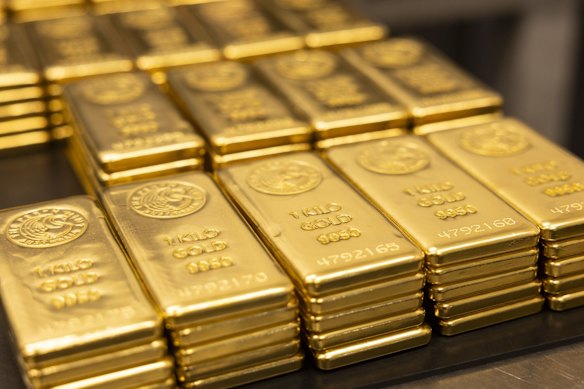
New figures from the Australian Bureau of Statistics showed the country shipped $5.7 billion in non-monetary gold to the rest of the world in October alone.Credit: Bloomberg
But they are not alone. Other countries, reserve banks and investment professionals are buying the precious metal by the truck load as a hedge against the so-called debasement of traditional stores of wealth like the US dollar and government bonds, which risk having their value eroded by massive government spending and rising debt levels.
The argument is simple, why store your wealth in financial instruments in governments spending way more than they earn, and whose only way out of the fiscal mess is to devalue their currencies and what they owe to lenders via the bond market?
Loading
It means that the average buyer at the Perth Mint is merely the froth on our nation’s latest flood of wealth.
Australia is one of the globe’s biggest gold producers and exporters, and it is starting to show up in the numbers that count, including Australia’s export numbers and GDP.
The Minerals Council of Australia really put things in perspective in October when it forecast that gold is now on its way to becoming our second-biggest export earner behind our world-leading iron ore industry.
It forecasts that gold exports will soar this year and top $60 billion, putting it well ahead of Australia’s dominant LNG and coal export sectors.
It will add to the tens of billions of dollars that Australia as a nation collects from elevated commodity prices each year and acts as a counterbalance to waning bulk commodity prices as China’s economy matures.
The most startling metric is how – despite Trump’s trade war with the world including Australia – the trade deficit between the two countries has not been this low in more than 20 years. A big driver has been the tenfold increase in gold exports to the US, which topped $US10.6 billion for the year to September.
As with our soaring beef trade with the US, this was not how things were meant to pan out for a country like Australia – built on global trade – in a world supposedly being forced to choose between the US and China.
Local gold miners are already spending a fortune to increase capacity – including multibillion-dollar deals like ASX-listed Perseus Mining’s pursuing West African gold explorer Predictive Discovery to create a $10 billion gold miner.
It is an expensive process to commercially exploit the tiny gold seams, of course, and for the average punter, it’s not easy to get to terms with its modest scale compared to the vast bulk exports of iron ore, coal and LNG.
Australia will export 900 million tonnes of iron ore this year compared with gold production expectations of just 369 tonnes, according to the MCA.
Loading
But iron ore trades at less than $US100 a tonne. Gold is currently trading at $US131 million a tonne.
And we don’t need to worry about the gold boom going bust just yet – not with Trump less than a year into his second term.
His pick for head of the US Federal Reserve is just the latest threat to the sort of orderly financial world that kills gold booms as professional market watchers know all too well.
“For investors, we think gold remains one of the most optimal hedges for the unique combination of stagflation, recession, debasement and US policy risks facing markets in 2025 and 2026,” Gregory Shearer, head of metals strategy at J.P. Morgan, said.
The Business Briefing newsletter delivers major stories, exclusive coverage and expert opinion. Sign up to get it every weekday morning.


