







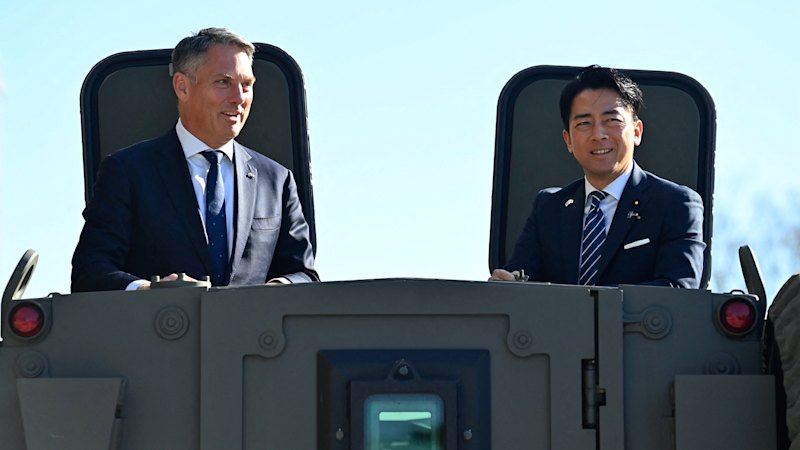
Marles’ comments represent the first major statement of support for Japan since Beijing has subjected Tokyo to a campaign of coercion over Takaichi’s Taiwan statements. Over the past month, China has warned its citizens to avoid travel to Japan, restricted seafood imports, halted the release of Japanese films, cancelled concerts by Japanese artists and increased military patrols. Marles
Defence expert Jennifer Parker said Marles’ comments were “strong”, but that this support from the Australian government to a key regional partner could have come earlier.
“If this economic and military coercion of Japan continues to escalate, then we will need to say something broader than just related to this specific incident to show that we’re supporting Japan in this area,” said Parker, an associate at the ANU’s National Security College.

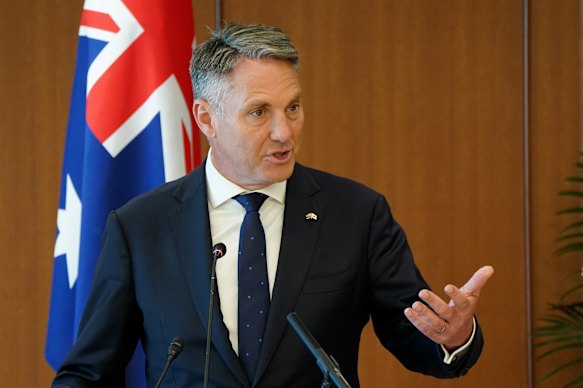
Richard Marles speaks during a press conference in Tokyo on Sunday.Credit: AP
Last week, Japan’s former ambassador to Australia, Shingo Yamagami, questioned Australia’s silence.
“When Australia came under tremendous pressure from China and was subject to similar economic coercion, Japan stated out loud that Australia was not walking alone,” he wrote in The Australian. “Is it too much to expect the same from our Aussie mates in times of need?”
Loading
Tom Corben, a research fellow at the United States Studies Centre, said Australia’s caution in weighing in on the worsening diplomatic feud between Beijing and Tokyo showed the tightrope the Albanese government was walking with its own strategy to stabilise ties with China.
“When there’s a high stakes incident of Chinese political, military, economic coercion against a key Australian partner, the broader stabilisation effort can have a drag on a more nimble or agile Australian government public response,” he said.
China claims democratically governed Taiwan as its own territory, and has demanded Takaichi retract her comments describing a Chinese military move against Taiwan as potentially a “survival-threatening situation” for Japan – a classification that would provide a legal justification for Tokyo to deploy its military alongside other countries if they chose to respond.
Taiwan lies just 110 kilometres from Japan’s westernmost island, Yonaguni.
Former Japanese defence official Hirohito Ogi said that while Australia’s intervention was a cautious one, it was welcome and contrasted with the limited support Japan had received from the United States.
Loading
“America’s attitude toward this incident was really disappointing. It has been the United States that pushed Japan to somehow make clear about its stance toward the Taiwan contingency,” said Ogi, a senior research fellow at the Institute of Geoeconomics, a Tokyo think tank.
“From now on, I think Japan will try and strengthen security partnerships with countries other than the United States, including Australia, South Korea and other like-minded nations.”
In a phone call last month, US President Donald Trump asked Takaichi to avoid further escalation with Beijing and not to provoke it with question of Taiwan’s sovereignty, reports by The Wall Street Journal and Reuters noted.
“It meant a lot to Japan that Australia spoke out with us about concerns over China’s actions. This was especially important at a time when the Trump administration was taking a hands-off approach,” said Tomohiko Satake, a security expert at Aoyama Gakuin University in Tokyo.
Loading
“Security ties between Japan and Australia have been steadily growing, and it’s unlikely that the Japanese government will expect Canberra to go any further in its response.”
It emerged last week that China was deploying a large number of naval and coast guard ships across East Asian waters, which at one point numbered more than 100, Reuters reported, citing sources and intelligence reports.
Taiwan’s government described that build-up as posing a threat to the Indo-Pacific region. Japan and Australia have said they are monitoring Chinese naval activity closely.
with wires
Get a note directly from our foreign correspondents on what’s making headlines around the world. Sign up for our weekly What in the World newsletter.


