







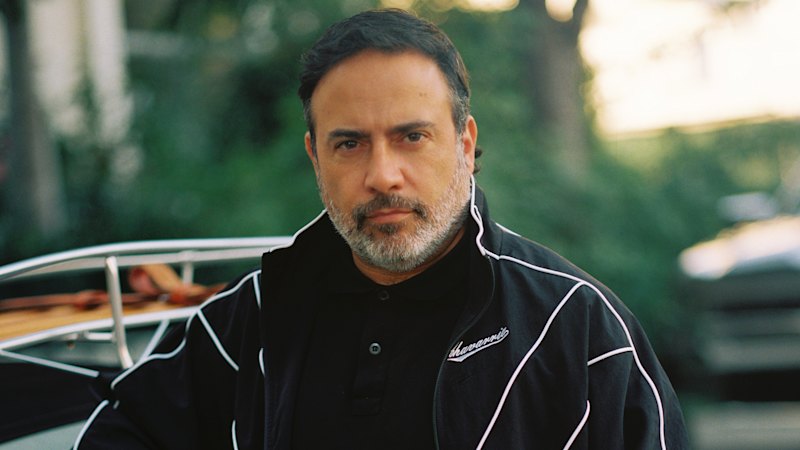


Each week, Benjamin Law asks public figures to discuss the subjects we’re told to keep private by getting them to roll a die. The numbers they land on are the topics they’re given. This week, he talks to Reko Rennie. The Kamilaroi artist, 51, has had his work projected onto the sails of the Sydney Opera House and the track at Melbourne’s Grand Prix. The National Gallery of Victoria staged a retrospective of his work in 2024-25.
experiences in high school with art teachers. Two in particular,” he says. “One told me my work was ‘shit’.”Jack Coltrane
MONEY
You were born and grew up in Footscray, right? Yes, in a proud, working-class environment. We had no money, but there was a huge immigrant community – Italians, Greeks, Macedonians, Vietnamese and Chinese – looking after one another. Because I had olive skin, everyone just thought of me as just another European kid.
They claimed you. They claimed me! All our parents worked in factories. There was no money or the ability to have a higher education, but you could walk into any of the factories, with no English, and do manual labour. That gave me a really healthy respect for how hard people worked just to put food on the table. Sometimes, I’d steal my clothes: runners, tracksuit tops, stuff to keep up with being a teenager. There’s no shame in that.
Did you ever get caught? No! You were crafty. And if you did get caught? You bolted.
I’m assuming you didn’t have the opportunity – or finances – to go to art school? No, never. And I had some really awful experiences in high school with art teachers. Two in particular. One told me my work was “shit”. Another questioned whether I’d actually created a piece myself.
Jesus. Did you invite those teachers to your shows to rub it in their faces? No, but I paid one out when I gave a speech at the National Gallery of Victoria [laughs].
Now that you’ve got money, what do you like to spend it on? Gifts for my daughter [Mila, who’s 22]. I’m very conscious of not being too flashy, but when you come from nothing, you like nice shit. So I also drive a Porsche, which I used to have a picture of on my wall when I was a kid.
Now I’ve got a mental image of you driving a Porsche past the houses of your former high-school art teachers. I actually do drive it through Footscray a bit [laughs]. But look, my life could have gone in a very different direction – I’ve lost a lot of friends to addiction, suicide and jail – and then I wouldn’t be here having this conversation with you. So I think of myself as very lucky.
BODIES
You grew up as a darker-skinned kid in a multicultural part of Melbourne. Then, as a teenager, you changed to a white-majority school. How did that change how other people saw you and your body? On the other side of town, it was a bit of an awakening: 80 to 90 per cent of the school had an Anglo background. I got called awful names. But I was about 15, so I was like, “Well, I’ll go toe to toe, motherf–––er.” I was already into the world of graffiti, so I hooked up with like-minded artists. That became my next journey.
I’m admiring your tattoos … Actually, I only got tattoos later in life. I was supposed to go when I was younger but, luckily, I didn’t: they would’ve been terrible.
Which is the most recent? The last one I got was with my daughter, actually. It’s a skull wearing a top hat, smoking a cigarette with a young woman: it’s supposed to be me and her. I don’t smoke anymore, but it’s about life, death, connection and family.
What are you liking about your body right now? Look, I don’t have many wrinkles, so I’m doing good there.
When has your body given you the most grief? It’s given me the most grief from being under duress – from painting and working too hard. I’ve done some massive murals and buildings here and overseas. Yeah, my body’s given way after that.
How is art good for your health? Because it can provide joy, sustenance for your soul and give you opportunities to have a voice. My grandmother couldn’t even speak her language on the street for fear of being jailed or persecuted because of her [Aboriginal] identity. Now I have the ability to say anything I want. That’s empowering.
DEATH
Your work has been projected onto the Sydney Opera House sails, been painted 15 metres high in the atrium of Reno’s Nevada Museum of Art and dressed a stack of shipping containers in New Delhi. You’ve had a retrospective comprising 20 years of work. Can you die happy now? No, I’ve got a few more things I need to achieve.
You’re known for your large-scale installations bearing the words, “Remember me” – a tribute to the stolen generations. More recently, your sculptural work used the phrase “Remember us”. Could you tell me about that shift? That work was a marble tablet, part of a new series of works I’m doing commissioned by [Sydney’s] Museum of Contemporary Art. The tablet is asking us to remember Aboriginal deaths in custody. [Inscribed in late 2023, Remember Us is a memorial to the 551 Indigenous deaths in custody that had occurred at that time since the 1991 Royal Commission into Aboriginal Deaths in Custody. That figure has since risen to 626 deaths.] It’s a travesty of justice: Aboriginal people represent 3 per cent of the population. There should be more outrage about it.
Does the idea of your work outliving you console or disturb you? I take the good and the bad. When I pass, hopefully people will remember some of the things I’ve made. They’ll either have an emotional response, or they’ll just be like, “Oh, I’m glad that f–––er’s gone”! [Laughs]
Rennie’s work appears in Searchers: Graffiti and Contemporary Art, at Sydney’s National Art School until April 11.


