










The astronauts hurtling back from the moon face the gravest danger of their journey in its final 15 minutes, when they’ll scorch through the atmosphere relying on a 7.5 centimetre-thick heat shield that failed during its last test.
The Orion spacecraft will also rocket back to Earth at 40,000 kilometres per hour on an intense and untrialled trajectory.
The Artemis I mission in 2022 sent Orion on a test run to the moon and back without astronauts. The glaring exception to the mission’s success was the chaotic breakdown of the capsule’s heat shield when it re-entered the Earth’s atmosphere in a fiery cocoon of plasma burning at 2500 degrees.
Former NASA engineer and astronaut Charlie Camarda branded the shield a “failure”, and wrote to the agency claiming technical and organisational problems with Orion represented a “serious risk” to the Artemis II astronauts.
Camarda went to space on NASA’s first flight after seven astronauts died on the Space Shuttle Columbia in 2003 after its heat shield failed. He told the ABC he fears a repeat.
The heat shields are made from a material called Avcoat, which forms a honeycomb of ultra-light tiles made from silica fibres encased in resin.
The material is designed to burn off when the spacecraft travelling at the extraordinary speed of 11 kilometres per second – more than 30 times the speed of sound – hits the atmosphere and generates meteoric temperatures via friction hot enough to melt steel.
The “ablative” shield, physics expert Ed Macaulay explained in The Conversation, is meant to burn away evenly and carry heat away from returning spacecraft.
But the Artemis I capsule splashed down on Earth marred with charred cracks and about 100 missing chunks.
Investigations revealed the explosive setback was down to Artemis I’s “skip re-entry”, a first-of-its-kind trajectory that saw the spacecraft “skip” off the upper atmosphere like a stone across a lake before making its final descent.
The aim of the manoeuvre was to gradually reduce the speed, heat and g-forces experienced by astronauts with a two-phased descent compared to one scorching plunge.
There was an unintended consequence. When the capsule first hit the atmosphere, its shield began to burn and generate gas. When Orion skipped back up into space, the shield’s melting resin hardened, trapping the gas.
Once the capsule again descended, the gas violently expanded and sent chunks blasting off the shield.
“The worry was that, should this happen again on the crewed Artemis II mission, it could expose the interior of the capsule to dangerously high temperatures,” Macaulay wrote.
NASA has said temperatures inside the Artemis I capsule held steady at about 23 to 24 degrees during the shield failure, and any crew inside would have been safe.
The agency has since developed a more porous shield material that would better release trapped gas. But it wasn’t ready in time for Artemis II, which will return to Earth with the original shield.
To solve the problem, NASA has opted for a shorter “skip” time and a more direct re-entry.
The risk of gas generation with a shorter, more intense re-entry is “sufficiently low” that NASA believes it won’t overwhelm the protective layer of char that builds up on the shield, the agency’s associate administrator Amit Kshatriya told a press briefing at the end of 2024.
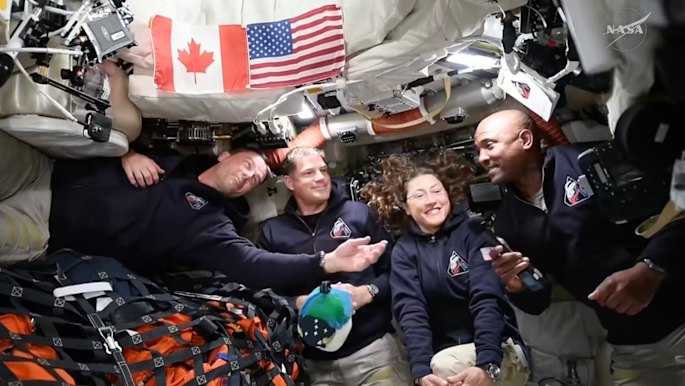
But it means astronauts Reid Wiseman, Victor Glover, Christina Koch and Jeremy Hansen will undertake the most dangerous part of their mission on a trajectory never tried with Orion.
Before NASA announced it would change the spacecraft’s trajectory, Glover, the pilot of the Artemis II mission, told technology news site Ars Technica: “There’s no guarantee that changing the trajectory is the answer. It will change something, but it won’t necessarily fix it.”
The Artemis II splashdown is expected at 10.07am on Saturday (AEST).
The Examine newsletter explains and analyses science with a rigorous focus on the evidence. Sign up to get it each week.


