




Opinion


Anzac Day should and does warrant mixed feelings, but each year rugby league drapes it in what historian Peter Cochrane called a “magic cloak” designed to sanctify everything that it touches.
Whether a football code should be getting involved in such ceremonies is a question that is always worth asking; we hear a bit too much about rugby league defenders making desperate tackles “in the Anzac spirit”.
That said, the NRL does a good job with pre-match formalities, including a moment of silent reflection that commemorates rather than celebrates the sacrifice. It’s a fine line.
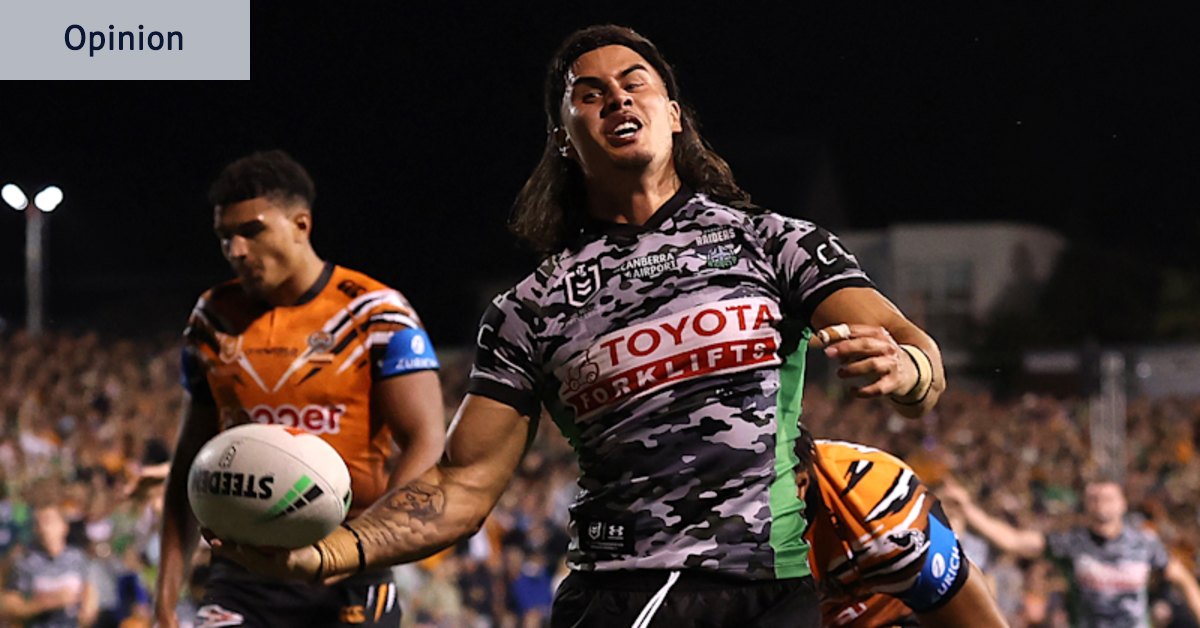
But then there are some of the special Anzac Round jerseys worn this year, which were just not good. Canberra’s had an ill-conceived camo design.
Some of the others, such as those worn by the Cowboys, Rabbitohs, Dolphins and Eels, looked like they had done heavy service in military laundries.
Since the Tigers’ Anzac jersey debacle a few years ago, when a rogue image appeared in the design, clubs have been careful.
But some of this weekend’s jerseys looked like the magic cloak had been put in a mixed wash on high temperature. The best jersey is the Dragons’, with poppies comprising the red V.
The fact that it’s also slightly off – the poppies originated with Remembrance Day, not Anzac Day – is somehow fitting. Remembrance Day, after all, commemorates the wish to end war.
Spineless wonders
Craig Bellamy was “the most embarrassed I’ve ever been in my footy life” after Melbourne fell 48-6 to South Sydney, their sixth straight defeat. Twice more, Bellamy used the word “embarrassing”. After 22 years of success at the Storm, now he knows how other coaches feel.
A notable feature of the Storm’s season, highlighted on Saturday night, might herald a change in orthodox rugby league thinking. Bellamy is the creator of the idea that if you get the spine of a team right, everything else will fall into place.
Year after year, Melbourne has cycled through forwards and centres but sustained their success through keeping an outstanding combination of 1, 6, 7 and 9.
Melbourne still have the best spine in the competition: Sua Fa’alogo, Cameron Munster, Jahrome Hughes and Harry Grant.
But the elastic might have finally snapped. To see Souths, a team with a moderate spine but brilliance across the field, their game most influenced by a lock (Cameron Murray) and a left centre (Latrell Mitchell), thrash Melbourne in this way suggests rugby league has changed fundamentally, and the spine is no longer the be-all and end-all.
Ode for a tryless game
Amid some one-sided games, the most disappointing of the round was the Cowboys’ nine tries to six win over Cronulla on Friday.
It was reminiscent of the Boxing Day Test in the Ashes cricket series last summer: both sides simply gave up on the hard work of defence, and three tries in the last seven minutes of the match were an ignominious ending.
To call it touch football would have been an insult to touch. Forty years ago, Parramatta and Canterbury played a tryless grand final, two Mick Cronin penalty goals defeating one from Terry Lamb.
It was seen as the nadir of the era of gang tackles, the day a fabulously attacking Parramatta team defeated Canterbury at their own game.
Peter Sterling, at a celebration last week, said: “I challenge anyone to go back and have a look at the 80 minutes and not be excited by it.”
I’m not sure everyone shared that view at the time, but sometimes today’s easy-breezy approach to defence makes you pine for the dark days of Warren Ryan’s ‘Wokball’.
Move over, Erling Haaland
Code-switching is always a rugby league talking point, but it’s not often you see it in the
middle of a game.
In the 24th minute of their match against Parramatta at Brookvale on Sunday, Manly’s Jason Saab was standing uncontested under a Jamal Fogarty cross-field bomb.
Instead of catching it or letting it bounce, Saab deliberately headed the ball forward about 15 metres.
“Is that legal?” Andrew Voss asked in commentary, before saying to Cooper Cronk, “Can you explain why he did that?”
The expert comments man replied, “I have no idea.”
A clue arrived minutes later, when Saab fumbled on the first tackle.
If you can’t use your hands, you can’t drop the ball. Voss, rather kindly, wondered if it was a “delayed concussion”.