


Updated ,first published
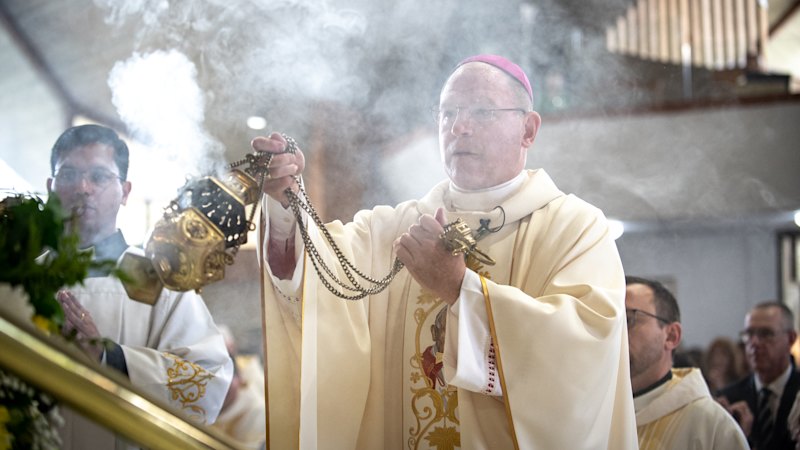
Anthony Randazzo could be the ultimate Bankstown boy to make good, giving the former prime minister Paul Keating a run for his money.
From three generations of Italian migrants who ran a fruit and vegetable shop in Sydney’s south-west, the 59-year-old bishop of Broken Bay was appointed on Wednesday to oversee the Catholic Church’s legal system in Rome.
Pope Leo XIV announced Randazzo will become an archbishop, effective immediately.
As prefect of the Dicastery for Legislative Texts, the Australian Catholic leader will head the Vatican office in Rome that oversees the church’s laws.
Sending a shout-out to the people of Bankstown, Randazzo said: “The day we forget where we come from is a sad day … We had a farm, and a business in Bankstown. I love the fact that my family are good working-class people.”
He may come from Bankstown, and support the same football team as Keating, who also attended a Catholic school, but that was where the similarities ended, Randazzo said.
There had been a lot of racial intolerance in the 1960s and 1970s towards Italians and others like his late aunt, an Indigenous woman, he said.
Many of the new Australians from the post-war period had now settled.
Yet he warned of the risk of taking “our eye off the fact that we are a country that still welcomes people from various parts of the world. We always have to be vigilant in ensuring that Australia is a welcoming country, and a country that encourages everyone to be a good citizen in this land.”
Under Randazzo’s leadership, evangelical Catholicism has flourished, and enrolment in Catholic schools in his diocese of Broken Bay – the Central Coast, Sydney’s north shore and the northern beaches – has grown.
He also supported a rapidly growing Catholic youth group conference, Ignite.
Its youth director, Kym Keady, has described it as “an incredible way to kick-start a newfound relationship with Jesus, revive a faith that has grown stale and equip emerging parish leaders”.
Asked if there was an upswing in faith, Randazzo said: “Young people are alive, and they are saying, ‘Wow we have faith.’”
Randazzo spent Thursday morning speaking with 800 students at St Joseph’s College at East Gosford, a Catholic girls’ high school. He was impressed by their enthusiasm for their faith and desire to contribute to the world.
Melbourne Archbishop Peter Comensoli told The Catholic Leader that Randazzo’s appointment – which he starts in three months – was a “great responsibility and honour that Pope Leo has asked”.
The Dicastery is the Vatican body responsible for interpreting Church laws and ensuring their application throughout the world.
“Only three other bishops from Australia have held a Vatican leadership appointment,” he said. They include the late cardinal George Pell.
Born in Sydney, Randazzo’s family moved to Queensland when he was young. He attended Catholic schools in Coolangatta and Southport.
He studied at Pius XII Provincial Seminary in Brisbane and the University of Queensland, and was ordained in 1991.
Randazzo studied canon law at the Jesuit Pontifical Gregorian University in Rome. He also worked at the Vatican’s Congregation for the Doctrine of the Faith. In that role, he dealt with the fallout of the church’s sexual abuse crisis, and the investigation by Australia’s Royal Commission into Institutional Responses to Child Sexual Abuse, including cases of priests raping children and cover-ups by bishops.
The announcement of Randazzo as an archbishop coincides with the appointment of former nurse Dame Sarah Mullally as the first female archbishop of Canterbury, the symbolic leader of the Anglican church.
After the Bondi terror attack, Randazzo used social media to strongly condemn antisemitism, saying: “Violence corrodes the soul of a nation. When it is directed at a people because of who they are, what they believe, or how they pray, it strikes at the very foundation of our common life.”
The Dicastery of Legislative Texts – the body Randazzo is set to lead – was first established in 1917 by Pope Benedict XV.
It advises the Pope, checks for legislative gaps, ensures proper legal application of Catholic doctrine, and co-ordinates with other offices in the Curia.
With AP
Start the day with a summary of the day’s most important and interesting stories, analysis and insights. Sign up for our Morning Edition newsletter.
 Emily Kaine is a national news blogger at The Sydney Morning Herald.Connect via email.
 Julie Power is a senior reporter at The Sydney Morning Herald.Connect via X or email.