



What in the World, a free weekly newsletter from our foreign correspondents, is sent every Thursday. Below is an excerpt. Sign up to get the whole newsletter delivered to your inbox.
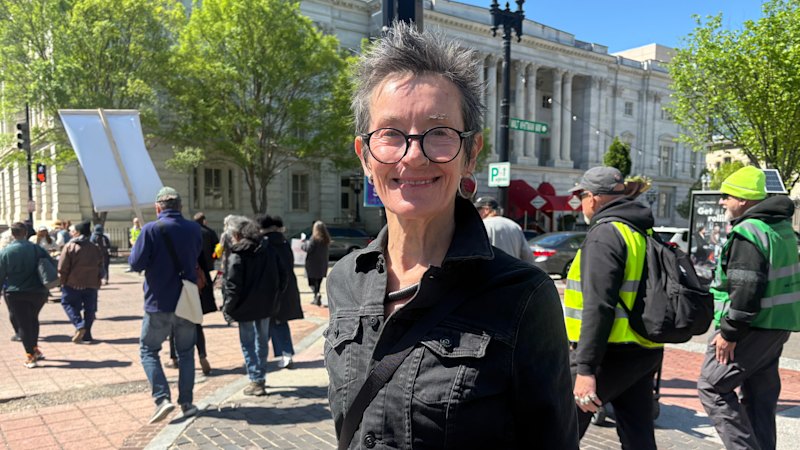
Washington: On a recent Tuesday morning, I observed a small rally across from one of the main convention centres in the US capital. A few dozen people had gathered to protest against the Data Centre World Conference, an annual gathering for the booming AI and data centre industry.
The crowd was mostly older, but with a smattering of youthful faces. They carried signs such as “People before Big Tech” and “Data centres = climate catastrophe”, and chanted slogans including “Pull the plug, stop the slop”.
Lo and behold, the organiser of the demonstration turned out to be an Australian: 65-year-old Linda Edwards, originally from Canberra, who has been in the US for more than 20 years.
She lives in Richmond, the capital of Virginia – the world’s unrivalled data centre hub. Northern Virginia alone is estimated to house nearly 15 per cent of worldwide data centre operating capacity.
That makes Virginia the epicentre of the global data centre backlash, too. The spread of these hulking, noisy, warehouse-like buildings is alarming many Americans, and they have fast become the focus of neighbourhood groups wherever they arise.
“These data centres are popping out around people’s homes and in their backyards, and they don’t know about it,” Edwards says as we amble down 7th Street. “It’s a bit like waking up one morning and there’s this friggin’ big data centre in your backyard and nobody knew it was going to pop up. That’s just got to stop.”
Like any construction project, data centres must go through the planning process or at least have the right zoning approval. But their proliferation in Virginia has certainly been rapid, thanks to generous tax breaks.
Ashburn, a 45-minute drive from Washington near Dulles Airport, has become known as Data Centre Alley, with more than 130 such facilities. There are dozens more throughout surrounding Loudoun County, which – partly thanks to the data centre boom – regularly ranks as the wealthiest county in the US.
Data centres are sometimes built in residential areas. But even if they don’t live next door, residents complain that noise from generators and cooling systems can be heard some distance away, causing disrupted sleep and headaches. And the centres consume electricity and water insatiably.
Last week, a Washington Post/Schar School poll found just 35 per cent of Virginians would be comfortable with a new data centre in their community, down from 69 per cent three years ago.
Community opposition groups are popping up around the US. The data centre boom in Australia is nascent, but it is growing. We should expect to see the same tensions play out between residents and industry.
In the US, data centre “NIMBYs” are starting to win. In Virginia’s Prince William County, a court recently voided a rezoning for a massive campus of up to 37 data centres near a national park. Local officials later dropped their legal bid to keep the project alive, amid vehement community anger.
In Archbald, Pennsylvania, the local council last month denied planning permission for an 18-building data centre campus. Two prominent members of Congress, Bernie Sanders and Alexandria Ocasio-Cortez, want a moratorium on all new data centres. That’s what Linda Edwards wants to see, too.
They also want an end to Virginia’s generous tax breaks, which are due to expire in 2035. A push by the state’s Senate would see them end next year. This debate has proven irreconcilable: a special budget session was due this week, but local reports indicate it will be delayed again due to the impasse over data centre taxes.
There is organised support for data centres from the big tech firms, as well as industry lobby groups such as the Data Centre Coalition. It argues that these facilities contribute handsomely to government coffers (despite the tax concessions) and create jobs (albeit relatively few permanent ones).
They are also vital for the artificial intelligence revolution that we now find ourselves in. Whether that’s a good thing depends on who you ask.
Edwards carries her iPhone in her hand as she walks down 7th Street. I point out that she, too, uses the kind of technologies enabled by data centres – something she readily acknowledges.
“We all use technology,” she says. “But we’re against just the expansion of all of this stuff in a very uncontrolled way. The people need to have a say over how AI is going to function in their lives.”
Get a note directly from our foreign correspondents on what’s making headlines around the world. Sign up for our weekly What in the World newsletter
 Michael Koziol is the North America correspondent for The Age and Sydney Morning Herald. He is a former Sydney editor, Sun-Herald deputy editor and a federal political reporter in Canberra.Connect via X or email.