










Updated ,first published
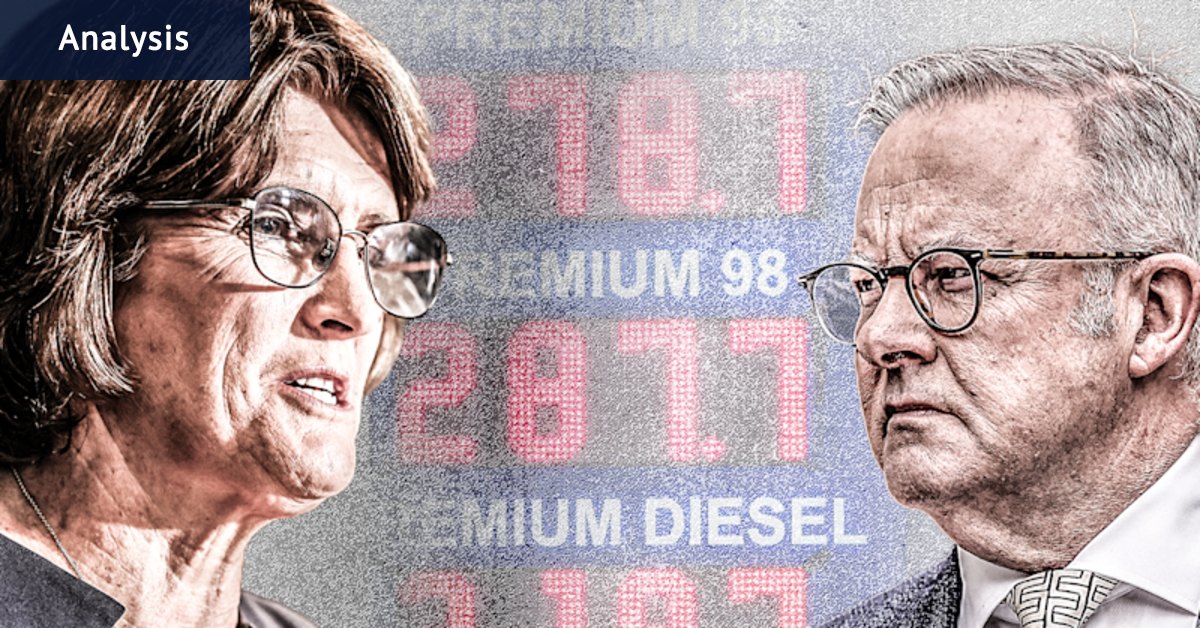
Anthony Albanese has set himself and the nation’s mortgage holders on a collision course with the Reserve Bank.
Monday’s decision to halve fuel excise for three months gives 26 cents a litre relief to motorists, but those with a home loan will likely pay for it with higher repayments.
Adding more than $2.5 billion into the economy, which is already feeling inflationary strains, will only end up in pain.
It was a bad policy when Angus Taylor announced a similar plan last week.
That prompted independent economist Saul Eslake to warn that an excise cut would increase the chance of a rate hike. That warning sticks for this move by Albanese.
Told about prime minister’s announcement, Eslake noted: “The government giveth, the RBA may well taketh away.”
Cutting the price of liquid fuels will only add to demand. As much as we all hate high petrol prices, they do act as a price signal.
A 26 cent-a-litre cut in excise, based on a series of economic studies both here and overseas, suggests demand will increase by between 1 and 3 per cent.
Given supply is driving the current crisis, anything that adds to demand is asking for trouble.
The decision will slice about half a percentage point off headline inflation over the next three months. But when the excise returns to normal, inflation will jump by that half percentage point.
We’ve got two recent examples of what that looks like. The recent end to electricity subsidies has been a key factor in the lift in inflation that has so concerned the Reserve Bank. Electricity inflation in Brisbane, for instance, hit an unfathomable 1695.3 per cent in August and September last year.
In 2022, the six-month cut in excise delivered by Scott Morrison and Josh Frydenberg just before that year’s federal election cut headline inflation by half a percentage point. But once the excise returned to normal, and Morrison had lost the keys to the Lodge, inflation headed to a 30-year high of 7.8 per cent.
So we know what happens when you fiddle with a price. But, hey, both sides of politics reckon we should roll the dice again in the hope of getting a different outcome.
There were alternatives. As the head of Curtin’s Bankwest Economics Centre, Alan Duncan, noted, the government could have directed its petrol relief much more precisely.
“A better approach would be to provide targeted support to more vulnerable households and businesses, and managing demand more actively, including introducing controls on purchases and prioritising fuel for key industries,” he said.
The Reserve Bank must be having kittens. It has lifted interest rates at its last two meetings as it seeks to reduce inflationary pressures across the economy.
Along comes Anthony Albanese and Jim Chalmers (egged on by Angus Taylor and Tim Wilson) putting $2.5 billion back into the economy. That’s money that consumers can spend – and add to inflationary pressures.
The bank was already facing difficult choices before this decision.
HSBC Australia chief economist Paul Bloxham, himself a former Reserve Bank economist, reckons there is a good chance the economy will contract through the June quarter.
Households, pouring more money into their fuel tanks and spooked by whatever decision US President Donald Trump takes to end or continue the war in Iran, will cut spending through the next three months.
“Whether it falls again in the September quarter – and thus Australia has a technical recession – depends heavily on how soon events in the Middle East de-escalate and oil prices fall, amongst other factors,” he said.
This is the concern of the Reserve Bank and every other central bank. They may be forced into making a choice between inflation or economic growth.
Given the price pressures the country was facing before the war started, there’s every chance the Reserve Bank will continue the fight against inflation. That will come at a huge cost to households and businesses.
Every country has been hurt by the actions of the US, Israel and Iran. No one can accurately predict when it will end and how far the economic turmoil unleashed more than five weeks ago will spread.


