

Close Menu
thewitness.com.au
  • Home
  • Latest
  • National News
  • International News
  • Sports
  • Business & Economy
  • Politics
  • Technology
  • Entertainment

Subscribe to Updates

Get the latest creative news from FooBar about art, design and business.

What's Hot

Is Australia ready for the electric vehicle

April 21, 2026

Universities accused of ‘scaremongering’ over proposed changes

April 21, 2026

Victoria’s new child safety regulator runs into FIFO controversy

April 21, 2026
Facebook X (Twitter) Instagram Threads
thewitness.com.au
Facebook X (Twitter) Instagram
Subscribe
  • Home
  • Latest
  • National News
  • International News
  • Sports
  • Business & Economy
  • Politics
  • Technology
  • Entertainment
thewitness.com.au
Home»Entertainment»AI textile recycling facility in Ipswich combats fast fashion waste
Entertainment

AI textile recycling facility in Ipswich combats fast fashion waste

info@thewitness.com.auBy info@thewitness.com.auApril 21, 2026No Comments4 Mins Read
AI textile recycling facility in Ipswich combats fast fashion waste
Share
Facebook Twitter Pinterest Threads Bluesky Copy Link


Neesha Sinnya

April 18, 2026 — 1:26pm

You have reached your maximum number of saved items.

Remove items from your saved list to add more.

Save this article for later

Add articles to your saved list and come back to them anytime.

From clothing markets to vintage stores, the options for buying second-hand clothes seem to be everywhere. But what happens when the abundance of pre-loved items overtakes demand?

“We have a one in, one out rule,” explains Hannah Klose, who is behind the popular Instagram account @nevereverpayretail.

Hannah Klose runs popular thrifting social media account Never Ever Pay Retail.

To avoid overconsumption, Klose and her family donate an item of clothing to local op shops for every item they purchase second-hand.

Across Australia, the Salvos are seeing an influx of donations, with some stores experiencing a five-week turnover, according to business development manager Meriel Chamberlin.

Related Article

Retail assistant Dorothy Togara says the quality of secondhand clothing imported from Australia has declined over the past few decades.

This is the same turnover as major fast fashion brands such as H&M.

“[Shoppers should] go regularly [to op shops]. That’s the only way we can handle the volume,” Chamberlin says.

But with donations often overtaking purchases, what happens to the clothes that don’t sell? Do they end up in landfill?

A new Australian-first textile recycling facility, opened by Salvos Stores at their Ipswich factory, is working to address this issue.

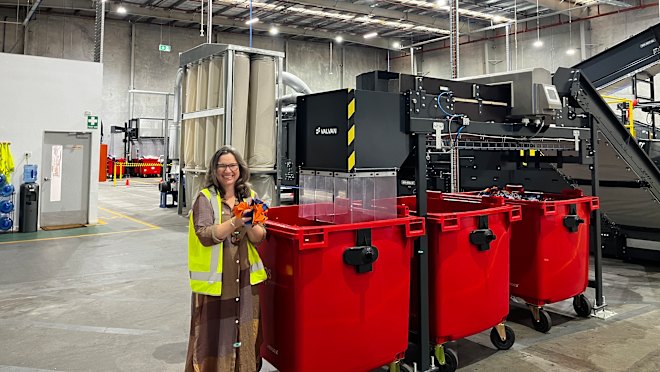
Chamberlin took this masthead on a tour of the Carole Park facility, where garments are assessed by world-first artificial intelligence technology and transformed into textile squares.

The automated process removes buttons and zippers and sorts the fabric based on composition or colour.

Salvos Stores head of business development Meriel Chamberlin has experience as a textile engineer.Neesha Sinnya

The resulting squares are then used to produce recycled yarn, insulation, sound-proofing panels and plastic products.

Anything deemed unsuitable for sale – old work uniforms, for example – is processed by the machine and repurposed.

Items are first sorted by humans, who decide whether they are suitable for recycling.Neesha Sinnya

Chamberlin says the volume of fast fashion being donated to second-hand stores has increased.

“More and more [donations] are not high quality because of fast fashion,” she says. “So how do we best optimise our resources but also get the good stuff that is sellable out?”

Artificial intelligence technology then sorts the garments based on either fabric composition or colour.Neesha Sinnya

The mammoth operation, backed by $4.9 million from the Queensland government, was developed to ensure that landfill was never an option.

Each year, according to the state government, 200,000 tonnes of clothing are sent to Australian landfills. The Ipswich facility can process 5000 tonnes of textiles a year.

Chamberlin says the technology also reduces the risk of offshore human exploitation by processing the clothes into squares before delivery.

Once items are sorted based on composition or colour, they are fed through a conveyor belt that creates textile squares.Neesha Sinnya

“If the [full garments] go offshore, the modern slavery risk is really high and hard to manage,” she says.

“We know we’ve taken out that massive first stage of human exploitation risk by serving them in this condition instead of the whole garment.”

But the recycling plant is just one south-east initiative aiming to cut down on textile waste and promote sustainability.

In Brisbane, the founders of the weekly Love Me Again markets have also noticed an increase in donations.

Co-founder Isobel Dear says they’ve seen a “100 per cent uplift on sellers over shoppers”, with the market spaces selling out a month in advance across multiple locations.

Lana Sciasci (left) and Isobel Dear have set high standards for their Love Me Again second-hand markets.

In a bid to promote higher-quality garments, the markets have strict requirements on what sellers can bring.

“We don’t allow ultra-fast fashion brands like Boohoo, Temu or Shein. We know what those brands are doing, they’re making fashion overconsumption, so ethically, we don’t allow them for that reason, but we also notice they just don’t sell [at the market],” Dear says.

Start the day with a summary of the day’s most important and interesting stories, analysis and insights. Sign up for our Morning Edition newsletter.

You have reached your maximum number of saved items.

Remove items from your saved list to add more.

From our partners

Share. Facebook Twitter Pinterest Bluesky Threads Tumblr Telegram Email
info@thewitness.com.au
  • Website

Related Posts

Is Australia ready for the electric vehicle

April 21, 2026

Universities accused of ‘scaremongering’ over proposed changes

April 21, 2026

Victoria’s new child safety regulator runs into FIFO controversy

April 21, 2026
Add A Comment
Leave A Reply Cancel Reply

Demo
Top Posts

Inside the bitter fight for ownership of a popular sports website

October 23, 2025143 Views

Police believe ‘Penthouse Syndicate’ built Sydney property empire from defrauded millions

September 24, 2025129 Views

MA Services Group founder Micky Ahuja resigns as chief executive after harassment revealed

December 11, 202595 Views
Don't Miss

Is Australia ready for the electric vehicle

By info@thewitness.com.auApril 21, 2026

SaveYou have reached your maximum number of saved items.Remove items from your saved list to…

Universities accused of ‘scaremongering’ over proposed changes

April 21, 2026

Victoria’s new child safety regulator runs into FIFO controversy

April 21, 2026

Rating the best and worst recruits of the 2026 AFL season so far; including some big names at St Kilda Saints such as Tom De Koning and Jack Silvagni, Christian Petracca at Gold Coast Suns, and Clayton Oliver at GWS Giants

April 21, 2026
Stay In Touch
  • Facebook
  • YouTube
  • TikTok
  • WhatsApp
  • Twitter
  • Instagram
Top Trending
Demo
Most Popular

Inside the bitter fight for ownership of a popular sports website

October 23, 2025143 Views

Police believe ‘Penthouse Syndicate’ built Sydney property empire from defrauded millions

September 24, 2025129 Views

MA Services Group founder Micky Ahuja resigns as chief executive after harassment revealed

December 11, 202595 Views
Our Picks

Is Australia ready for the electric vehicle

April 21, 2026

Universities accused of ‘scaremongering’ over proposed changes

April 21, 2026

Victoria’s new child safety regulator runs into FIFO controversy

April 21, 2026

Subscribe to Updates

Get the latest creative news from FooBar about art, design and business.

Facebook X (Twitter) Instagram Pinterest
  • Home
© 2026 ThemeSphere. Designed by ThemeSphere.

Type above and press Enter to search. Press Esc to cancel.