


Prices had fluctuated dramatically over the past year, going from about $US2.30 per pound in mid-September 2024, to a record of more than $US4.40 per pound in February. Over the past week, prices slid back to about $US3.70. News reports of light frost in producing regions can trigger price spikes for such a sensitive crop.
Loading
Also over the past year, many crops in Vietnam, the world’s second-largest coffee grower, responsible for about 40 per cent of global robusta exports, failed due to dry conditions. Prices of arabica’s main alternative reached record highs.
Roasting businesses and cafes may have felt the pinch, but the rise hasn’t been fully passed on to customers. In 2025, the average cup of coffee in Australia cost $5.50, according to an IBISWorld analysis, up from a pre-pandemic figure of $4.
While Australian cafe-goers pay comparatively less for their flat whites, a drink that costs as much as $10 on average in some European cities, many in the industry think menu prices will have to rise, as supply issues are expected to persist at the same time as growing demand, especially from China, pushes bean prices higher.
New species and hybrids
As scientists predict a changing climate will cause havoc in coffee-growing regions, growers are now looking to different species and hybrids for greater resilience.
“Climate change is not good news for coffee,” said Robert Henry, an emeritus professor of agriculture at the University of Queensland.
In Brazil, arabica is grown in areas at higher altitude and in tropical areas, but with even slight increases in temperature, it becomes a problem, Henry said.

A worker harvests coffee on a farm in Minas Gerais state, Brazil.Credit: Bloomberg
“A lot of areas where they produce coffee now have been mapped as not suitable for the climate of the future. We’re likely to see premium coffee in short supply,” he said.
One upshot of increasing arabica prices is that Australian-grown coffee, which Henry describes as a tiny sector in northern NSW and parts of Queensland that commands ultra-premium prices, could become more price competitive.
Globally, however, crop alternatives are gaining traction.
Arabica and robusta, and some of their sub-varieties, have been crossbred to create plants that benefit from the former’s lower bitterness and higher sugar content and the latter’s disease resistance.
Loading
Timor Hybrid, a product of natural cross-breeding, has become “highly sought after”, said Jordan Morrison, a barista in Melbourne’s north, who runs Atom Research, a platform devoted to coffee news and culture.
“Depending on how it’s processed, you can get groovy notes, all the way to floral notes, and still good acidity you’d associate with arabica,” Morrison said.
Some are banking more hope in mainstreaming entirely separate, obscure species.
Dr Aaron Davis, head of coffee research at the Royal Botanic Gardens in Kew, London, said many farmers had begun experimenting with more resilient species as they replant recently failed crops. It’s a roughly three-year wait for coffee plants to mature and bear fruit.
While other species are unfamiliar territory, many farmers have been left with no choice, Davis said.

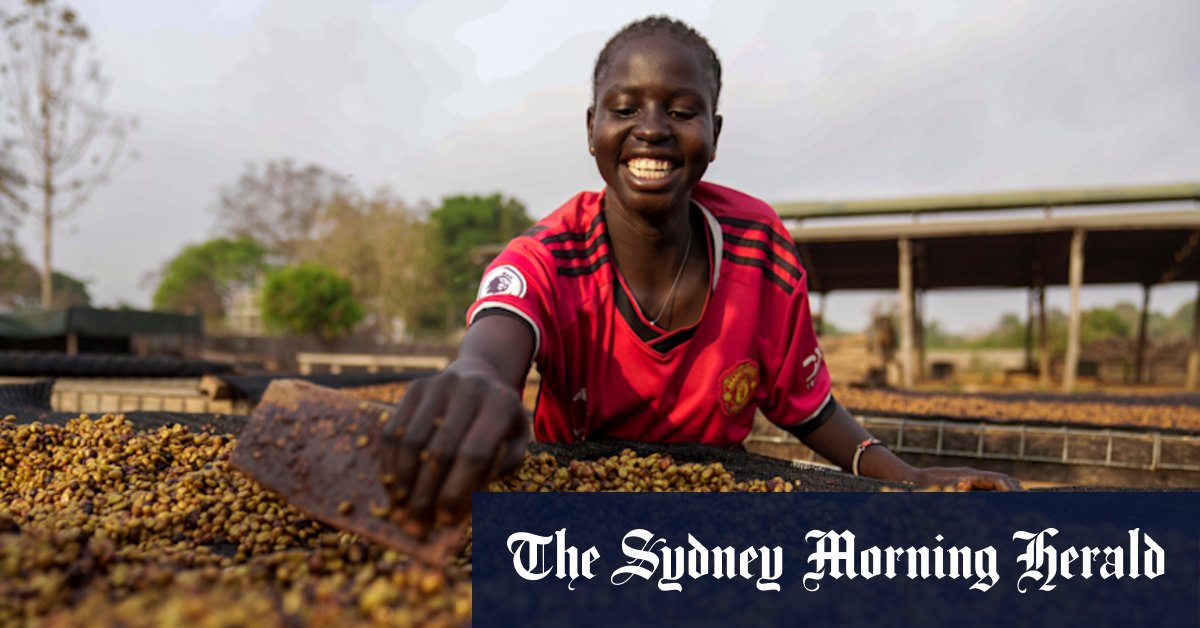
A worker turns excelsa coffee beans to dry near Nzara, South Sudan during this year’s harvest..Credit: AP
Excelsa and liberica
Excelsa, a species suited to mid-elevations, can tolerate higher temperatures better than arabica and it can survive drought better than robusta. Its flavour profile has been described as easy drinking yet multidimensional, with potential for sharp, fruity, sweet, nutty and chocolatey notes.
A historical crop, excelsa had been eschewed by farmers due to its taller trees, up to 15 metres, which are difficult to harvest. Now, its climate resilience stands out.
“Some producers have already shifted or are shifting to excelsa, because of climate change, notably in Uganda and South Sudan,” Davis said.
Liberica is another species that boasts impressive drought resistance and tolerance of warmer temperatures, and like excelsa, it has been historically neglected due to its tree height, which makes it hard to harvest.
Liberica, which is suited to lower elevations, even down to sea level, is known for its bold taste, low-acidity and sweetness. It has smoky, woody and fruity notes.
Liberica coffee beans are typically much larger, narrower and pointier than arabica and robusta.
“Liberica and excelsa are very saturated. The flavours jump out and take over the whole cup,” said Jordan, the Melbourne barista.
For now, excelsa and liberica remain niches that have yet to dent Australia’s coffee market.
David McKennariey, general manager at importer FTA Coffee, which brings in “green” (unprocessed) beans and sells to Australian roasters, said roasters “are so conscious of price”, as price spikes hadn’t flowed through to end consumers yet.
As such, the infancy of liberica and excelsa exports means they’re expensive and not yet commercially viable to bring here and sell.

Excelsa plants in South Sudan. Its trees stand much taller than more market-friendly coffee plants, making them difficult to harvest.Credit: AP
For now, roasters are still focused on what’s proved most popular to Australian palettes. “It’s arabica and it’s the Snickers combination – chocolatey, roasted nuttiness and caramely is the crowd pleaser,” McKennariey said.
Demand for new species would one day develop, he said, once the varieties scaled up and became cheaper at the same time as arabica and robusta are challenged by climate change.
“They will be something in the future. It’s not happened yet but it will happen,” he said. “There’s an awful lot of noise in the coffee market, but what really moves the dial is absolutely related to climate, harvest and yield,” McKennariey said.
For now, excelsa and liberica were largely limited to the specialty coffee scenes of London, the US and Melbourne.
Cham, a West Melbourne cafe focusing on Vietnamese coffee, recently held a tasting event featuring liberica from its supplier Every Half, which has said that farmers hit by recent robusta crop failures across Vietnam had begun planting more liberica.
Cham co-owner Tony Nguyen plans to offer liberica soon. He said it was important to embrace the species “to make sure coffee can still be grown for the next generation”.
“Liberica has gained a lot of attention in recent years,” Nguyen said. “We have yet to see its full potential, and I think Australians will start encountering it more, slowly, as roasters and cafes introduce its characters and interesting stories.”
The Business Briefing newsletter delivers major stories, exclusive coverage and expert opinion. Sign up to get it every weekday morning.
