







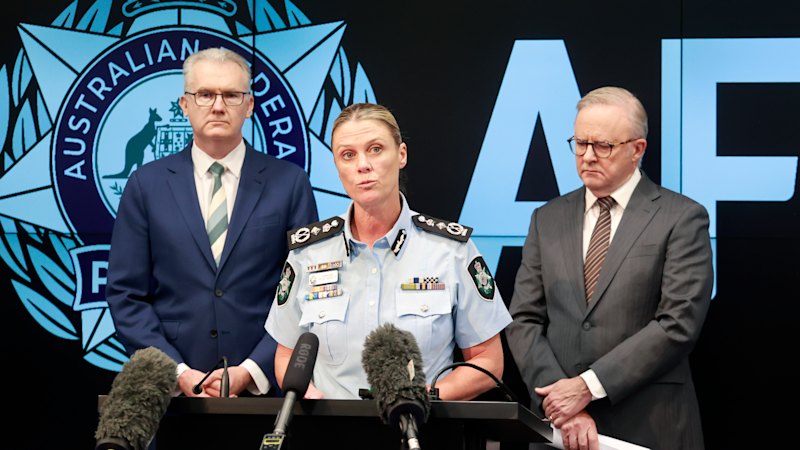


Politicians will get increased protection at home, in their electorate offices and at high-risk public events under a $150 million proposal to shield public figures from what analysts say is the most dangerous security environment in generations.
Home Affairs Minister Tony Burke met with a cross-party group of MPs in a closed-door briefing on Monday in Canberra to emphasise the seriousness with which the government was taking the growing threat level.
Some of the MPs expressed anxiety about their safety, as the number of police cases against Australians threatening politicians rockets up.
At least 10 people have been charged with serious offences since September after making violent threats to politicians. The AFP investigated 950 politically motivated threats in the 2024-25 financial year – a 63 per cent increase on the combined total of the previous four years.
Three sources said Burke’s department had worked up a budget bid that would provide:
- more capacity to patrol MPs’ homes if they felt unsafe, rather than at all times;
- more officers to protect MPs at events deemed high-risk;
- boosted security at electorate offices, after years of vandalism at Labor MPs’ offices by pro-Palestinian activists;
- proactive online monitoring to make sure MPs’ personal details are hidden; and
- active monitoring of MPs’ social media pages to weed out ominous characters.
The push to ramp up security for Australian politicians comes as hostilities and divisions have been exacerbated by global events and the rise of extremism.
Politicians and public figures, from a British Labour politician to right-wing influencer Charlie Kirk, have been attacked or killed in the US and Britain in recent years. Donald Trump also survived two assassination attempts during the last presidential campaign.
The Bondi massacre in December, where 15 people were killed and dozens more were injured in the worst killing of Jews outside Israel in decades, has elevated the security debate in Australia. At the same time, years of stagnating living standards, worsening inequality and distrust in institutions have helped fuel a rise in populism.
Prime Minister Anthony Albanese has repeatedly called on politicians, media outlets and others to lower the temperature of political debate, echoing a call ASIO boss Mike Burgess made after the October 7 attacks by Hamas in October 2023, which precipitated Israel’s war in Gaza.
Albanese in January said politicians being able to interact with the public was “an important characteristic of our democracy” and that he was still able to get “food for the dog at the supermarket”.
“That’s something that you can do here. You can’t do it in other countries,” he said.
Home Affairs officials are deeply worried about the rise in conspiratorial extremists who do not acknowledge the authority of police forces and governments, as well as the visible rise in organised neo-Nazis and other white supremacist or nationalist groups. Radicalism stemming from the conflict in Gaza and Australia’s positioning on the US-Israeli strikes on Iran have also added to the department’s workload.
Officials were concerned by Albanese’s visit to a mosque in Lakemba, in western Sydney, last month at which this masthead reported Albanese was rushed into an office amid a crush of people protesting against Albanese’s stance on Gaza. Some attempted to confront the prime minister.
The funding bid has been lodged by the Home Affairs Department, but the security functions in question go across agencies including the Australian Federal Police and the Finance Department.
Josh Roose, a leading extremist expert and a Deakin University associate professor, said the government should be contemplating a major shift in how it protected public figures.
He said in Australia and elsewhere, politicians, police, academics, journalists and other public figures were facing threats from people who were spending lots of time online and developing obsessions with narrow grievances against specific people.
Roose pointed to the threats against former Victorian premier Daniel Andrews, made by anti-government sovereign citizens, as an example.
“The current threat level is significantly worse for public figures, including politicians than it has been in recent memory,” Roose said.
Greens senator Mehreen Faruqi has said authorities had not been taking racist hate seriously enough.
“The government recognises that the threat level is rising, but continues to draw a false equivalence between political protest and violent extremism. This only serves to politicise genuine critiques of the government and doesn’t keep anyone safer,” she said.
Cut through the noise of federal politics with news, views and expert analysis. Subscribers can sign up to our weekly Inside Politics newsletter.


