


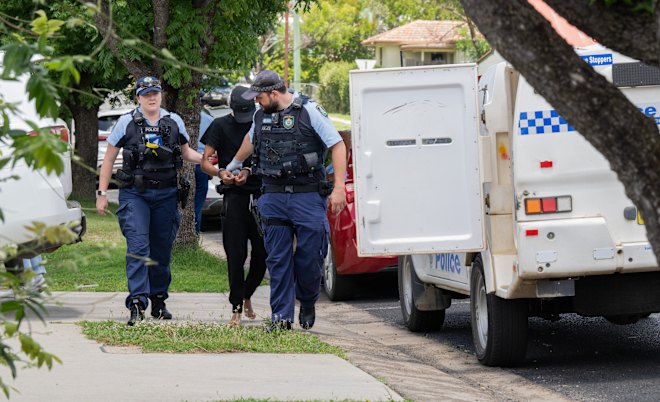
The woman sits on a bench outside Armidale’s police station, her face drawn and her fingers twisting with anxiety. She watches the windows; her 16-year-old son, John*, is inside. Officers arrested him at home earlier that day, suspecting he’d been riding in a vehicle stolen by older boys. He’d cut a lanky, vulnerable figure as they escorted him out.
“He’s a good boy,” his mother insists as she fidgets with her grandson’s pram. He doesn’t skip school, she says. He’s looking forward to his year 10 formal. He’d been heading to the police youth club – “he’d gotten up, cleaned his room, got dressed” – before his older cousins turned up and he went out with them instead.
She concedes she’s been worried. The police liaison officer dropped in two weeks ago to warn about the company he’d been keeping. “They might be related to you,” she warned her son, “but they don’t have good intentions.”
Maybe, John’s mother hopes, this arrest will be the wake-up call he needs to cut ties with troublemakers. Maybe his clean record – he has a single warning for trespass – means he’ll be released with a caution. A caution was looking likely, but hung on one contingency: what officers found when they went through John’s phone.

The older boys (aged 17 and 18) had been arrested the day before for breaking into a house, stealing keys, and speeding off with the car. It’s a crime that has become a scourge across regional NSW and often involves serious violence, speeds of 250km/h or more, and very young perpetrators. Kids film their crimes and post footage online, in a dangerous game of one-upmanship that has left communities terrified. The prevalence of the crime often depends on whether a town’s ringleaders are behind bars. While rates have fallen recently, fear remains high.
After arresting the two older teens in Armidale that day, officers did what’s called a Cellebrite analysis of their phones. The boys had documented everything for bragging purposes and there was enough evidence to damn themselves and their mates. Police recognised John’s face in the photos and videos, so knocked on his door under the auspices of Operation Soteria (which aims to disrupt and prevent youth crime). They spoke to his mother, and took him to the station.
Their primary aim was intervention; to warn John that those boys would lead him to trouble. No one, including police officers, wants kids entering the criminal justice system if it can be avoided. Before they made any final decisions, though, they did the Cellebrite analysis of his phone.
Everyone, except John, was shocked. It was full of self-incriminating photos and videos. John wasn’t, as his mother and police feared, on the threshold of criminal involvement; he was well and truly ensconced. He was not cautioned but charged with 31 offences, including eight of aggravated break and enter.
He spent the night in one of three cells that line a wall inside Armidale’s police station’s custody room, with its metal bench, green tiles and beige blankets.
He faced court the next day, and was granted bail. That night he was back home playing Nintendo, a 16-year-old oblivious to the bleak shift in his life trajectory that will be the likely result of his entry to the criminal justice system.

Many of the kids involved in these crimes come from dire backgrounds. Their families are deeply dysfunctional – jail, addiction, violence. Support services and police know of kids aged 10 or younger who are wandering the streets at night to get away from their drunk or high parents. They might have foetal alcohol syndrome, or other developmental problems that leave them impulsive and lacking empathy. They may have seen more trauma before high school than most of us see in a lifetime, and it has disrupted their cognitive development.
But John isn’t one of these kids. He has a mother and a grandmother. His home is a magnet for other local kids with less stable lives. But in a town like Armidale, this violent and reckless form of crime has become so normalised – even glamorised – that it’s regarded by some kids as a standard night out. John’s case also shows that it’s not only dysfunction at the heart of this – it’s also peer pressure, social media and a desire for belonging that can lead to what one child development expert described as a “terrible tribalism”.
Living in fear
Residents of towns such as Armidale, Tamworth, Kempsey and Moree struggle to have sympathy for kids like John. The youth crime in those towns has been so violent, and so regular, that it’s no exaggeration to say that many residents live in fear. When the kids break into homes, they wear balaclavas and arm themselves with machetes. They smash glass, surround beds and demand keys. Then they drive away at terrifying speed, before dumping and burning the car. Some residents have been targeted multiple times.

South West Rocks, near Kempsey, has been hit hard. Tania Van Stekelenburg is still traumatised after teens in black began smashing her front windows with bricks just after 4am one morning. Eventually, they smashed the glass front door, “and this hand came through and was trying to open it,” she recalls. “They had a knife.” She hid in her bedroom, screaming, until bricks shattered that window too, and she spotted her husband hiding behind their caravan outside, covered in blood. It was the fifth attempt at a break-in, and the second car theft.
She only has to spot a discarded black glove on the footpath to find herself in a panic. The house is now fitted with alarms and security systems. She’s also angry. Her sense of safety has been shattered, and she feels like the young criminals face few consequences; courts will often grant the kids bail even if they offend repeatedly. “[Police said] the magistrates just let them go,” she says. “Police said ‘we catch them, and the magistrates give them a free ticket’.”
In Moree, Shane Brooker agrees. The northern NSW town, famous for its artesian pools, is now notorious for its youth crime. This week, police officially launched a controversial drone capability in Moree to reach and record crime scenes more quickly. Brooker and his wife were victims too in 2023, and they’re still struggling. He is only working one day a week.
“I’m anxious, I’ve got a stomach that feels funny, and I’m on edge all the time,” he says. “We lock our house up and check it each night. Every time a dog barks, I’m looking. It affects our sleep, we’re hyper-vigilant – why should we be living like that in this country? [In the past], if you were naughty, you knew you were going to get into trouble so you behaved yourself. Now…”
Like many of his colleagues in the regions, Michael Kemp, the Nationals MP for Oxley which covers the Mid-North Coast from Wauchope to Dorrigo, is furious. His Kempsey office has been inundated with people whose houses have been broken into five or more times by out-of-control kids, only to see the perpetrators strike again while on bail. The government says crime rates are either stable or falling, but it doesn’t feel like that. And it’s the same kids, over and over again. The NSW Nationals plan to make youth crime an election issue ahead of the March 2027 state poll, as it has been in Queensland and Victoria.
“We have zero consequences for poor behaviour in our community now,” Kemp says.
He knows the problems run deep, to a dysfunction that’s multi-generational and that no government has been able to fix, but says that’s all the more reason for services such as the Department of Communities and Justice, which looks after child protection, to step up.
“Kids are being left in dangerous situations with poor role models and having to fend for themselves,” he says. “You see them out on the street at night because they don’t want to go home, and no one has the courage to say that’s not the right environment for the kid. We need skills and employability for our kids, our community needs reliability and consequences for illegal and unsafe choices.”

The claim for compassion is strong from both sides. These children are traumatised through no fault of their own. But they are causing further trauma for people who are trying to live peaceful, law-abiding lives. Even the police are torn. “We’re bound by the Police Act and our section 6 and all those duties and responsibilities we have to community and safety,” says Deputy Commissioner Paul Pisanos. “If you bring that down to the Young Offenders Act, we’ve also got a responsibility around diversion and prevention. There’s this rub between the two of them.”

Many blame the criminal justice system for letting the kids out on bail. There is particular frustration with the system’s response to 10- to 13-year-old kids due to a legal principle called doli incapax, which requires prosecutors to prove that kids under 14 fully understand the difference between right and wrong. This hurdle became more difficult to clear after a High Court decision in 2016, which said prosecutors must prove the child knew their crime wasn’t just naughty, but seriously wrong. Now, many charges are withdrawn because police struggle to find evidence that reaches this threshold.
In October, an 11-year-old boy from Tamworth faced children’s court, charged with two counts of assault, and taking and driving a car (the boy was also present when a 13-year-old stabbed the manager of the Comfort Inn at Moree). The Tamworth case was lost at hearing because prosecutors could not surmount the doli incapax hurdle. He had been charged 25 times since November 2024, and 12 of the criminal matters – including robbery, assaults, trespass, larceny, and armed with intent – had also been dismissed due to doli incapax.
Just this month, two boys, aged 12 and 13, were charged with stealing a car (later found burnt out), then breaking into a shop in Scone and stealing knives. They were on bail at the time.
Last year, amid calls from some groups to raise the age of criminal responsibility, and calls from others to give adult time for adult crimes – positions adopted by Queensland and Victoria, which are also grappling with the crime problem that appears to have ballooned in the post-COVID era, as social media use intensified and school engagement dropped – the NSW government commissioned a review of doli incapax. The report recommended it be retained, but the law codified to list the explicit steps prosecutors can take to meet the “seriously wrong” threshold (the government has acted on the recommendation).
In March, the NSW government tightened bail laws for alleged offenders over 13, requiring a judicial officer to refuse bail unless they have a high degree of confidence the youth will not commit another serious offence. That same month, the youth prison population was at 229 – 10 per cent higher than one year earlier.
Underlying problems
Statistics show that contact with the juvenile justice system worsens a child’s outcomes. But there are warning signs that these kids are on this path well before they reach this system, yet there’s little intervention. Of the 10- to 13-year-olds who had a finalised court appearance in 2023, 90 per cent had been identified to child protection services as at risk of serious harm, 68 per cent had been the subject of more than 10 child protection reports, and almost three-quarters had appeared in police reports as a victim of crime.
So dire can their lives be that some children regard “juvie” not as a punishment, but as a welcome respite from their daily hardship; for many, it’ll be the first time they have a medical check-up, regular meals, and feel safe as they sleep.
A Moree Plains Shire Council report said: “Workers shared stories of children eager to return to juvenile detention where they are fed, safe and have structure and routine. The threat of detention is not a disincentive for offending for some children and young people.”
When asked by the Herald about what kids thought about “juvie”, one 18-year-old from Armidale said: “They don’t think nothing. It’s just a normal thing for them.” Adult jail is different. “When I see some boys go to the big house, they just cut it out straight away because that’s just a different level,” he says. “Way worse than juvie. They get treated like little f—ing babies in juvie. In the big house, you are treated like shit.”

So where’s the child protection system? Professor Mark Dadds, an expert in diagnosing and treating troubled children, says the system suffers the same neglect as the children it tries to protect. “[It] is like the unloved bastard child of all government departments,” he says. “It’s the railway terminal at the end of the line for kids. That’s not well resourced, [and] attracts the youngest and most untrained people.”
Police are trying. At-risk children are referred to youth action meetings – known as YAMs – which involve police working with government and non-government services. In a perfect world, the departments work together to help the child. “In a real world, it’s limited by the resources and the will of the agencies and the representatives to be able to provide the services under stretched budgets and stretched capacity,” says Pisanos.
Dadds understands why victims want the children to face consequences. “Unfortunately, the data on just punishing kids out of this is really, really weak,” he says. A more effective response is reparations (requiring the child to do things to make amends, such as keeping a town clean to make up for an act of vandalism). The catch is that to be effective, the reparations have to be immediate.
“Unfortunately, that’s very hard to set up because in Australia, we have a situation – which is quite civilised – where you have to be found guilty before any kind of reparation or punishment can occur, and those things take a long time.”
A child’s strongest protection against criminality is a secure, supportive childhood, and, in their teen years, a community that gives them boundaries, security and a sense of belonging, to buffer the normal rebellions of adolescence. If they don’t feel that belonging at home or school, they’ll seek it elsewhere, Dadds says.

“You get this terrible tribalism,” says Dadds. “The structure of these groups has their own complex hierarchies, and there is generally one or two children who are the most severe … who are pushing the group to ever-more drastic behaviour.”
In a life marked by neglect, kids also derive a sense of achievement from their criminality. As Pisanos puts it, “it’s driven by notoriety. It’s like brand management; you have to be more dangerous and deadly than the last group.”
All levels of government over decades have tried and failed to address the family breakdown and social disadvantage that’s at the root of this violence. It’s worse in regional communities, and – particularly among First Nations people – is often the result of generational poverty and trauma. The doli incapax review recommended, “as a matter of some urgency”, new court-directed therapeutic intervention pathways for children aged between 10 and 13, to ensure they can get the support they need before they enter the prison system.
It suggested voluntary residential programs modelled on a planned bail facility in Moree (which was announced by the NSW government almost two years ago, and is yet to open). The Moree council report also floated safe houses, in a town where services are only open from 9am to 5pm.
“It’s driven by notoriety. It’s like brand management; you have to be more dangerous and deadly than the last group.”
NSW Police Deputy Commissioner Paul Pisanos
The police want therapeutic orders too. “We submitted strongly that some kind of mandated therapeutic order would be extremely valuable,” says Pisanos.
Dadds says therapeutic orders would be a big step forward. His research shows two things make a difference to children already offending. The first is reparations. The other is multi-systemic therapy, or MST, an intensive intervention that wraps myriad participants – school, sports clubs, services – around the children and their families. It’s so intensive that each therapist only takes on about five cases. It’s expensive, but so is keeping a child in juvenile detention (which costs around $1 million a year).
“It feels like it’s just too hard,” Dadds says. “But that’s the only way I know how to do it.”
The NSW government is considering therapeutic orders. A spokeswoman for NSW Attorney-General Michael Daley said work was under way to develop a voluntary diversion pathway and a mandatory option for high-risk alleged offenders. “This work began at the end of last year and is ongoing,” she said. “It’s important we take the time to get this right to support vulnerable children and their families.”
The government says its police operations are driving down youth crime across northern NSW with the number of violent ringleaders falling from about 200 to 59 in the past year.
Police Minister Yasmin Catley says stronger laws, better technology – such as Moree’s drone trial – and targeted operations, such as Operation Soteria, have made an impact. “Since it began, more than 440 people have been charged with over 3080 offences – many while already on bail,” she said. “We’re not declaring victory because there’s more to do and we won’t ease up. Every family deserves to feel safe in their home. Every business owner deserves peace of mind when they close their doors at night. And we’ll keep going until we get there.”
John faces court again in March.
* John is not his real name.
Start the day with a summary of the day’s most important and interesting stories, analysis and insights. Sign up for our Morning Edition newsletter.
