


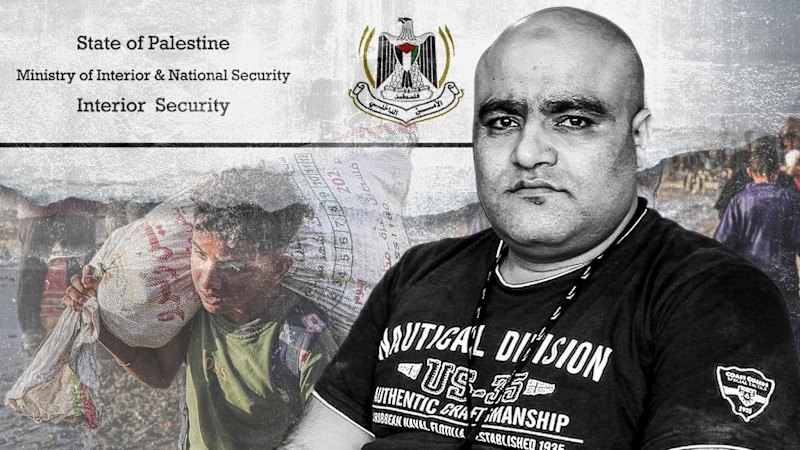

Mohammad al-Halabi says even Hamas believed the “lie” that he had siphoned off millions in aid money, insisting the Palestinian militant group launched its own inquiries into his terror trial because it thought he had stolen funds it never received.
The former Gaza director of World Vision, jailed in 2022 for intentionally diverting large volumes of materials to assist Hamas with digging tunnels, has rejected as “pure fabrications” newly released documents that show the proscribed group terror spied on and interrogated the aid organisation staff to obstruct his prosecution in Israel.
Halabi, who has maintained his innocence, spent more than eight years in detention before he was freed last year in a hostage and prisoner exchange between Israel and Hamas. His lengthy trial drew worldwide condemnation from human rights groups because of its secrecy.
“Any investigations that were performed by Hamas were initiated because they believed the lie that I had taken $50 million of World Vision’s money – they believed I had stolen this money and that I hadn’t transferred to them anything – because of course they hadn’t received a single cent,” Halabi said in a statement.
When Halabi was arrested in 2016, World Vision was one of the Australian government’s largest aid partners in the Palestinian territories.
Several reports, authored by Hamas’ Ministry of Interior and National Security, alleged Halabi used his senior role inside the international aid agency while secretly working for Hamas, and that the terror group treated his exposure as a major internal security failure.
The declassified material, published by this masthead last week, was captured by the Israel Defense Forces over the past two years and reviewed by NGO Monitor, a Jerusalem-based research centre. It detailed Hamas’ monitoring of the lengthy closed Israeli court proceedings over several years, attempts to identify suspected leakers and efforts to prevent potential witnesses from reaching Israel.
Halabi, who says he is now living in a tent in North Gaza, rejected that characterisation outright.
“There can be no doubt whatsoever that the documents presented to you are all false and pure fabrications,” he said.
He dismissed as “too absurd to comment on” claims that a Hamas human source attended closed court hearings in Israel.
“The closed sessions are called closed sessions because they are closed to the public. They were only attended by me, my lawyer, the prosecutors and the judges. Is it the claim that the Israeli judges were a Hamas human source or were the prosecutors supposed to be the human source?”
World Vision accountant Mohammed Mehdi, who was among those interrogated by Hamas, according to the disputed documents, allegedly acted as a whistleblower, alerting authorities that Halabi had diverted World Vision funds to Hamas over the course of several years.
Much of the evidence used to indict Halabi remains classified, as does the 254-page ruling by the Beersheba District Court. A condensed version released to the press upon his conviction in 2022 leaned heavily on Halabi’s confession to Shin Bet security agents. Halabi said he never confessed and even refused a plea deal.
According to the court ruling, Halabi was recruited by Hamas in 2004 and initially worked as a soldier for the terror group before eventually joining World Vision in 2005.
Previous releases of documents purported to be from Hamas – not about Halabi – have proved controversial after an IDF investigation found some files leaked to foreign media were forged to shape public opinion on Israel.
That probe raised concerns that classified material seized in Gaza – or documents only alleged to have been taken from Hamas — was being manipulated and fed to international outlets to influence debate, prompting anger within Israel’s security establishment.
The IDF confirmed to this masthead the legitimacy of the Halabi documents, which were later translated by NGO Monitor and checked independently by this masthead. Several attempts were made to verify them through Hamas’ legal representation in Australia and Europe.
NGO Monitor, which is privately funded, has attracted criticism over many years from international aid groups for defaming aid organisations by claiming they are influenced or controlled by Hamas or any other armed group.
It has also been alleged through its research about aid work in Gaza to only target human rights groups that criticise the Israeli occupation.
Halabi also said assertions that World Vision staff were unwilling to testify were “a blatant lie disproven by the facts”.
“The World Vision employees all wanted to attend the hearings and testify in court. In fact, even after the prosecutor said that a World Vision witness would be jailed if he came to testify in court, he continued to express his willingness to come. The Israeli authorities prevented their testimony,” he said.
After the 2022 conviction, World Vision Australia said it had “not seen anything” to make it question its conclusion that Halabi was innocent. It argued its Gaza programs were subject to regular audits and internal controls and that it had seen no credible evidence of aid diversion.
When asked about the documents, a Department of Foreign Affairs and Trade spokesman said it suspended funding for World Vision’s activities in the Palestinian Territories in August 2016. A review found “nothing to suggest any diversion of government funds”, but the review only covered information in its possession about the management of Australian funding.
Halabi said in his statement that Israeli authorities had failed to produce anything linking him to the group.
One of the documents from March 11, 2020, noted that “the aforementioned [Halabi] was in contact with very few parties of brothers” and described how authorities uncovered his involvement in the terror group.
“The fact that in spite of all the efforts and the fact that the above fabricated lies are ‘the best evidence that they have’ proves that I am an innocent victim of a malicious campaign to smear the INGOs. I paid the price of this campaign.”
NGO Monitor president Gerald Steinberg said aid organisations and governments that funded many of them had failed to ensure even minimal oversight or transparency.
Cut through the noise of federal politics with news, views and expert analysis. Subscribers can sign up to our weekly Inside Politics newsletter.
 Rob Harris is the national correspondent for The Sydney Morning Herald and The Age based in Canberra. He is a former Europe correspondent.Connect via email.