



As you follow the winding, two-kilometre driveway that leads from the pot-holed Boneo Road to The National Golf Club on the Mornington Peninsula, a fit-looking man in his 50s can sometimes be seen working on the fence that borders the farm next door.
Once, the man was found showering in the members’ bathroom. Startled officials demanded to know what he was doing there.
This is where clubhouse legend starts to diverge from the truth. One version of the story that circulates among members of The National is that four-time Hawthorn premiership coach Alastair Clarkson had explained that his bathroom was being renovated so he was using the facilities at the neighbouring golf club instead.

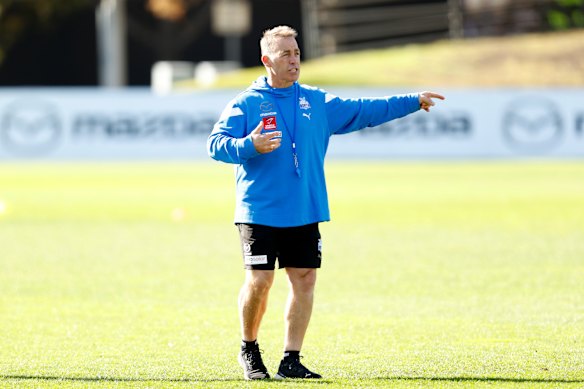
AFL coach Alastair Clarkson can vouch for The National’s facilities.Credit: Getty Images
In fact, the now North Melbourne coach clarified to this masthead, Clarkson had been playing at The National that day as an invited guest and, while it’s not the done thing for non-members to use the members’ bathroom, he had not wandered into the club unannounced. Clarkson is also close friends with course superintendent Leigh Yanner.
Like Clarkson, The National’s club captain, Andrew Tunks, and chief executive Matthew Corby laughed when they were asked about the legendary coach’s visit.
Apocryphal or not, the story serves as a reminder that The National, like others profiled in this masthead’s series about Victoria’s elite golf clubs, prides itself on privacy.
Another, actual intrusion illustrates the point.
Seven’s head of sport, Chris Jones, and news director Chris Salter last year received an angry letter complaining about what the club viewed as the “inappropriate behaviour” on club grounds of Seven’s chief football reporter, Mitch Cleary.
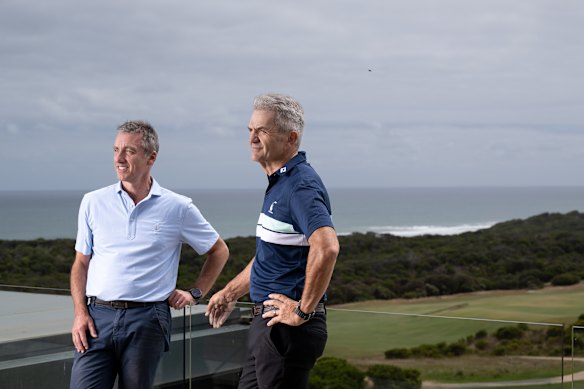
CEO Matt Corby and club captain Andrew Tunks on the clubhouse balcony.Credit: Penny Stephens
Cleary was on the scent of a story, and had arrived near the 18th green at Gunnamatta with a cameraman just as Port Adelaide star Zak Butters putted out.
Butters was, and still is, the subject of intense trade speculation about a possible return to Victoria. Cleary was chasing the interview everyone in footy had been hunting.
He landed the interview, and members of The National were furious.
Watching the market
Even among Melbourne’s famous golf clubs, The National stands apart, with a unique model that allows memberships to be bought and sold on a fluctuating share market, a diverse community of prominent people from business, sporting and cultural society, and a reputation among foodies for dining excellence.
The National has four golf courses, which is why it’s often referred to as one of the best value memberships in Australian golf despite a price tag that runs into the tens of thousands.
There’s the recently renamed Gunnamatta course (previously called the Ocean) which is one of three at the Cape Schanck complex. The others are The Old and Moonah courses. Then there’s Long Island, on Melbourne’s sandbelt, which has just undergone a $9.3 million redevelopment.
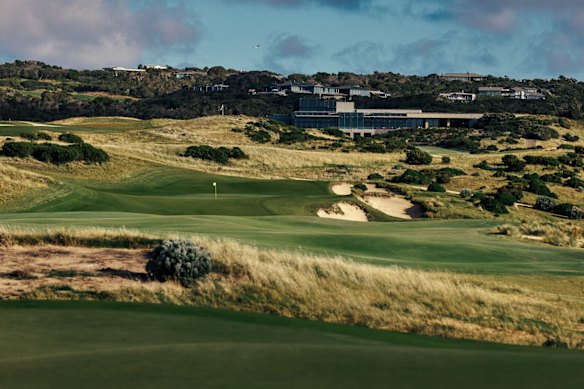
The Gunnamatta Course at The National Golf Club.
Some wealthy members are also members of one of the other prestigious clubs on the sandbelt, so they can play in Melbourne during the week and escape to the peninsula on weekends.
At Cape Schanck, as you round the first corner of the driveway and start the steep descent to The National, perhaps passing “Clarko” on his tractor, you are met by one of the most spectacular views in world golf. The club is so close to the water that the occasional Kombi van can be seen doing laps of the car park, as lost surfers make their way to one of the most dangerous breaks in Australia.
How the share model works
Despite the emphasis on privacy, Tunks and Corby agreed to discuss the unique entry rules at The National and the distinct communities or “tribes” that make up the membership.
Loading
At most golf clubs, you pay the fee, wait your time, get the keys and play the course.
But at The National, instead of paying a joining fee you buy a share in the club.
I have been a member of The National since 2018.
Crucially, Corby explains, the transaction usually does not involve the club at all. The buyer acquires their share from an existing member who wishes to sell. The club merely approves the transfer and holds the cash as a third party, acting more like a gatekeeper than a vendor. The marketplace exists between the members, influenced by prestige, demand and scarcity.
Right now, demand is high. Ten years ago, you could join The National for less than $10,000. Last week, a share sold for $74 000.
Why the boom?
“What’s changed is working from home,” Corby said.
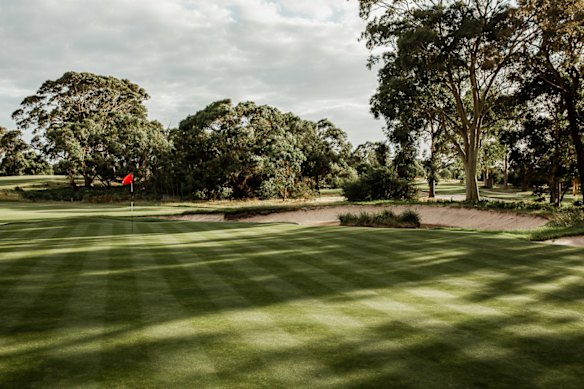
The National’s Long Island course.
“People can control their schedules better. It’s just not nine to five. So people are in better control of their time and they value their leisure more. The combination of those two things has shifted the goalposts. I suspect what we’re calling the boom may actually become the norm.
“Pre-COVID, average games per member were around 24 or 25 a year. Now it’s over 40.”
While Tunks prefers not to think of the club’s membership as an “investment”, the reality is that members who sell their shares when demand is high can make more than what they paid. But in weaker markets, a share can decline in value. The risk is real, but unlike an entry fee, the money is parked, not burnt.
Former Victorian deputy Liberal leader Sam Groth, known for his booming tennis serve and an equally big hitter on the golf course, last year sold his share at a healthy profit.
But does the rising price of a share risk pricing potential candidates out of membership?
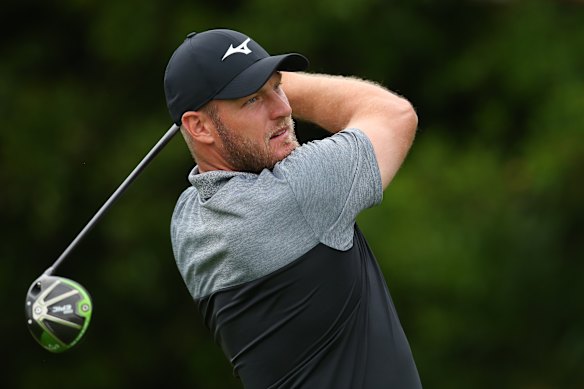
Sam Groth takes a swing at The Lakes in Sydney in 2018.Credit: Getty Images
“Personally, I don’t love members seeing it as a genuine investment. But we’re arm’s length from it. It’s a regulated market between members,” Tunks said.
“Lower prices would arguably make us more accessible. But we can control that about as much as the weather.”
The tribes
As club captain, Tunk has his own parking spot, but unlike many in his position, he is happy for other members to use it – as long as they ride a motorcycle.
A geologist and mining expert, Tunks wants to start a “tribe” – a group of members – just for fellow bikers. If he’s successful, they’ll be able to play in the annual Tribal Challenge against the Wednesday Warriors, the Testaments, The Goat Slappers and the Sassy Sheilas, of which former club captain Meredith Ramadan is a member.
Of the 3200 members listed of The National, 13 per cent are women.
One of the criticisms from both outside and members, is that it feels less like a “club” than Melbourne’s other exclusive golf clubs.
‘People can control their schedules better. It’s just not nine to five. So people are in better control of their time and they value their leisure more.’
The National’s Matthew Corby on the club’s boom
Because of the giant clubhouse – functional rather than luxurious or intimate – the large membership base and the four courses, it’s harder to feel like part of a golfing community.
Tunks is keen to change that mindset.
“I hear that all the time,” he said.
“My answer is the tribes — clubs within the club. Groups of 12 to 50 people who organise to play together regularly. There’s plenty of social fabric here — but you have to engage with it.
Loading
“And also, one of the great things about this club: it’s a broad church. Lawyers, bankers, QCs, geologists — and plumbers, sparkies, teachers.”
Inside the clubhouse, a sunken bar and cafe-style seating area looks onto the 18th green of the Gunnamatta course and beyond to the rugged coastline.
There is a helipad behind one of three practice chipping greens available to members as long as they give the club prior notice, an option sometimes taken by trucking magnate and Lindsay Fox.
Other famous members include AFL and media personality Sam Newman, whose Lamborghini can sometimes be seen parked across two spots in the underground car park, former St Kilda coach Grant Thomas, Davis Cup captain and former tennis world No.1 Lleyton Hewitt, and comedian Mick Molloy.
The foodies
Executive chef Craig Gorton jokes that The National is “a restaurant with a couple of golf courses attached”.
His menu features roast fioretto cauliflower with tomato curry leaf sauce, alongside a crisp Asian omelette with smoked oysters and XO sauce.
Even the bar menu transcends the usual golf club fare: spanner crab spaghetti with roast cherry tomatoes and basil, MB7+ wagyu sirloin with salsa verde, char-grilled kingfish treated with the same respect as a tournament green.
Chef Adam D’Sylva is a member at The National.
“That’s world-class Sher wagyu, by the way!” says Gorton. “They export that stuff to Japan.”
This is why members speak about the food with the same reverence as the courses. The restaurant is part of The National’s culture. Long lunches bleed into afternoon rounds. Post-golf drinks turn into gourmet dinners.
But there are also chefs at The National who are not there to cook.
Adam D’Sylva, famous for award-winning restaurants like Tonka and a keen golfer, is a member. So, too, is French Saloon veteran restaurateur Con Christopoulos.
The member known as ‘Tiger’
As is the case with almost every private golf club, regardless of its prestige, phone calls inside the clubhouse at The National are strictly prohibited.
But, given many members are high-flying businesspeople, they are accustomed to balancing etiquette with their business needs.
Loading
Some years ago, a member was sitting by the window sipping a Peroni when his phone rang. He ducked outside through a nearby exit door to answer when an unexpected guest joined the call.
A two-metre tiger snake.
The man dropped his phone and sprinted from the scene.
Unfortunately, he didn’t make it far. He tore his calf muscle from the bone and collapsed to the footpath as the snake slithered away.
Members say it’s the only time a doctor has been called to the club because of a snake-related injury that didn’t involve a bite.
The man is nicknamed “Tiger”, but not after the 15-time major champion.
Start the day with a summary of the day’s most important and interesting stories, analysis and insights. Sign up for our Morning Edition newsletter.