











The Women’s Asian Cup is done, the Matildas came close but fell just short again, and the post-mortems have begun.
So, did Australia’s national team live up to expectations? What does this tournament say about where they are 15 months out from the next World Cup? And can the tournament in general be considered a success?
Is making the final good enough?
Absolutely. The definition of a pass mark really is subjective, but reaching the semi-finals – and securing direct qualification for the 2027 World Cup – had to be the bare minimum.
Some might say even the semi-finals is not really up to the required standard, given the Matildas’ 2022 quarter-final exit was so below par. Others would point out that Australia are the third-ranked Asian nation, behind champions Japan and North Korea (who they beat in the quarters), rendering the final four in line with their continental position.
If the latter is the case, then making the final is punching above their weight. Arguably even more so given the context. Joe Montemurro was appointed as coach less than a year ago and had very limited time to prepare for a major home tournament.
Add to this that the Matildas matched Japan on the field and, on another day with more precise finishing, could have lifted the trophy. These are all encouraging signs 15 months out from the World Cup in Brazil.
Montemurro preferred to focus on Australia’s talent per capita.
“We’re Australian,” he said. “I grew up in this country. We like to make sure that we’re going to win the thing, you know what I mean? And you have to go in with that positivity and with that idea, and it’s not wrong to expect us to be the best.
“But we have to put this all in context. We’re a country of 26 million people and our talent pool isn’t that of 129 million [Japan’s population is approximately 122 million] or three billion [the population of semi-final opponents China exceeds 1.4 billion] like we played the other night … we’re doing some amazing things, but I know we can do better.”
Player management
It was better than under Tony Gustavsson, whose favourite “it takes 23 in ’23” line did not match the reality. Still, there could have been more rotation in a compressed draw of six matches in 21 days.
Let’s get the caveats out of the way first.
Montemurro was dealing with some elements out of his control. There were the pre-tournament withdrawals of two goalkeepers, Teagan Micah and Jada Whyman, and the minor injury to Mackenzie Arnold, which meant late call-up Chloe Lincoln started the opening two games for only her fourth and fifth caps (and did very well).
Then there were the concussions to Steph Catley and Hayley Raso, which sidelined both for two games, not to mention Kyra Cooney-Cross being unavailable for the opening stages.
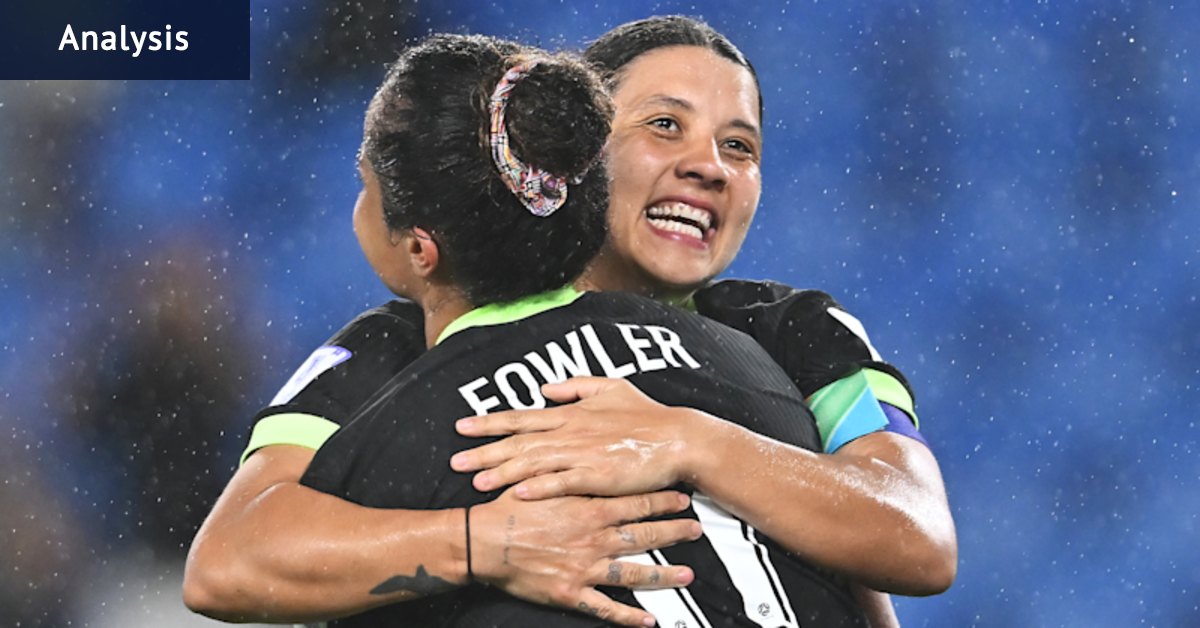
Yet, it was still surprising that Sam Kerr and Mary Fowler, both returning from ACL injuries, played significant minutes in every match – Kerr started all six and Fowler started five – and were not managed more. Especially so given Montemurro’s language when announcing his 26-player squad indicated that everyone had a role to play.
In reality, some had none, except to keep the training levels high. Midfielder Alex Chidiac, defender Jamilla Rankin, forward Kahli Johnson and third-choice goalkeeper Megan Aquino did not make it onto the pitch at all. A-League Women top scorer Holly McNamara and fellow forward Remy Siemsen each made one appearance as a substitute, while veteran Michelle Heyman was given a total two minutes across two games.
Charlize Rule played against Iran, but was only a stoppage-time substitute in other games. And Amy Sayer was criminally underused given the attacker’s physicality and vision, and in the final looked a more appropriate substitute for Fowler than the one used, Emily van Egmond.
Japan, meanwhile, made 33 changes throughout the tournament. The champions used every single player, including their third keeper, and still scored 29 goals.
The Matildas’ ambition has to be an interchangeable 26 that can be deployed in various combinations and still perform at the same level.
Australian football identity
Montemurro on Saturday coined “Joe Montemurro cultism” to convey a strong desire to spread his football philosophy throughout every tier and youth level – “the magnitude of the national team spectrum” – as the only realistic way of ensuring the next generation can play like the current crop.
“The thing for me is to make sure that our mentality is this type of football,” he said. “The way we want to play, we want to dominate games, because that’s what the best teams in the world are doing.”
But where is it at now? How far has Montemurro-ball come at this early stage?
The tournament overall was a work in progress, and the quarter-final and semi-final wins were both more reflective of the Matildas’ long-standing backs-to-the-wall, counterattacking mentality that the coach described as “old habits”. The final against Japan was perhaps the best example of how he wants his team to play, with final-third execution the glaring missing piece.
“The next phase is to make sure that when we do go forward, that the attacking third is a little bit more dominant,” Montemurro said. “I think zone one and zone two – if you want to talk in those zones – we’re OK, we understand. But now we need to be more dominant in those areas.”
The numbers game
The pre-tournament commentary zeroed in on the perceived lack of hype about the Asian Cup and the apparent death of Matildas mania.
It is true that the marketing paled in comparison to the 2023 World Cup, and the audience numbers for Saturday night’s final were a fraction of the record-breaking 11.15 million that tuned in for the Matildas’ semi-final against England three years ago.
But this was not the World Cup; it was a continental competition. And 2.66 million viewers for the final was Network Ten’s biggest audience since the 2023 Melbourne Cup.
There were disappointing dips, such as the half-empty Perth Stadium for Australia’s semi-final win over China. But 74,397 at Stadium Australia for the final was close to capacity.
Overall, the 2026 tournament was the most attended Women’s Asian Cup in history, with a total of 355,528 fans coming through the gates – six times the previous record.
The major disappointment came from the Asian Football Confederation (AFC), which refused to entertain demands for an increase in the paltry $US1.8 million ($2.6 million) prize pool, despite the commercial success the governing body said it hinged on.
Human rights
Iran’s plight during their campaign in Australia has exposed a yawning human rights void that should have been filled by FIFA and the AFC. Months before the US-Israeli strikes began on the eve of the Asian Cup, there were concerns about the safety of the Iran women’s national team.
Global players’ union FIFPro requested a human rights risk assessment similar to the one undertaken before the 2023 World Cup in Australia, yet neither FIFA nor the AFC could confirm whose responsibility this was and why it appeared to be overlooked.
What ultimately played out was a stressful, delicate federal government intervention to offer players and staff asylum following regime threats to their lives back home, with almost all ultimately returning to Iran.
It was a gross failure of football’s authorities to uphold their self-stated human rights obligations.


