









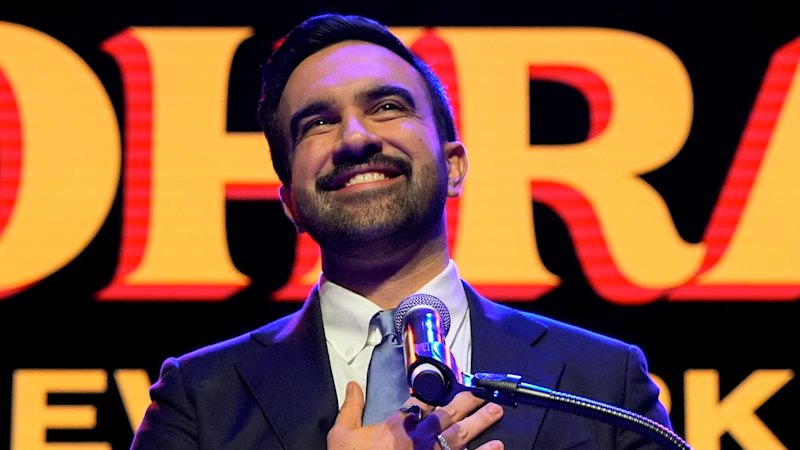
Washington: Six years ago, Zohran Mamdani was an unknown New York rapper with four Twitter followers. Even at the start of this year, four in five New Yorkers had no idea who he was, or at least had no view on him.
Today, the 34-year-old is about to take the reins as the city’s youngest mayor in a century, the first Muslim and only the second democratic socialist to hold the role.
His rapid rise – stunning former New York governor Andrew Cuomo to win the Democratic primary in June, and commanding just over 50 per cent of the vote in a three-way race this week – has shocked the establishment as much as it has excited large parts of the Democratic base.

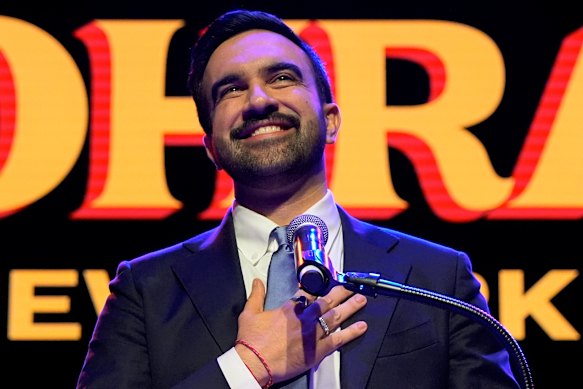
“We have toppled a political dynasty,” Zohran Mamdani told his raucous crowd of supporters on Tuesday night.Credit: AP
“We have toppled a political dynasty,” Mamdani told his raucous crowd of supporters on Tuesday night. “I wish Andrew Cuomo only the best in private life. But let tonight be the final time I utter his name.”
The day after his decisive victory, Mamdani had lunch with another young firebrand, the New York Democratic congresswoman Alexandria Ocasio-Cortez, whom many believe will challenge Senate leader Chuck Schumer for his seat and one day seek the presidency.
Meanwhile, veteran Democrat congresswoman Nancy Pelosi – the first woman to serve as speaker of the US House of Representatives – announced she would retire at the end of next year, another major symbol of the changing of the guard in a Washington that has largely become a gerontocracy.
Mamdani’s success came on a red-letter day for Democrats in elections elsewhere, with Mikie Sherrill elected governor of New Jersey by 13 points, and Abigail Spanberger elected governor of Virginia by 15 – decisive wins that have party strategists thinking big about what’s possible at next year’s national midterm elections.
Loading
“This was an excellent night for Democrats,” says James Booth, a Washington-based Democratic strategist and pollster who also works with the Australian Labor Party.
“If you only read The New York Times and Twitter [now X] over the last nine months, things feel bleak. But data points that come from elections are the most important data points. We are in a 2017 ballpark world in terms of reactions against Trump and Trumpism.”
Democrats have been anxiously trying to work out where they sit in comparison to Donald Trump’s first term (in 2018, they won 41 House of Representatives seats at the midterms in a “blue wave” election).
“A week ago, we were kind of worried that the Democratic brand was much more tarnished now than in 2017,” Booth says. “This is a very important data point suggesting the Democratic electorate is out there and alive …[and] there to be mobilised again.”
The question is how best to mobilise it. Does the answer lie with left-wing populist candidates such as Mamdani – whose appeal in a city like New York is clear, but who would fail to resonate in Arizona, Michigan, Nevada or North Carolina? Or does it sit with moderates such as Spanberger and Sherrill? Can both things co-exist?
The Republicans will do their best to make sure the answer is no. Trump has branded Mamdani a “communist lunatic”, but it’s not just the US president. Texas senator Ted Cruz has called the New York mayor-elect “a literal, Karl Marx-quoting, America-hating jihadist”. And House of Representatives Speaker Mike Johnson spelled out how Republicans would seek to use Mamdani to attack Democrats over the next 12 to 36 months.
“His brand of Marxism is truly a bellwether for the Democrats nationwide,” Johnson said. “We pointed out that other major metropolitan areas in the country are facing the same threat with candidates similar to Mamdani. And we are going to continue to call out their effort to mainstream and normalise socialism and Marxism in America. Working families watching this play out have a right to know that socialism and communism are not just confined to New York City.”
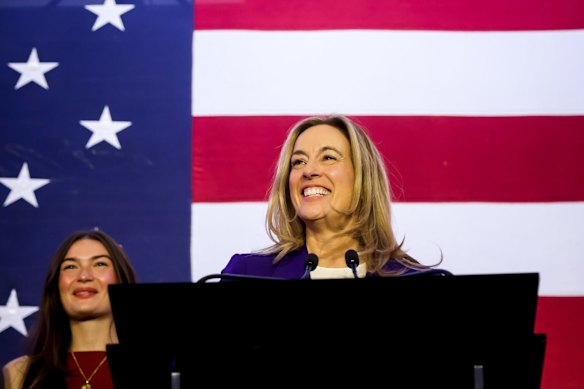
Mikie Sherrill was elected governor of New Jersey by 13 points.Credit: Bloomberg
Booth, however, says the Democrats can walk both sides of the street – in fact, they need to, to patch together a winning Coalition, much like Australian Labor has to manage its left and right flanks.
“The Democratic Party is in a moment of figuring out how to cohere a coalition that looks more like 51 per cent than 49 per cent,” he says.
Booth says Mamdani’s campaign and the successful gubernatorial campaigns were more alike than people may realise. They focused on practical, local issues; in Mamdani’s case, how to make America’s most expensive city more affordable for working people by redistributing wealth.
The data appears to bear this out. According to the Searchlight Institute, a new think tank whose raison d’etre has been described as pushing the Democrats towards “the most effective, broadly popular positions”, exit polls found 51 per cent of New York City voters identified “affordable prices” as one of Mamdani’s top issues, compared with only 24 per cent who said the same for the national Democratic Party.
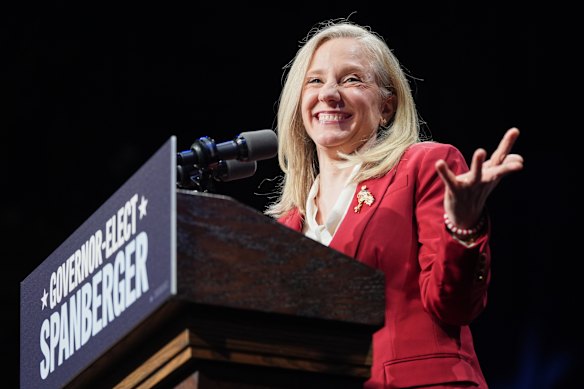
The victories of Abigail Spanberger (pictured), Sherrill and Mamdani have party strategists thinking big about what’s possible at next year’s national midterm elections.Credit: AP
The Searchlight Institute said: “With his relentless focus on the cost-of-living crisis, Mamdani avoided usual Democratic problems with ‘crowding out’ his best issues with other lower-priority issues.”
That was no mean feat for Mamdani, who was dogged throughout the campaign for his previous support for defunding the police, and his criticism of Israel. The probable lesson for Democrats, if it were not already clear, is that jettisoning ideological, identity politics-rooted causes in favour of hip-pocket politics is the way to win.
“These are all campaigns where, in their own place and way, the candidates did not get sucked into culture war fights or put themselves in a position where we were pushing our ideological concerns on the electorate,” Booth says. “That is the overarching thread that makes those campaigns similar – just different flavours in different places.
Loading
“We are going to have to figure out how to do a national version of that, and with national party leadership. The big tent goes left and right. We’re going to need a bigger tent than we had in 2024.”
In New York, Mamdani now faces great expectations. Many of his commitments – tax increases on the wealthy, free childcare, free buses, a rent freeze and a big affordable housing build – will require co-operation from the state government in Albany.
Democratic governor Kathy Hochul endorsed Mamdani but opposes his tax plans; she fears taxpayers at the top end of town will flee and leave middle-class residents to pick up the tab.
In one of his first interviews after the win, Mamdani told The New York Times he was “clear about the mandate that we won” to lift taxes on the city’s richest residents. The Times said the interview matched the defiant and at-times boastful tone he struck in his victory speech, which some observers found off-putting.
That speech contained a direct challenge to Trump, who was watching at the White House. “Turn the volume up,” Mamdani urged him, pledging to take on the billionaire president, even though Trump had threatened to choke federal funding for New York if it elected the “communist” mayor.
Loading
And yet, Trump also seemed to mellow a fraction in the face of Mamdani’s overwhelming win. “We’ll help him, we’ll help him – we want New York to be successful,” Trump told the America Business Forum in Miami. “We’ll help him – a little bit, maybe.”
Booth says this week’s elections ought to be a wake-up call for the president, who has been focused on trade deals, ending foreign wars and vanity projects such as the White House ballroom.
“He’s projecting a disinterest in the practical challenges facing voters in their daily lives, and has been captured by the ideological parts of Trumpism in a way that voters saw from us last year,” Booth says. “This is bad news for Trump.”
Marjorie Taylor Greene, a hard-right Republican congresswoman from Georgia who was at one point a MAGA standard-bearer, has in recent weeks become the leading voice of dissent. Appearing on CNN this week, she blamed Trump’s advisers for distracting him with foreign affairs instead of focusing on domestic concerns.
“Keeping him on non-stop tours around the world and non-stop meetings with foreign countries’ leaders is not America First,” she said. “It’s just not. Domestic policy should be the most important issue that the president – and the Republican-controlled House and Senate – are working on, and that showed up on Tuesday.”
Get a note directly from our foreign correspondents on what’s making headlines around the world. Sign up for our weekly What in the World newsletter.


