


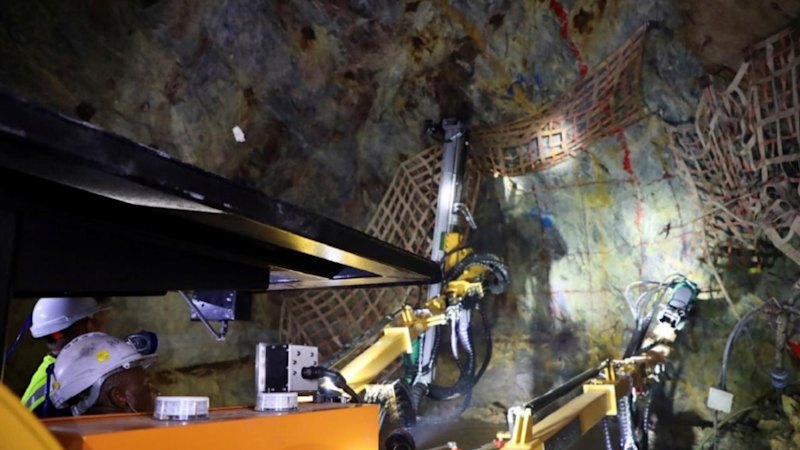
After lying dormant for two decades – a period in which gold prices started low but skyrocketed to record highs – West Wits was handed the keys to one of South Africa’s most famous goldfields in 2018, when the Department of Mineral Resources and Energy gave the company approval to reopen the legendary Witwatersrand Basin.
Between 2021 and 2023, a series of scoping and feasibility studies mapped out the project’s full potential, outlining a colossal global resource of 5.025 million ounces grading a respectable 4.66 grams per tonne gold. The company quickly zeroed in on the Qala Shallows deposit as the logical starting point – a near-surface, easily accessible orebody packing 10.7 million tonnes at 2.98g/t for 1.026 million ounces of contained gold.
Adding to its appeal, Qala Shallows already boasts an existing adit, decline and shaft – all of which have since been refurbished to provide rapid underground access for sampling and survey work. One early foray into the old workings produced a 150-kilogram bulk sample that confirmed the continuity and quality of the ore grades.
Five months ago, West Wits unveiled its much-anticipated definitive feasibility study – and the numbers turned heads. The study modelled a net present value of US$500 million (A$766 million) at a 7.5 per cent discount rate, paired with a post-tax internal rate of return of a staggering 81 per cent.
The mine is tipped to produce about 70,000 ounces of gold a year, generating a cumulative free cash flow of US$983 million (A$1.5 billion) over a 12-year mine life based on a very conservative assumed gold price of US$2850 an ounce (A$4368). Even more compelling is its cost profile with the forecast for all-in sustaining costs per ounce coming in at just US$1289 (A$1975) per ounce, putting the project squarely within the lowest quartile of global producers.
Perhaps the most attractive element, however, is the modest price tag. Given West Wits is reopening a historic operation rather than starting from scratch, much of the underground infrastructure remains intact and has already been brought back to working order. The total capital cost to bring Qala Shallows into production sits at just US$60 million (A$92 million).
Peak funding requirements are capped at a lean US$44 million (A$67 million), comfortably covered by the company’s already approved loan facilities. That financial headroom gives West Wits the breathing space to bring South Africa’s newest underground gold mine back to life – leaner, faster and more profitably than anyone could have imagined when the lights first went out 20 years ago.
Absa’s involvement offers more than just financial muscle—it brings a strategic endorsement from one of Africa’s biggest banks, with deep experience in corporate and investment financing across the continent. The partnership could also position West Wits favourably for future expansion and refinancing options as its development footprint grows.
The company now finds itself fully funded thanks to Absa bank’s syndicated loan, a recent US$35 million (A$53M) funding package from United States-based Nebari Natural Resources Credit Fund II and $17 million from a fresh capital raising.
With mining now in full swing and the first pour expected as soon as the new year, Absa’s equity-for-fees move is a strong vote of confidence from one of Africa’s biggest banks and appears a clear validation of West Wits’ strategy.
And for West Wits, the message seems clear. The old Witwatersrand Basin is stirring again – this time powered by modern mining, strong institutional backing and the golden tailwinds of a booming metal price.
Is your ASX-listed company doing something interesting? Contact: mattbirney@bullsnbears.com.au
