


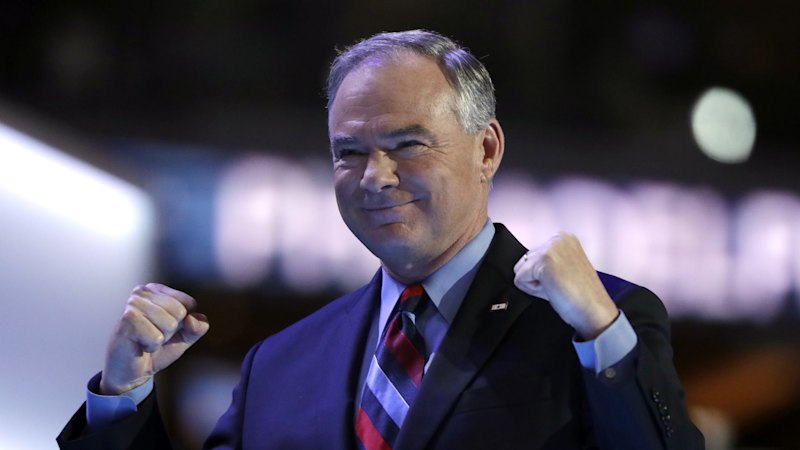

A leading United States congressman says he has no doubt that a future US president will deliver on the pledge to provide Australia with nuclear-powered submarines, as he backs the idea of a new AUKUS visa to accelerate implementation of the three-nation pact.
Tim Kaine, a Democratic senator who was Hillary Clinton’s vice-presidential running mate in the 2016 election, said China would weaponise any collapse in the AUKUS plan, making it crucial for the US to deliver on its promise to a close ally.
Kaine also urged the Trump administration to move urgently to breathe new life into the Quad grouping of the US, Australia, Japan and India to ensure it does not lose relevance as a counterweight to Beijing’s growing influence in the region.
US President Donald Trump declared AUKUS was “full steam ahead” in his White House meeting with Prime Minister Anthony Albanese last October, but sceptics such as former prime minister Malcolm Turnbull continue to insist that the US is unlikely to sell three to five Virginia-class submarines to Australia as promised because of sluggish production rates.
“I believe 100 per cent we will provide them because I don’t think we have any other choice. I think the security demands make this a necessity,” said Kaine, who is in Australia visiting Defence facilities in Adelaide, Perth and Darwin.
“I can tell you that in Congress – Democrat, Republican, House, Senate – I’ve seldom seen an initiative that has had the bipartisan support that AUKUS has.”
Albanese announced a $3.9 billion down payment over the weekend to deliver a new submarine construction yard in Adelaide, following a $12 billion pledge last year to establish a new shipyard in Perth.
Kaine said the fact Australia had taken the difficult decision to send $US3 billion ($4.2 billion) to the US to improve its industrial base made it vital for the US to transfer Australia Virginia-class submarines from 2032 as promised.
Trump’s successor as president will be required to authorise the transfer.
“China would love … for [AUKUS] to fall short and they would use it falling short for a kind of disinformation advantage, and they would really promote that. And so I think we have to make sure that we meet those commitments,” he told this masthead.
“Because look, let’s face it, the US and Australia will make other commitments in the future on other important priorities … People need to know about us that if we go into a commitment like this, we’ll honour it.”
Kaine, the top Democrat on the Senate Armed Services’ seapower subcommittee, represents Virginia, one of the two states where the Virginia-class submarines are constructed.
He said 2025 was a good year for Virginia-class production “and we see that increasing”.
However, he acknowledged AUKUS was a “big and hard” project and that US submarine production rates needed to rise from the current level of 1.13 vessels a year.
“We’re really grappling with what is the path to having the adequate workforce to do that,” he said.
On proposals for a new AUKUS visa to address skills shortages, Kaine said: “I like that idea a lot … we have to be creative.”
The Australian parliament’s foreign affairs and defence committee recently said there was a strong argument for the creation of an AUKUS visa, echoing a proposal by former US ambassador Caroline Kennedy.
Kaine revealed that senior Pentagon official Elbridge Colby had been conducting a standalone review into AUKUS pillar II, which covers collaboration on advanced technologies such as hypersonic weapons and is separate from the submarine pact.
He said that, while Colby’s review into the AUKUS submarine program was classified, he could speak about its contents in general terms.
While the review backs the AUKUS pact, he said: “It raises some issues about the implementation on both sides.”
For the US, he said the report focused on increasing submarine production rates and addressing skills shortages. For Australia, it stressed the need to develop the infrastructure required to host regular American nuclear-powered submarine visits from 2027.
The review urges the adoption of ambitious short-term deadlines to ensure the pact’s success, he said.
Quad needed for ‘clear signal’ to China
Kaine and Republican Senator Pete Ricketts wrote to Trump over the weekend urging him to convene a summit with his fellow Quad leaders before he meets Chinese President Xi Jinping in April.
“At this pivotal moment of intense strategic competition with the People’s Republic of China, convening a Quad Leaders’ Summit would send a clear signal of unity, resolve, and strategic coherence among leading Indo-Pacific democracies,” the senators wrote.
Last year’s Quad summit, scheduled to be held in India, was cancelled when trade tensions flared between the US and India, raising doubts about the future of the grouping.
Kaine, also a member of the Senate Foreign Relations Committee, said he understood why traditional US allies were alarmed by aspects of Trump’s foreign policy, including the imposition of tariffs on countries such as Canada and Australia.
But he said he did not fully agree with a dramatic speech by Canadian Prime Minister Mark Carney last month in Davos in which he declared the global rules-based order a “pleasant fiction” that had lost relevance.
“I am not as pessimistic as him about [the] rules-based order being dead,” he said. “I think the rules-based order has served our nations, but also humanity, in a really powerful way, especially since the end of World War II.”
While global rules needed to be updated to reflect modern realities, he said: “I don’t think the right answer to change is to abandon the notion of rules.”
Trump has ordered the world’s largest aircraft carrier to sail to the Middle East as he tries to raise the pressure on Iran to strike a deal to curb its nuclear program.
Kaine said he believed it would be a “disaster” for Trump to launch military strikes in Iran, and that Americans did not want to become entangled in another war in the Middle East.
“Every action produces reaction,” he warned.
Cut through the noise of federal politics with news, views and expert analysis. Subscribers can sign up to our weekly Inside Politics newsletter.
 Matthew Knott is the foreign affairs and national security correspondent for The Sydney Morning Herald and The Age.Connect via X, Facebook or email.