


Trump posted on his Truth Social account a photo that he said showed Maduro in custody, including blindfolded and in a sweatsuit.
Early morning attack
Early Saturday, multiple explosions rang out and low-flying aircraft swept through the Venezuelan capital. Maduro’s government accused the United States of attacking civilian and military installations, calling it an “imperialist attack” and urging citizens to take to the streets.
The attack lasted less than 30 minutes and the explosions — at least seven blasts — sent people rushing into the streets, while others took to social media to report what they’d seen and heard. Some Venezuelan civilians and members of the military were killed, said Vice President Delcy Rodríguez, without giving a number. Trump said some US forces were injured in Venezuela but none were killed.

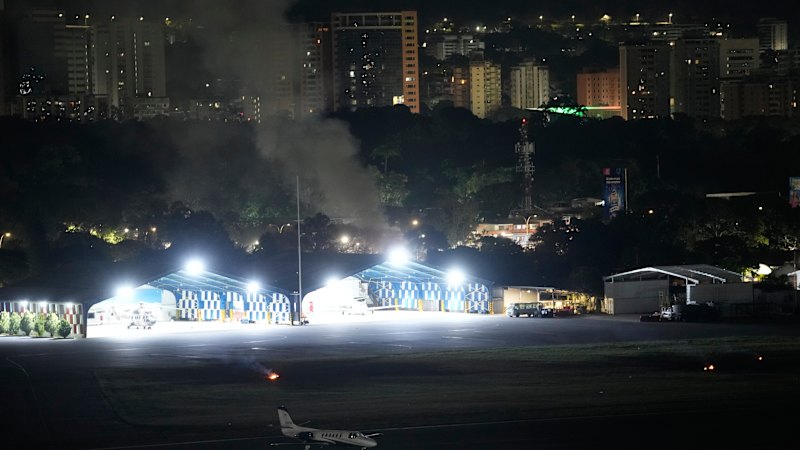
A fire burns at Fort Tiuna, Venezuela’s largest military complex, after a series of explosions in Caracas on Saturday.Credit: AFP
“We think, we develop, we train, we rehearse, we debrief, we rehearse again, and again. not to get it right, but to ensure we cannot get it wrong,” said Dan Caine, the chairman of the Joint Chiefs of Staff.
Video obtained from Caracas and an unidentified coastal city showed tracers and smoke clouding the landscape as repeated muted explosions illuminated the night sky. Other footage showed cars passing on a highway as blasts illuminated the hills behind them. The videos were verified by The Associated Press.
Smoke was seen rising from the hangar of a military base in Caracas, while another military installation in the capital was without power.
Venezuelan ruling party leader Nahum Fernández told The Associated Press that Maduro and Flores were at their home within the Fort Tiuna military installation when they were captured. “That’s where they bombed,” he said. “And, there, they carried out what we could call a kidnapping of the president and the first lady of the country.” Under Venezuelan law, Rodríguez would take over from Maduro. There was no confirmation that had happened, though she did issue a statement after the strike, demanding proof of life for Maduro and his wife.
The strike followed a months-long Trump administration pressure campaign on the Venezuelan leader, including a major build-up of American forces in the waters off South America and attacks on boats in the eastern Pacific and Caribbean accused of carrying drugs. Last week, the CIA was behind a drone strike at a docking area believed to have been used by Venezuelan drug cartels — the first known direct operation on Venezuelan soil since the US began strikes in September.
In a demonstration of how polarizing a figure Maduro is, people variously took to the streets to deplore his capture and celebrate it.
At a protest in the Venezuelan capital, Caracas Mayor Carmen Meléndez joined a crowd demanding Maduro’s return.
Earlier, armed people and uniformed members of a civilian militia took to the streets of a Caracas neighborhood long considered a stronghold of the ruling party. In other parts of the city, the streets remained empty hours after the attack, as residents absorbed events. Some areas remained without power, but vehicles moved freely.
Questions of legality
The Armed Services committees in both houses of Congress, which have jurisdiction over military matters, have not been notified by the administration of any actions, according to a person familiar with the matter and granted anonymity to discuss it.
Lawmakers from both political parties in Congress have raised deep reservations and flat-out objections to the US attacks on boats suspected of drug smuggling near the Venezuelan coast and Congress has not specifically approved an authorization for the use of military force for such operations in the region.
AP
Get a note direct from our foreign correspondents on what’s making headlines around the world. Sign up for the weekly What in the World newsletter here.
