


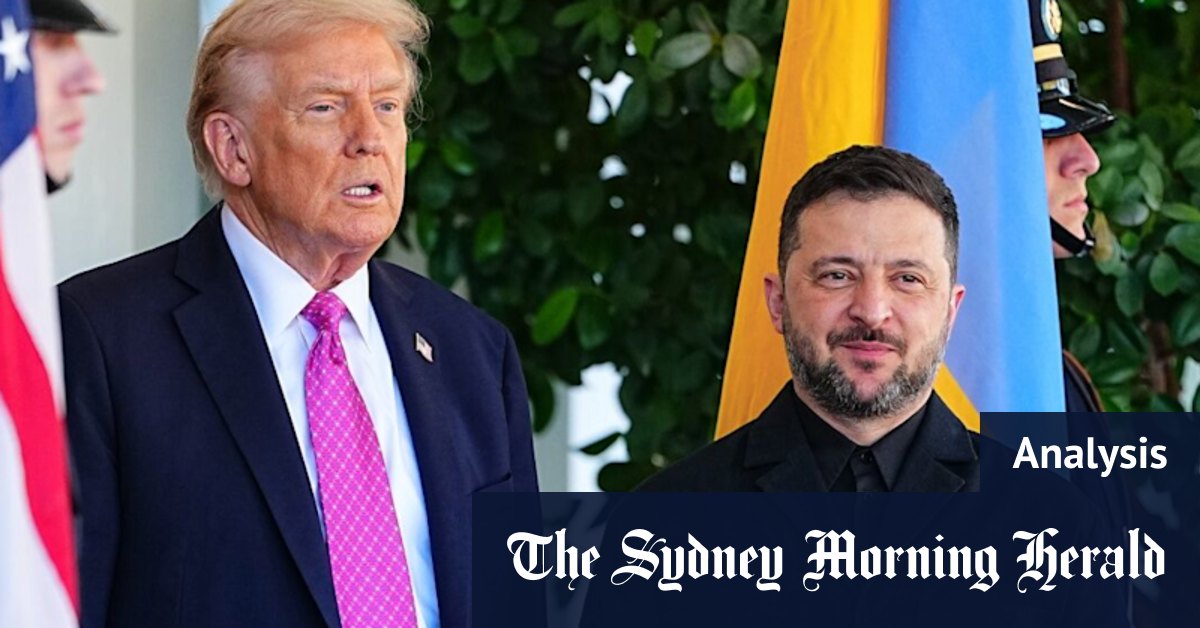
Later, at a press conference in a park opposite the White House, Zelensky said both leaders agreed not to talk publicly about long-range missiles “because the United States doesn’t want escalation”.
And in a Truth Social post, Trump described the meeting as “interesting” and “cordial”, but said it was time to strike a deal and stop fighting: “They should stop where they are. Let both claim Victory, let History decide!”

Volodymyr Zelensky speaks to reporters in a Washington park after his meeting with Trump.Credit: AP

Russian President Vladimir Putin addresses an energy forum in Moscow on Thursday.Credit: AP
There are different ways of looking at this. On one hand: less than a week ago as he flew to Israel, Trump was threatening to give Ukraine the missiles, saying it was appropriate to discuss it. A few days later – and a day before he met Zelensky – Putin gets in his ear and the two men agree to meet in Hungary. Then, rather than agreeing to give Ukraine the Tomahawks, Trump appears to cool on the idea. On the face of it, it seems that Putin bought himself more time – again.
“When it comes to Russia and China, he [Trump] gets an itch in his eye, and he constantly blinks,” Rahm Emanuel, a former chief-of-staff to Barack Obama, told CNN. “Tomahawks with Russia, tariffs with China.”
Loading
On the other hand, looks can be deceiving. Trump has not ruled out sending Ukraine the missiles. His threats from earlier in the week were not entirely empty: as The Washington Post’s editorial board noted, “[they] had a clear effect: Putin initiated Thursday’s call”.
Trump says that during the two-hour call, he threatened Putin directly, albeit lightheartedly. “I did actually say, ‘Would you mind if I gave a couple of thousand Tomahawks to your opposition?’ He didn’t like the idea.”
It may not be the type of pressure campaign some advocates want to see, but it is an escalation of pressure nonetheless.
Trump is playing the role of impartial mediator. He does not care about the history or the principles at stake. According to new reporting by The Financial Times, at the Alaska summit in August, Trump grew restless when Putin went on a “rambling historical discursion spanning medieval princes such as Rurik of Novgorod and Yaroslav the Wise” – part of his treatise on why Russia and Ukraine are one nation.
The Financial Times reported that Trump raised his voice several times and even threatened to leave, citing multiple sources briefed on the talks. Ultimately, a planned working lunch was cancelled, and at a short joint news conference, the men took no questions.
Trump needs the Budapest summit to be better. He suggested on Friday that it might be a “double meeting”, where he would see Putin and Zelensky separately.
