









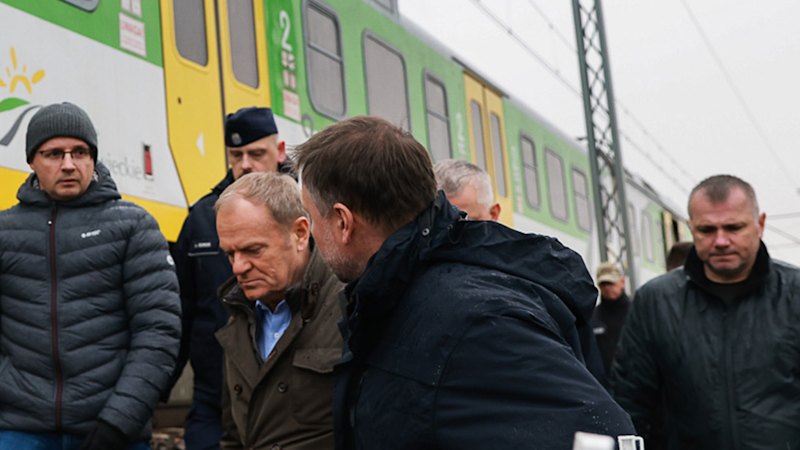
“Those who ordered this – and everything indicates these are Russian secret services – would very much like to know which direction the investigation is being taken,” Dobrzynski told reporters in Warsaw. He referred to a probe undertaken by the police and Polish counter-intelligence, who are securing evidence and collecting information about the rail incidents.
Kremlin spokesman Dmitry Peskov rejected the accusation. “It would be very strange if Russia were not the first to be blamed,” he said, adding that “Russophobia is flourishing” in Poland.
Military-grade explosive
Tusk said on Monday that a military-grade C4 explosive device was detonated on 15 November at about 9pm near the village of Mika, about 100 kilometres from the capital.
Damage was also discovered along the same rail route, which is a crucial link connecting Warsaw and the Ukrainian border crossing at Dorohusk, that has been used daily to carry passengers and Western aid to Kyiv since Russia’s full-scale invasion began.

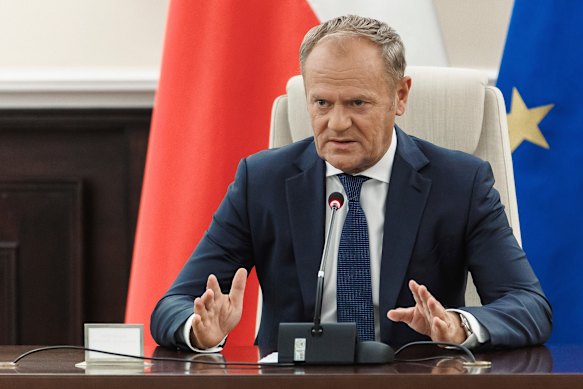
Polish President Donald Tusk has ordered increased security measures along certain rail routes.Credit: AP
The explosion, which happened as a freight train was passing, caused minor damage to a wagon floor. It was captured on CCTV. Tusk said the train driver did not even notice the incident.
A previous attempt to derail a train by placing a steel clamp on the rail had failed, he added.
In the second incident, on Monday, a train with 475 people on board was forced to perform emergency braking due to damaged railway infrastructure, Tusk said.
He said he would issue an order to raise the alert level on certain railway lines.
One of the suspects was convicted in May of sabotage by a court in Lviv, while the other was a resident of the Donbas region in eastern Ukraine, Tusk told parliament. They both arrived in Poland from Belarus in the northern autumn, he said.
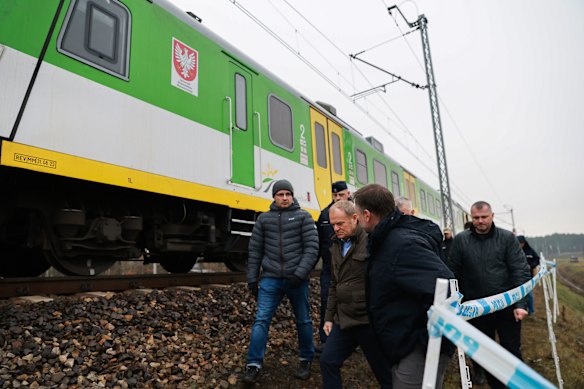
Donald Tusk visits the scene where a passenger train was forced to come to an emergency stop.Credit: Getty Images
NATO was in close contact with Polish authorities and would await the outcome of the investigation, Secretary-General Mark Rutte said on Monday. Since the invasion of Ukraine, the alliance has been grappling with an onslaught of cyberattacks, signal jamming, sabotage and misinformation campaigns attributed to Russia.
The drone incursion in September prompted the unprecedented decision to deploy fighter jets to shoot down the unmanned aerial vehicles, which appeared during a massive Russian air strike on Ukraine.


