








Opinion


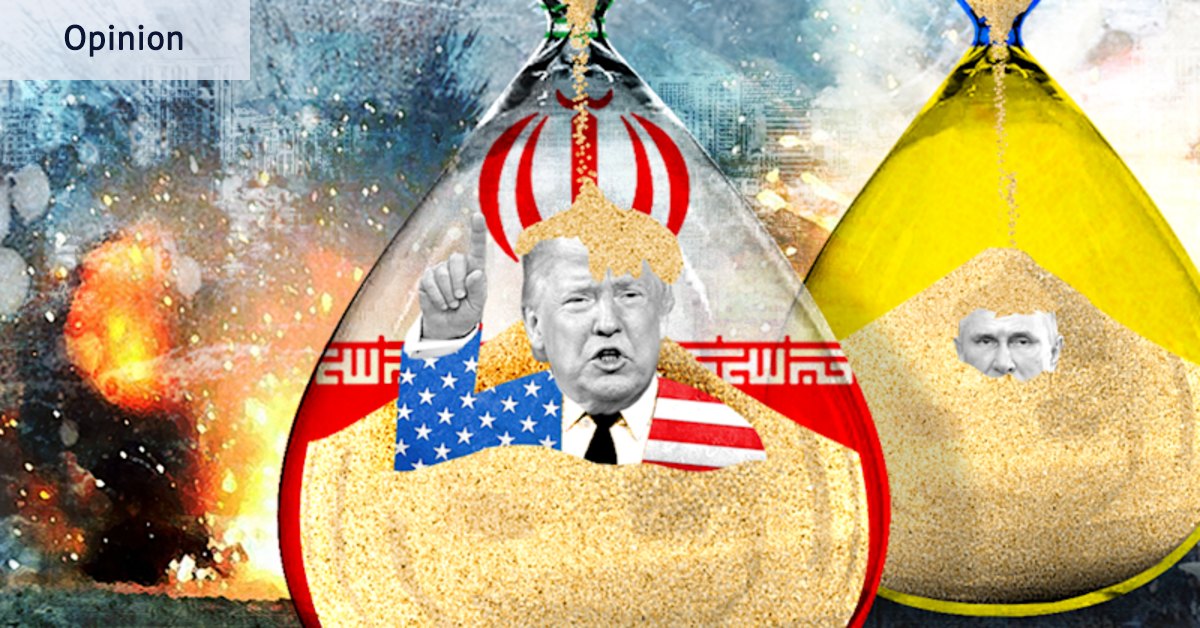
Great powers are prone to great delusions. Vladimir Putin thought he’d defeat Ukraine in three days. The Pentagon believed him. The war is now in its fifth year.
Donald Trump allowed a little extra time for his planned war on Iran. He was confident of defeating the Islamic Republic in four days, according to a credible expert. It’s now halfway through its fourth week.
The war is turning out to be full of surprises for the American president. First, before the war began, his administration assured anxious officials in Turkey that the US-Israeli assault on Iran would be over in four days, says Asli Aydintasbas, a Turkish scholar with the Brookings Institution in Washington.
The administration had convinced itself that if Supreme Leader Ali Khamenei were removed, the entire Iranian regime would collapse in short order: “Trump wanted to carry out a hit-and-run move, and now he is stuck in an open-ended war,” she says.
Trump should not have been surprised. His own peak intelligence adviser had told him not to expect the regime to fall: “A classified report by the National Intelligence Council found that even a large-scale assault on Iran launched by the US would be unlikely to oust the Islamic republic’s entrenched military and clerical establishment,” reports the Washington Post.
The intelligence assessment had been informed by a raft of government experts on Iran. It seems Trump consulted no Iran specialists anywhere inside or outside the government.
Bloomberg, however, reports that he was urged by the well-known authority on Iran, Rupert Murdoch, and Israeli Prime Minister Benjamin Netanyahu to attack Iran. Should we be surprised that the president who advised his population to try injecting bleach to cure COVID also did no homework on going to war?
Second, Trump publicly expressed “surprise” that Iran took the opportunity of the war to strike out at its Arab neighbours in the Gulf. Tehran has launched thousands of missiles and drones at them, as well as assaulting Israel.
Third, Trump said he’d been “surprised” to learn how big Iran’s navy was. Seriously.
Fourth, Trump was surprised that Iran closed the Strait of Hormuz. He blithely brushed aside the warning from his senior military adviser, the chairman of the Joint Chiefs of Staff, General Dan Caine, that Tehran might do exactly that.
“Trump acknowledged the risk,” reports The Wall Street Journal, but “told his team that Tehran would likely capitulate before closing the strait – and even if Iran tried, the US military could handle it.”
All of these casual assumptions and hubristic claims no doubt help explain why Trump was still fumbling in search of an oil supply plan after more than three weeks of fighting.
Fifth, after abusing and threatening America’s allies for years, Trump seemed surprised when none rushed to send their navies into the Strait to escort oil cargoes through the gauntlet of Iranian fire.
The evidence is piling up – Trump has no idea what he’s doing. Which helps explain why he contradicted within 24 hours his Friday (US-time) statement that he was considering “winding down” the war – and, instead, issued his Saturday ultimatum to escalate the war by obliterating Iran’s power stations unless it reopened the Strait. Tehran responded defiantly. It threatened to wreak yet more havoc on its neighbours’ power supplies.
This was the moment where global markets made a decisive shift. Investors had been preoccupied by the fear that oil shortages would fuel worldwide inflation. But market fear of inflation is now overshadowed by fear of a collapse in global economic growth. The analysts at Hong Kong-based Gavekal economic research called it “the end of optimism”.
The war was veering out of control and America had no idea what it was doing.
Iran’s fundamentalist Shia rulers established the Islamic Republic in 1979 specifically as the headquarters of resistance to the US and Israel. So when Israel assassinated its leader on day one and then worked with the US to eliminate Iran’s air defences soon thereafter, the regime didn’t draw up its articles of surrender. It enacted its doomsday plan.
Implicitly conceding that its existence was in jeopardy, Tehran is simply inflicting as much damage as possible on everyone and everything it can reach. It figures that this might work to extract unbearable pain from its enemies, and, if not, what does it have to lose?
Iran continues to deliver surprises to the US and the wider world. It managed to hit a US F-35. The pilot was unhurt, but the plane was forced into an emergency landing. It’s the first known combat damage to the plus ultra of the West’s military aircraft.
And on the weekend, Iran’s launch of two intermediate-range ballistic missiles revealed that it covertly had developed the reach to strike London, Paris, and most of Europe.
The US had demonstrated in Iraq and Afghanistan a genius for tactical military brilliance accompanied by strategic and political stupidity. Trump, we clearly see, learnt nothing from America’s glaring failures of the last quarter-century.
In fact, he’s brought a new level of supercilious recklessness to American warfare. What is this Icarus syndrome that leads Putin and Trump to so woefully misjudge their opponents and overestimate their own capability? When they fly so close to the sun, the heat seems to affect their brains and melt their wings.
Putin had always condescended to Ukraine as inferior. As early as 2009, Putin blustered that he represented Big Russia and Ukraine was “Malorossia”, little Russia, and subordinate to Russian will.
Trump considers Iran to be “the loser of the Middle East”, requiring his special brilliance to “Make Iran Great Again”, as he put it. But, after he survived an assassination attempt, he also considered himself to be ordained by God with special purpose.
Even before that, he’d bragged that he could “do anything” with women and get away with it, which, so far, he pretty much has. This same grandiosity now also infects his approach to foreign policy. “I could do anything I want” with Cuba, he said a week ago.
The ancient Greeks could have told Putin and Trump that the inevitable chaser to the heady potion of hubris is nemesis. But both probably would seek consolation in Julius Caesar’s temporising: “It’s only hubris if I lose.”


