


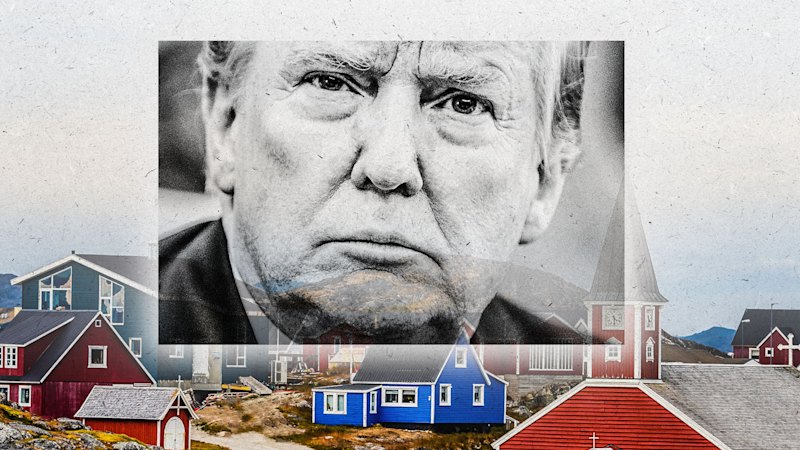
US Secretary of State Marco Rubio is expected to meet foreign ministers from Denmark and Greenland in Washington on Wednesday to discuss the US’s ambitions.
Jardine said his company’s experience with the zinc project confirmed the high cost of mining in Greenland when new projects need transport links, energy, labour and political certainty to succeed.
“They’re not issues that will be fixed simply by changing the flag,” he told this masthead.
The Citronen deposit was discovered in the 1990s and is located on the northern coast of Greenland, about 750 kilometres from the North Pole and further north than the US military base at Pituffik, formerly called Thule.

Daniel Mamadou, managing director of Energy Transition Minerals.
The project gained support in 2021 from the Export-Import Bank of the United States, a government agency known as EXIM, in a non-binding plan to provide up to $US657 million ($979 million) in debt.
The loans were never issued, however, because the cost structure of the project was too high to secure equity investors, a necessary step for EXIM.
“Debt is relatively available, and government debt is available, but when you go to do project equity it is much, much harder,” Jardine said.
“As a company and a collective of people, we probably overcommitted to trying to make that project work … And there comes a point where sinking more and more time, energy and capital into it is just the wrong decision. So we are leaving with our heads held high.
“I’m sceptical that any of these geopolitical concerns will change project outcomes when investors come to the point of needing to write very large equity tickets.”
Loading
The experience is a reminder of the obstacles to major projects despite the promise of loans from government funds that are guided by strategic as well as financial goals.
EXIM said last October it was willing to lend $US2.2 billion to Australian rare earth companies including Arafura Rare Earths, Northern Minerals and Sunrise Energy Metals – but the companies have to meet key conditions to gain the loans.
Skylark, previously known as Ironbark Zinc, has a market value of $35 million on the ASX. Its shares rose above $6 in the wake of the EXIM announcement, but have since fallen below 30¢.
Jardine said the company was now focusing on more promising projects outside Greenland, and he cautioned that exploring for minerals in the Arctic territory cost about 10 times that of similar work in Australia.
Loading
Energy Transition Minerals sued the governments of Denmark and Greenland for $US11.5 billion three years ago when the Greenland parliament passed a law to ban uranium mining.
While the company sought to mine rare earths and not uranium, its project fell foul of the law because there are small amounts of uranium in the ore at Kvanefjeld.
Energy Transition Minerals has a market value of $386 million on the ASX. It announced last Friday that it had hired Ballard Partners as strategic advisers in Washington DC. Its lawsuit continues in the courts after an arbitration tribunal ruled last October that the Danish government should not be a party to the case.
Mamadou told this masthead that barriers to mining in Greenland were not insurmountable.
Loading
“Greenland unquestionably has the geological endowment to develop critical minerals,” he said.
“The question is whether the policy and governance framework can consistently support long-cycle, capital-intensive mining projects.
“Our experience highlights that the key challenge is not geology, but uncertainty.”
Another Australian company, European Lithium, has a stake in a project in Greenland through a US company, Critical Metals Corporation, which is seeking to mine the Tanbreez rare earth deposit in the far south of the island.
Loading
The companies announced on Friday that work would start on a pilot plant at the Qaqortoq site.
European Lithium, based in Perth, saw its shares rise as high as 48.5¢ last October, in the months after Critical Metals gained a letter of intent from EXIM to lend money to the Greenland project. The share price has since fallen to 27¢.
Get a note directly from our foreign correspondents on what’s making headlines around the world. Sign up for our weekly What in the World newsletter.
