








New York: Pictorially, Donald Trump had a blockbuster 24 hours. One minute he was in Busan shaking hands and signing deals with Chinese President Xi Jinping, the next he was back at the White House, handing out Hershey chocolate bars to children for Halloween.
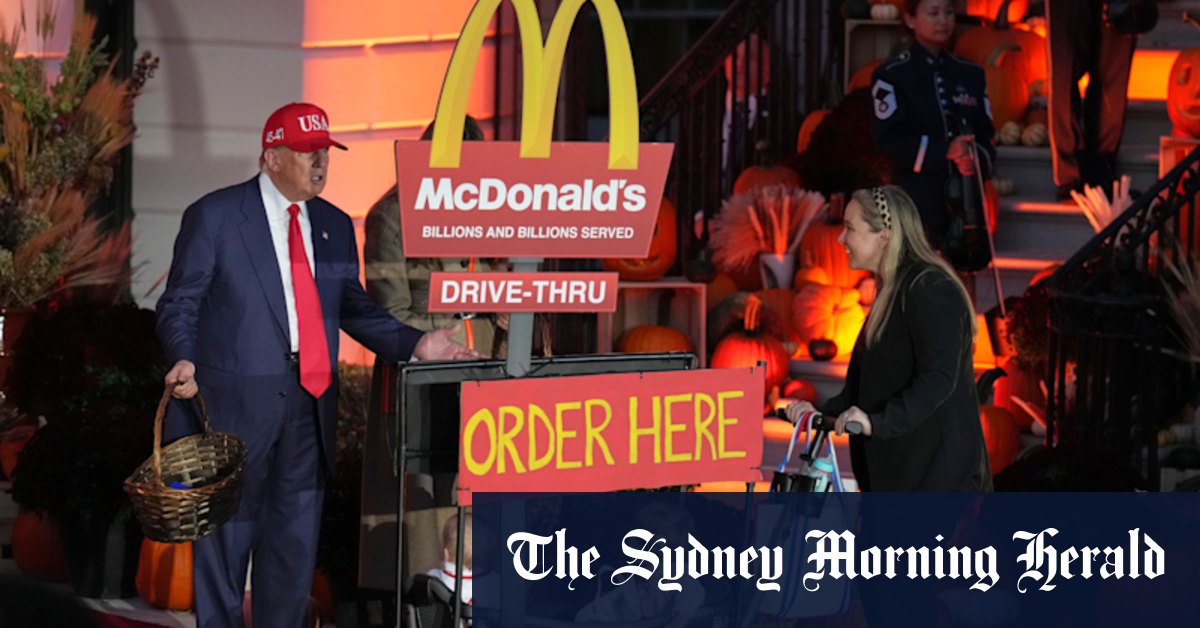
That included a pair of babies whose costume – a pram decked out as a drive-through McDonald’s – obviously won the cheeseburger-loving president’s heart.


President Donald Trump was handing out Halloween chocolate to children within hours of arriving back in Washington from Asia.Credit: AP
In their usual style, Trump and his team cast his six-day Asia trip as a superlative success. “President Trump remains the greatest dealmaker in the world,” the State Department posted on social media. Scott Bessent, Trump’s treasury secretary, said his boss was “commanding respect around the world like no other leader”.
Whatever Trump did in Malaysia and Japan, it was always going to be his sit-down with Xi – his first since 2019 – that mattered most. On the surface, there was much to like about the trade war “truce” between the world’s two largest economies. The much-anticipated meeting has ostensibly delivered a year-long reprieve from the on-again, off-again battle between Trump’s tariffs and Xi’s coercion on rare earth minerals.
It will certainly be welcome news for America’s soybean farmers, who depend on Chinese buyers for their livelihoods and were begging Trump for relief. China has now agreed to buy 12 million tons of American soybeans from now through to January, and then 25 million a year.
Caleb Ragland, a ninth-generation farmer whose Kentucky farm this masthead visited in April, praised the agreement as “a meaningful step forward to re-establishing a stable, long-term trading relationship”.
Trump himself rated the meeting a “12” out of 10, and agreed to cut US tariffs by 10 per cent, from a putative total of 57 per cent to 47 per cent.
But experts say that behind the flashy headlines and photographs, this détente has come at a hefty price. Xi would be emboldened by the outcome, says Julian Gewirtz, who was the senior director on China and Taiwan affairs on Joe Biden’s National Security Council, and is now a scholar at Columbia University.
“The meeting between President Trump and President Xi has been widely interpreted as a return to the status quo, but unfortunately for the US it’s worse than that,” he says. “The reality is that although some of the recent escalation has been put on pause, China has still put its significant new weapons on the table. And while it has said it will not use them for a year, we know that the possibility of this temporary truce not holding for a year is all too high.”

The meeting was heralded for cooling the trade war between the world’s two largest economies.Credit: AP
While the meeting was not as bad as it could have been, Gerwitz says, “much of the world will be reinforced in their view that China is winning this standoff between the United States and China, and that the US has not demonstrated that it has a coherent China strategy”.
Trump’s strategy with Beijing – as with the rest of the world – has effectively been to bet that the size and power of the US market is so great that other countries will be forced to cave to American demands to avoid tariffs and keep selling as cheaply as possible to the American consumer.
It has, by and large, worked. Even if many of Trump’s “deals” around the world have involved vague, long-term investment pledges – or repackaging existing endeavours as fresh commitments – world leaders have generally been anxious to ink a deal with Trump and claim a win to their own constituencies, just as Trump does.
Even Australia played this game by relaxing rules about the import of US beef products, and a critical minerals deal signed at the White House last week.
But in China, Trump faces a great power with comparable – perhaps even greater – leverage. As the gatekeeper in charge of 90 per cent of the world’s critical mineral processing, Beijing knows it “holds the cards”, to use one of Trump’s favourite expressions. The rapid demise of his 145 per cent tariff on Chinese goods earlier this year, which he quickly admitted was unsustainable, stands as testament to that reality.

Trump has enjoyed a positive run on the international stage. Back home, he may soon preside over the longest government shutdown in US history.Credit: AP
One of Trump’s apparent achievements in Busan was a one-year delay to sweeping restrictions on rare earth exports announced by China in the lead-up to the meeting, which most analysts viewed as a bargaining chip. Wendy Cutler, senior vice president at the Asia Society Policy Institute in Washington, said Beijing will likely keep using the threat as “a hammer over the US’s head”, making Trump’s tariffs threats less credible.
“The announced outcomes do little to resolve underlying structural issues that are at the heart of our bilateral economic tensions, including excess capacity, excessive subsidies, and unfair trade practices. As such, this truce may be short-lived,” Cutler said.
“Unlike the ‘phase one’ trade agreement concluded during Trump’s first term, this time around Beijing drove a hard bargain insisting on getting paid for every concession it made, particularly regarding reducing tariffs and unwinding shipping fees.
“This is in sharp contrast to the other trade agreements that Trump has concluded in recent days, which were heavily tilted in the US’s favour. Trump has met his match with China, which has shown that two can play at this game.”
Trump intends to head to China for another Xi meeting in April, and welcome the Chinese leader to the US at some point after that. He remains confident of cutting a final trade deal.
For Australia, the Trump-Xi encounter – as well as from Albanese’s successful meeting last week – should expel any notion that Trump is a China “hawk” who will look poorly on Canberra for cultivating a better relationship with Beijing.

Chinese President Xi Jinping departs the meeting in Busan, South Korea, in his presidential limousine.Credit: Getty Images
Gewirtz says there is a lingering view among some in Washington that because the first Trump administration helped foster a bipartisan appreciation of China’s threats to American interests – such as its military buildup, technological prowess and stranglehold on rare earths – the second Trump term would continue in that vein.
But it has been markedly different, in part because – as the Asia Group’s Mira Rapp-Hooper wrote in the journal Foreign Affairs this week – policy is no longer being co-ordinated by a whole-of-government approach led by the National Security Council but by a small coterie headed by Trump.
“The reality is that in this term, across the board, Trump has done what he said he was going to do, [including] pursue a ‘big, beautiful deal’ with China. And he has made clear again and again over the course of 2025 that a deal is his priority,” Gewirtz says.
“From Beijing’s perspective, they’ve seen this show before and are, I think, girding themselves for whatever point this truce ceases to be the order of the day.”
That day may come sooner rather than later. Trump’s dealings with China are, like his presidency writ large, characterised by sudden, severe changes of heart. This is likely to be, in wartime parlance, a ceasefire, not a permanent peace.


