


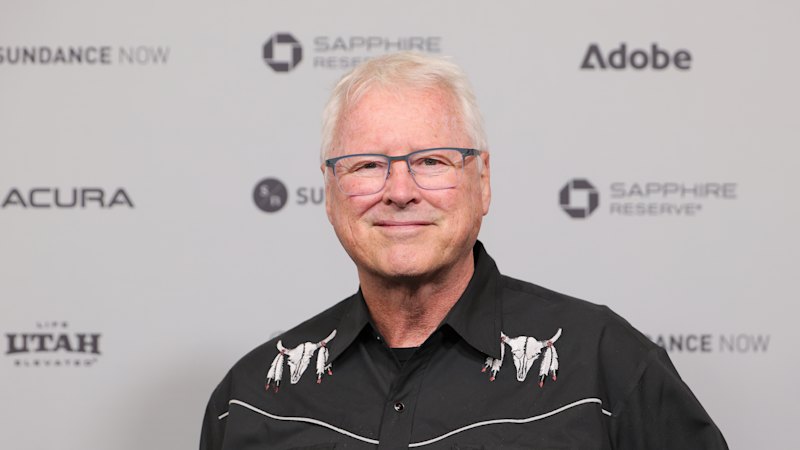

Veteran ABC journalist Tony Jones has just returned from the Sundance Film Festival where his documentary Sentient – an exposé on the reality of animal testing in laboratories, and the impact it has on both animals and testers – had its premiere to strong reviews.
Fitz: Tony, good to chat. I assure you I won’t ambush you in this interview, much, by first getting you onto the sad demise of Q+A, but do you miss it?
TJ: I do, from time to time. But actually, to be honest, I think the country misses it, not just me. It was a such a unique program on Australian television, a chance for ordinary folk to come and sit in an audience and ask really serious questions to a great range of people, including the highest-level politicians.
Fitz: Oh go on, throw me one sausage! Why did the most agenda-setting program on Australian television crash and burn after you left?
TJ: I don’t know. Maybe it had come to its natural end. I really don’t quite understand why that happened. I feel very sad about it.
Fitz: You’re being very diplomatic.
TJ: [Laughing.] That’s the role of a Q+A moderator, isn’t it?
Fitz: I’ll take that as a comment. [TJ: (Eyeballs roll.)] Meantime, I couldn’t help noticing your executive producer on this documentary was none other than your fine wife, the ABC’s 7.30 host, Sarah Ferguson. What was that like at the first production meeting? Did one or the other say, “Hang on, don’t I know you? Haven’t we had breakfast together for the last 35 years? Haven’t we raised three fine sons together?”
TJ: [Laughing.] Sarah’s role as an executive producer was profound, and right from the beginning of the project. Working with her has been one of the great pleasures of my career. So, for me, becoming a kind of late-career film director has been quite something. To be able to do it with your beloved wife even better. And it was fantastic being together at Sundance, on the press line, as people threw questions at us. There are 16,000 films submitted for consideration to be in competition at Sundance, and we were obviously one of the very lucky few who made it into competition in the World Cinema Documentary Competition. We didn’t win, but we won by being there.
Fitz: The reviews certainly said so. I particularly agree with the take of that influential publication, The Playlist.
“In the best possible way, director Tony Jones has created the documentary version of a car crash; you don’t want to look, but you can’t bring yourself to look away. [A+]”.
Where did the idea to do it come from?
TJ: A few years ago, one of the guests on Q+A was the famous Australian philosopher and ethicist from Yale, Peter Singer, who also wrote the most influential text for the animal rights movement, called Animal Liberation. On the program he said, “Sometime in the future, we will come to see how we treat animals today in the same way that we look at slavery in the 16th, 17th and 19th centuries.” Everyone gasped, but I went away and started to do research into the sentience of animals, the new science as to how much animals feel – not how they think or how smart they are, but what they feel.
Fitz: People like me, who eat chicken, lamb, steak and fish, don’t want to think about the animals our meals come from, but if we do, choose to believe they are not particularly sentient. The real premise of your documentary is not only that terrible, terrible things are happening around the world to tens of thousands of animals in laboratories – particularly macaque monkeys – not as a quick death at an abattoir, but over many weeks and months. Is that a fair summation of your doco?
TJ: Yes. The way we set it up is through the life of a woman called Dr Lisa Jones-Engel. I would describe her as the Jane Goodall of macaque monkeys, because she’s trying to do what Jane Goodall did for chimpanzees, which is have them taken out of cages and experimental laboratories. But before that, she spent a whole life working with apes and monkeys, and she got to know very well the nature of these creatures.
Fitz: She makes a strong case that in so many things, these monkeys are just like us, and spend shocking lives of not just being effectively tortured themselves, but with the added distress of seeing it happening to all those around them, including family members, and are suffering terribly.
TJ: Yes, and she maintains that we are complicit in their suffering, as pretty much everything that goes into our bodies is tested on animals – and the primary animal, the one closest to us since they took chimpanzees out of the equation in 2015, is indeed the macaque monkey.
Fitz: I found some of the footage very upsetting, most particularly some of the old footage you got from archives of a mother chimp fighting to protect her three babies, who keep clinging to her, even after she is felled by a needle, only to be torn from her breast. The horror, oh, the horror. If we saw someone do that to humans, they’d be put in prison, but this kind of thing is now done on an industrial scale across the world. The footage you have of the monkey farms in Cambodia, with 80,000 monkeys in a single facility – were you shocked by the scale of it?
TJ: Absolutely. It’s a hidden industry, a massive one, and one that involves billions and billions of dollars in order to source the monkeys for laboratories run by these large pharmaceutical companies. Over time, they’ve strip-mined the forests for macaque monkeys. People go and capture them and bring them to these facilities, to add to the ones bred there. So from there, they’re put in these coffin-like boxes and transported to airports. They sometimes spend 20 to 30 hours on aircraft, and then they land at the other end, at the facility that’s bought them.
Fitz: And there, they are divided up into four groups. First group gets none of the new drug. Second group a small dose. Third group of a big dose. Fourth group gets an overdose. Now, pass the clipboard, let’s observe closely what happens to all of them …
TJ: That is exactly the process of testing. And with those massive overdoses, they’re trying to find what would happen if you gave a human this level of this particular substance. So to do it, you have to poison the fourth group, in a serious way. And none of the animals survive this process. Even the ones that get nothing are taken at the end to what they call necropsy, the place inside these testing laboratories where the animals are killed and they take their organs for further examination.
Fitz: “Killed”?? They’re not “killed”, Tony. Please. They’re “euthanized for scientific purposes”!
TJ: Indeed. I don’t think anyone’s seen anything like this in terms of what we might call undercover footage.
Fitz: And yet you are very careful in the whole documentary to present the case for this testing to go on. Most compelling was from one of the pioneers of the industry, Professor Jim Mahoney, who said: “Do we have a right? No, but we have a need.”
TJ: Yes, he said that when he’s a younger scientist. But when he retires, years later, he decides he made a mistake there. He says it’s all wrong, and it went wrong from when we put them in cages in the first place.
Fitz: Indeed, as we now have macaque monkeys – used to having a habitat larger than 700 football fields – actually living in a space no larger than a telephone booth, before being tortured to death and then killed. But then you give a big platform to Dr Cindy Buckmaster, an animal testing industry leader, who says: “Don’t talk to me about the ethics of testing on animals. Talk to me about the ethics of not testing on the animals.” Her point is that if we don’t test on these animals, people are going to die of cancer and terrible diseases that they don’t need to. If not for those animals, we wouldn’t have so many vaccines that save so many lives.
TJ: Yes, Dr Buckmaster worked for many years as a lobbyist for the pharmaceutical industry, for the biomedical industry, so she goes around the country talking to groups of workers about how what they’re doing is for the greater good of humanity. She says, “You are heroes. You’re the reason that a six-year-old with leukemia gets to be seven.”
Fitz: You have indeed presented both sides of this whole story. But let me take you back to that famous journalistic aphorism: “If someone says it’s raining, and another person says it’s fine, it’s not your job to quote them both. It’s your job to look out the f—ing window and find which one is true.” So my final question to you, is it right to do this kind of industrial level animal testing, or is it wrong?
TJ: Well, Peter, I’m going to disappoint you slightly, but one of the things that the Sundance audience was most surprised about is that the film is balanced. It tries to allow both sides to put their arguments for and against animal testing, and then we leave it up to the audience to make their own judgement.
Fitz: Fair enough. But now I am asking you for your judgement. You put it together, and have no doubt left more appalling footage than a mass audience can stomach on the cutting room floor. Is it right or wrong?
TJ: [Singularly long pause.] The answer requires some soul-searching. It would be hypocritical of me to say that I will stop taking medicines which I now know have been tested in these appalling and confronting circumstances. But what happens in these testing labs is the industry’s darkest secret. That’s why they refuse to allow cameras in to record what happens there. Our film pulls back the curtain on that. For our own good and for the sake of the abused creatures we see in our film, we need to demand that these companies urgently invest in the new science that will inevitably replace the use of animals.
Fitz: That works for me, thank you, and in the meantime I look forward to seeing you and Sarah over a leg of lamb, shortly.
Sentient appears at Antenna Documentary Film Festival (5-15 February), and will stream exclusively on DocPlay later in 2026.
Start the day with a summary of the day’s most important and interesting stories, analysis and insights. Sign up for our Morning Edition newsletter.
 Peter FitzSimons is a journalist and columnist with The Sydney Morning Herald.Connect via X.