


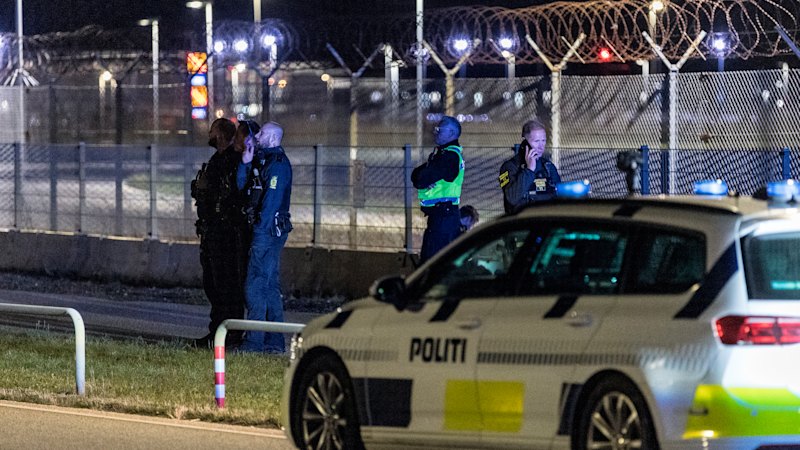
A single night of calculated mayhem left at least 20,000 passengers in chaos when a small number of drones flew over Copenhagen airport and forced authorities to ground dozens of flights. The chaos came to Oslo airport soon afterwards, and then to smaller airfields. Within days, there were drones over military bases in Denmark and Norway.
Europe was suddenly reminded of its total exposure to airborne malice. The chronic disruption in September forced national leaders to step up their work on drone defences. The European Union quickly updated its defence plans to pledge more spending on systems that could intercept drones and force them to the ground. Leaders even talked about a “drone wall” to stop attacks.
But none of that helped Belgium’s Brussels Airport on Tuesday or Thursday this week when it had to ground flights after drones were seen around the runway, which it shares with the Melsbroek military air base. Nor Sweden’s second-largest airport, Gothenburg-Landvetter, which halted traffic on Thursday and started a sabotage investigation after drones were spotted there. Week after week, the drones keep coming – and authorities are struggling to stop them. Amsterdam was targeted in September, Munich in October.
The events force urgent questions about the cost and capacity of new technologies that can protect people and essential infrastructure. Some of the answers come from Australia.
“No civilian airport in the world, to my knowledge, has a fully deployed counter-drone system,” says Oleg Vornik, the chief executive of DroneShield, a company based in Sydney that exports systems to stop drones. He knows of many projects under way, and his company is part of the work at airports and other sites, but he does not describe these systems as full defences. Not yet, at least.
Another Australian company, Electro Optical Systems (EOS), is making drone defences in Canberra and exporting them at a rapid rate. Its chief executive, Andreas Schwer, is watching what happens in Europe because he expects it to keep happening. Like many others, he sees drones as an emerging “hybrid” threat from hostile nations.

Passengers look at a departure board after cancellations and delays following the latest drone incursion, this time over Brussels Airport this week.Credit: AP
“Those kind of threat scenarios are extremely hard to defeat,” he says. “Why? Because those kinds of drones can be launched from anywhere. In the case of Copenhagen, it looks like they were launched from a vessel close by. They fly 30 or 40 kilometres, they do the mission over a few hours, and then they can return to the vessel and nobody knows where they came from. We have to expect this to happen more frequently in the future.”
The timing points everyone to a natural suspect. Russian drones flew over Poland two weeks before the Copenhagen incidents, in a startling move that led NATO to scramble fighter jets to shoot them down. At least one Russian drone flew over Romania. These were military alerts directly linked to the war in Ukraine, but Western military officials do not regard them as accidental incursions. After all, three MiG fighters also flew over Estonia.
The overwhelming belief is that Russia is testing Western defences. And it has help from allies: the drones that bombard Ukraine use motors and electronics made in China, based on designs from Iran, and sometimes using explosives from North Korea. There is even speculation that North Korean labourers will work at Russian factories to help increase drone production.
At the same time, Chinese ships have sailed from Russia and been accused of dragging anchors in the Baltic to cut major communication cables on the sea floor, disrupting phone and internet traffic. Cyberattacks are routinely sourced to Russia, China and North Korea. The hybrid threats are increasing.
The danger, in other words, is not limited to Europe. The drone arms race is global. Liberal democracies are waking up to the need to work together. This is galling for those who could see the way such cheap consumer technology – small motors, propellers and frames – could be exploited for such costly disruption.
“The really astonishing thing in all of these drone shutdowns at airports is that we’ve known about this problem for a decade,” says Keir Giles, a senior consulting fellow at Chatham House in London and a director of the Conflict Studies Research Centre. His most recent book, Who Will Defend Europe?, examines the threat from Russia.
“These major European airports don’t have the means to mitigate, or sometimes even detect, the drone incursions,” he says.
“It’s an astonishing lapse in security, so of course there are going to be more attacks. It’s not just Russia that recognises that this is a major vulnerability for Europe, where they can cause enormous amounts of disruption for very little investment. Also, you’ll have any number of local idiots cottoning on because they enjoy the drama.”
It would be wrong to say that nothing was done. Gatwick Airport, near London, grounded hundreds of flights seven years ago after drone sightings over two days, in what police called a malicious attack. Australian authorities acted soon afterwards to tighten controls at airfields. Even so, it is clear that stronger defences will be needed.

A mobile radar installation deployed on the Danish coast following a string of unidentifed drone incursions in September.Credit: AP
More radio frequency (RF) systems, for instance, could detect drones in and near airports and other essential services. In a white paper released last month, DroneShield and consulting firm SRI Group called this the foundational layer for defence.
“RF sensors can identify the presence of drones by detecting control links, telemetry transmissions, or video feeds, often providing early warning before the drone becomes visible or enters restricted airspace,” they said.
The next layer of defence uses RF systems to jam a drone and force it to the ground. But these systems may not be enough, so there is a case for using radar and optical systems to detect intrusions.

A “no drone” sign outside the perimeter of Brussels Airport after more drone activity this week.Credit: AP
When it comes to taking down a drone, the equipment seems lifted from a sci-fi movie. One of the DroneShield products, called the DroneGun, looks like a handgun at one end and a chunky black tube at the other. Once hit with the radio waves, the drone should fall to the ground or return to its base.
Loading
The systems from EOS include the Slinger, which looks a little like one of the swivelling cannons from Star Wars. It can be fitted to the back of a vehicle and includes radar and a 30mm cannon to hit drones with ammunition. Another product, the Apollo, uses light waves. The company says the laser weapon can kill 20 drones a minute over a range of up to three kilometres.
Hundreds of companies are now working in this field, some of them producing drones and some making the defences. The Department of Defence chose 11 Australian suppliers last year to develop uncrewed aerial systems, and some companies are enjoying surging sales and soaring share prices.
DroneShield increased its sales to $92.9 million in the three months to September 30, up from $7.8 million in the same period last year. Its share price shot up at the time of the September airport disruptions and then fell back, but the stock is nonetheless five times higher than it was at the start of the year. The company is now worth $3.6 billion.
EOS recently announced an order for its Apollo laser weapons from a NATO member state, which it will not name, worth $125 million over the next three years. The company’s revenue has been lumpy, partly due to corporate restructures, but its market value has climbed to $1.2 billion. Its share price has risen fivefold over the year to date.
The stocks are up because the entire industry is surging. There are no guarantees that the Australian companies will ride the global boom to success; anyone who remembers the tech booms of the past will know that failure comes with the territory.
Will this make Australians safer? Unfortunately, nobody is promising an electronic shield that can stop every drone.
European Commission President Ursula von der Leyen spoke about a “drone wall” in September, in a sign of the urgency around the work to build defences against Russian incursions. In the weeks since then, however, the language has changed because the European Union’s defences are unlikely to be so concrete.
European Defence Commissioner Andrius Kubilius also used the “drone wall” phrase in October but quickly switched to a new term: the European Drone Defence Initiative, which will put billions of euros into new defences. These are meant to be operating in part by the end of next year and in full by 2030. This is much broader than protecting airports because the NATO and EU member states have to take into account direct military threats from Russia.
“The fact that drones could penetrate sensitive airspace over major airports without immediate attribution exposes real vulnerabilities in NATO’s situational awareness and air defences,” says Kateryna Bondar, a fellow at the Centre for Strategic and International Studies in Washington, DC, and previously an adviser to the government of Ukraine.
Loading
“For decades, Western systems have focused on ballistic and cruise missile threats, not on small and medium-sized drones launched covertly from maritime platforms.
“The airport shutdowns are a necessary emergency response, but the wake-up call goes much deeper. Europe cannot view Ukraine as the sole buffer against Russia; it must begin treating this as if the continent itself is already under threat. The next wave of drones may not be reconnaissance but strike-capable, meaning no one in Europe is truly safe.”
The threat will come, over time, from autonomous drones that do not need a ground operator to create havoc. Ukrainian President Volodymyr Zelensky highlighted this in a speech to the United Nations in September that drew on the experience on the battlefield against Russia.
“It’s only a matter of time, not much, before drones are fighting drones, attacking critical infrastructure and targeting people all by themselves, fully autonomous,” he said.
Every advance in drone technology requires a rapid response with stronger defence systems.
Australia faces different challenges from Europe, but it is likely to learn from the overseas threats. One lesson is that Australia will have to race to catch up with foreign drone makers.
“We are 100 per cent falling behind,” Vornik says. “When it comes to small drones, the Chinese have been the innovator. You think of the early adopters and the largest sellers of small drones worldwide, they are Chinese companies.”
Vornik makes the defences, not the drones, so other Australian companies might disagree. The key point is the need to invest in drones and drone defences, while at the same time working with allies.
Another lesson is that protecting Australian airports and other infrastructure will be an expensive project. The interference at European airports has not been matched in Australia, but it could emerge at any time. China has been named as a source of cybersecurity threats, while Iran was held responsible for antisemitic attacks in Sydney and Melbourne. Both work with Russia on drones.
Loading
Schwer, who is investing heavily in lasers at EOS, says Australia has the technology to defend its airspace.
“If you want to protect the most critical airports, air bases, harbours and other critical areas, yes, you can afford it,” he says. “A typical installation of an airport with lasers and cannon-based air defence and other equipment is around $100 million per airport. So yes, you can protect most of the critical assets in your country. That is achievable.”
The danger seems distant at the moment. Australian travellers might be caught up in the disruption at European airports, but they are a long way from home.
Then again, the threat also seemed distant for Europeans. They could watch the media coverage of drone strikes in Ukraine while thinking the war was being contained. Now they are being reminded of their total exposure to drones – albeit, thankfully, without warheads.
It is not possible, yet, to be sure about Russian complicity in the drone intrusions. NATO has blamed Moscow for some of the breaches of allied airspace, but political leaders have been wary about naming Russia as the source of the civilian airport disruptions.
Every airport shutdown now highlights the emerging threat. Like other countries, Australia will have to prepare for malicious damage from cheap drone technology, delivered without a declaration of war.
Get a note directly from our foreign correspondents on what’s making headlines around the world. Sign up for our weekly What in the World newsletter.
