


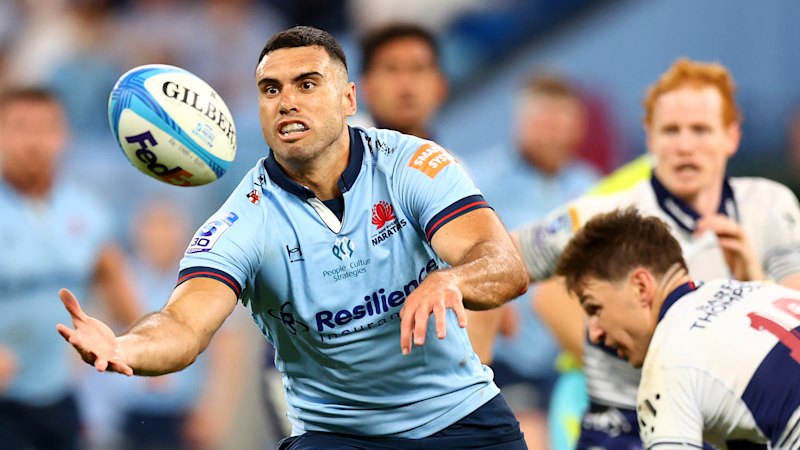

They botched six tries and a winnable game last week but ahead of a potentially season-defining derby in Canberra on Friday, the Waratahs are holding on to the upside of getting repeatedly close against the Blues – and not the lack of cigars.
The Waratahs will need to urgently turn around an alarming drop in strike power to be any hope of upsetting the in-form Brumbies, however, with stats showing their ability to score points in their opponent’s quarter has nosedived drastically since a big opening win over the Reds.
The Tahs led the Blues 20-8 in the second half last Friday and had ample opportunity to push on to win, but they blew four tries with dropped balls near the line, and were held up twice. The Blues swooped home in the last quarter and won 35-20.
It was the Waratahs’ third loss in a row and former NSW captain Michael Hooper said the pressure growing in a season slipping away had appeared to play a part.
“I feel like I’ve seen this movie before, and I’ve been in the movie,” Hooper said on Between Two Posts. “It’s when as a team you feel under pressure … so how does that come out on the field?
“You make a line break, you’re so close to the tryline and you throw the pass that might not be on, because you’re so desperate to score off the immediate line break, or that immediate inroad.
“I’ve been in a couple of teams that have been that way, and in my own head thought that way. You’re under pressure, you want it to happen so bad. But how that displays itself is just pushing things that might not be on, because you need it straight away.”
The Waratahs’ stats in the Blues defeat showed season-high tallies of 19 turnovers and 14 penalties conceded, and season low tallies of tries (2), defenders beaten (12) and points scored per entry into the Blues’ 22 (0.9).
One of the most alarming results for NSW is seen in a stat category regarded by many as critical to a team’s ability to win games, and titles: 22m efficiency. The stat records the percentage of times a visit to the opposing quarter results in points, or being awarded a penalty.
The Waratahs’ 22m efficiency was just 31 per cent, down from 70 per cent in their five-try win against the Reds in round one. Since then, it has declined almost week-on-week. It was only 41.7 per cent last week in the Tahs’ loss in Brisbane.
In five games this season, the Waratahs have averaged just 1.4 points per visit to the 22m, the lowest of all 11 teams in Super Rugby Pacific. The top-ranked side is the Blues, who average 2.8 points per visit. Eight teams average over 2 points per visit.
The side’s average 22m efficiency of 50.4% is the second-worst in the competition. In a positive sign, however, the Waratahs are ranked second for getting into their opponent’s 22m, with an average of 11.2 entries per game. That indicates the Waratahs are still doing plenty right – the forward pack in particular – in retaining the ball and building pressure.
But the inability to convert in the red zone is clearly the major problem, and again the stats point to contributing issues: the Tahs are ranked second for most turnovers (17.4 per game) and the attack appears too reliant on Max Jorgensen – who has scored six of the Waratahs’ 19 tries, and assisted in two others – or the forwards, who have scored nine tries between them.
The Waratahs will be heavy outsiders against the Brumbies, who haven’t lost to NSW at home since 2018. The Waratahs’ hopes of playing in the finals already hangs in the balance. They sit in seventh, three points behind the Chiefs, but are away in six of their last nine games.
Impressive young Tahs fullback Sid Harvey said the team are focussing on learning from the last-pass mistakes against the Blues, while maintaining confidence from the strong lead-up work.
“We could have had probably three or four more tries and had a completely different outlook,” Harvey said.
“There’s probably a lot more belief this week than there was last week, and the week before, within the group of what we can do once we get our process right.
“When we’re at our best, we compete with the best [teams] and are better than them. It’s just when we clock off those 10 or 15 minutes, a couple of phases, teams can hurt us and Brumbies can do that.
“There’s a lot of belief, a lot of trust within each other. It’s just on finishing those opportunities in that zone and winning those games.”
 Iain Payten is a senior sports reporter for The Sydney Morning Herald.Connect via X or email.