


It might preserve American security, however, because Greenlanders can reach their own defence pact with the US. Broberg does not oppose more US forces. Nor do other political leaders. In fact, he believes an independent Greenland would build on the 1951 pact between the US and Denmark that set up the military bases in the first place.
“You can’t continue having a defence agreement between Denmark and the US about the defence of a colony that no longer exists,” he says.
“So, we need to have a defence agreement with the US. If that is the big talking point for the US, that they need something else that they can’t get from the 1951 agreement, we should do that.

Danish military forces participate in an exercise with hundreds of troops from several European NATO members in the Arctic Ocean in Nuuk, Greenland, in September.Credit: Ebrahim Noroozi / AP
“Because that will benefit us, as well as give them peace of mind. We are not the obstacle that Trump needs to remove. Denmark is.”
The 1951 agreement has been updated several times, most recently in 2004 to acknowledge the autonomy of Greenland. This update said the US would “consult with and inform” the governments in Denmark and Greenland on any changes to its military presence.
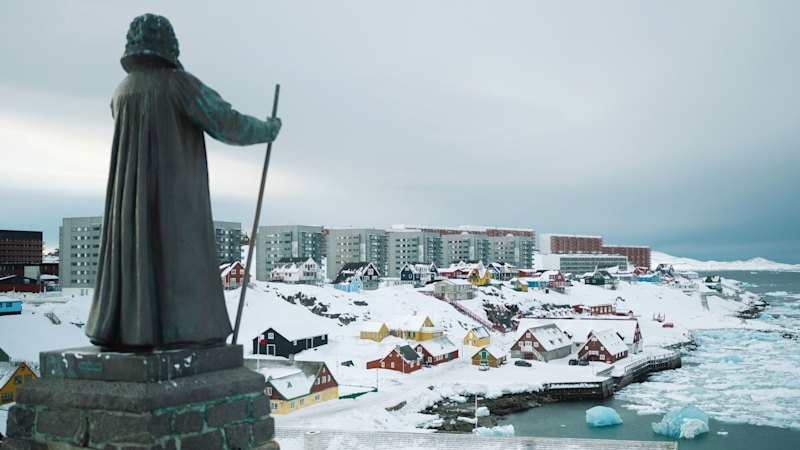
A troubled history shapes the argument over the future. Nuuk, the capital of Greenland, is watched over by a statue of Hans Egede, the Norwegian missionary who colonised the island in 1721. Denmark ruled the colony from the early 1800s, but the Inuit trace their time there to at least 1200, when historians believe they crossed from Canada.
When Denmark and Greenland agreed on self-government in 2009, the law set out a mechanism to decide full independence by a referendum.

Danish forces join NATO troops in exercises in Greenland in September.Credit: AP
Broberg believes that time has come. He raised this last Friday when he joined Nielsen and three other party leaders in making a statement to soothe nerves about Trump’s talk of gaining their territory and even using force to do so.
The statement said: “We will not be Americans, we will not be Danes, we are Greenlanders.”
Broberg calls that a declaration of independence.
“We needed a joint statement to calm the waters in Greenland because people are worried,” he says. “We don’t want to be Danish. We want our own identity back.”
Broberg has risen quickly to become opposition leader. Raised in regional towns on the west coast north of Nuuk, he worked in business before becoming a pilot for Air Greenland. He entered politics in 2018 and became leader of Naleraq four years later. At the election last year, Naleraq gained 25 per cent of the vote; Nielsen’s party, Demokraatit, gained 30 per cent and rules with a coalition.
The cause is personal for Broberg. He is the son of an Inuit father and a Danish mother, and he says he might not have been born if his mother had been Greenlandic. That is because Denmark imposed birth control on Inuit women and girls in the 1960s and 1970s by making sure they were fitted with intrauterine devices, or IUDs.
Loading
“At that point, the genocide against the Greenlandic people was ongoing by the Danish state,” he says. “My mother didn’t get an IUD because she was Danish.”
This is uncomfortable history for Danes, and it was the subject of a formal apology by Danish Prime Minister Mette Frederiksen in September.
In Denmark, the links with Greenland are so deep that many cannot see a future for the island without its mother country. A large group in Greenland, especially in Nuuk, are also loyal to Denmark. Some accuse Broberg of hating Danes and being a racist, but he says those claims are false – and that he simply wants independence.
Trump is bringing this debate to a head. He has identified a problem: control of the Arctic is fundamental for US security, and this requires decisions about Greenland’s destiny.
Observers outside Greenland have raised the idea of copying US policy in the Pacific, where it has Compacts of Free Association with small states like Micronesia and Palau. This requires the US to help fund those states, while it gains broad scope for its military operations.
Loading
Greenland differs, however, in having the legacy of two centuries of Danish culture and control. The colonial history is a source of grief for many, but it also means they gain health and education from Copenhagen and annual funding for other services. Greenlanders can live and work anywhere in the European Union.
Would they be better off with a form of statehood aligned to the US? In Nuuk, some people tell this masthead that losing Danish financial support would be too costly, making full independence impractical.
White House officials have discussed paying Greenlanders for the right to control the island, according to a Reuters report, but there has been no suggestion from Trump or his aides about annual US funding for health and welfare. It is difficult to see Trump’s base, which is sceptical about foreign entanglements, accepting that cost.
Nielsen and his government are not talking about a referendum on independence. This masthead approached government ministers and officials for comment.
Broberg, in contrast, wants a faster move towards cutting the bonds with Copenhagen. He says Greenland has enough resources, such as fisheries and mining, to fund its own future.
Most of all, he argues that the people of Greenland can make independence work.
“We are one of the most coveted territories in the world – by Denmark, the US, and Europe,” he says. “Everybody just seems to forget somebody lives here.”
Get a note directly from our foreign correspondents on what’s making headlines around the world. Sign up for our weekly What in the World newsletter.
