









What in the World, a free weekly newsletter from our foreign correspondents, is sent every Thursday. Below is an excerpt. Sign up to get the whole newsletter delivered to your inbox.
Lviv: I’m writing this week’s dispatch from Lviv, in the far west of Ukraine, where it is possible to walk the narrow streets of the historic centre and feel utterly removed from the war. The shops have put up their Christmas decorations, the central square is beautiful and the traffic moves at a crawl. It is a busy town. If you forget about the world for a moment you can stroll along the cobblestones without thinking about missiles and drones.
But I’m just back from a volunteer centre where people work every day to keep soldiers alive. And I’ve met Nina Synyakivych, a retired teacher, who leads the volunteers in what has become an essential task: making camouflage nets for the army. Seeing them at work, on the third floor of an old building, brings home the fact that this war reaches everywhere in Ukraine.

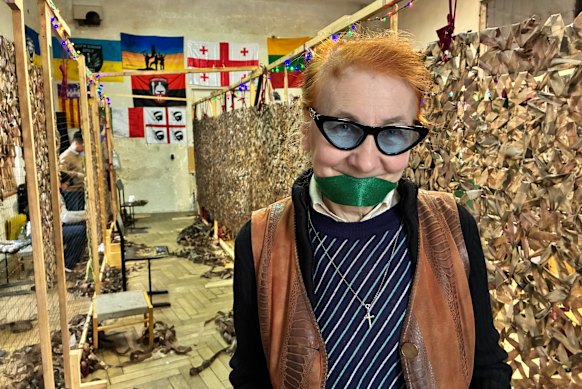
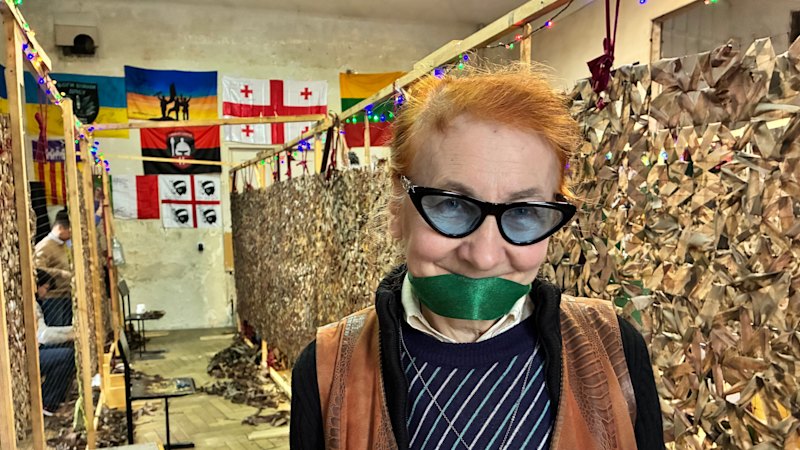
Retired teacher Nina Synyakivych knows the camouflage nets made by her team of volunteers save lives. Credit: David Crowe
“We want to save our soldiers, our defenders,” Nina tells me. “We save those who save us. We make these nets in order to save not only their weapons but themselves as well.”
I’m talking to Nina while she sits at a desk and cuts camouflage material into long strips, each of them two centimetres wide and two metres long. The colour varies but today it is white: the team is preparing for the onset of winter. There are machines to do some of the work but Nina also works by hand with a pair of scissors.
Behind her stand two rows of timber racks, like the supports for an art display. Black netting hangs from the timber while volunteers weave green, brown or white material into the base to create a sheet of camouflage that runs the length of the room. A handful of volunteers thread the material while they sit or stand at the net, some chatting quietly to each other.
Nina knows the camouflage works. She heard from one soldier who was at the front and knew he was being tracked by a drone in an open field, with no place to hide. “He covered himself by our net,” she tells me in English. “He became invisible.”
I’m not discovering anything new here. After getting back to my laptop I find stories about camouflage workshops from three years ago in The Washington Post and NBC News. You could say I’m covering a “stale” story. But I didn’t have a moment to write about these workshops when I was last in Lviv. And the point is that these centres are still so necessary, almost four years into this cruel war.
In fact, the nets are more valuable than ever. The front line is not really a line any more – it is a broad death zone underneath the drones. Checkpoints are covered in nets and so are city streets. Anywhere a drone can reach is the front line. Army trenches and dugouts need acres of camouflage.


