


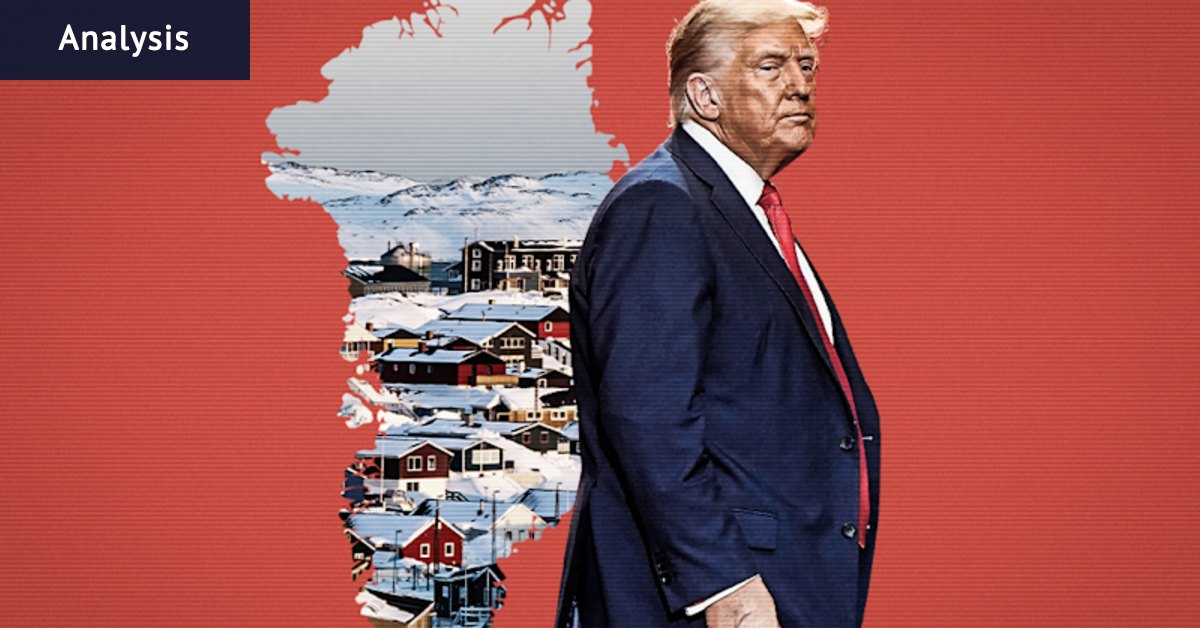
Greenlanders know this. Many follow the news in Danish, English and their Inuit language. They are remote, but connected. Thank the internet for that. They can see through Trump’s fake claims, just as others can.
“It doesn’t make sense saying that he needs Greenland,” Kristian Bernhardtsen, a crane operator, told me in Nuuk last week.

People protest against Trump’s policy towards Greenland in front of US consulate in Nuuk, Greenland, at the weekend.Credit: AP
“He can have bases. We have a base up north, and if he wants to expand it or make other military installations, he’s allowed to. There’s nothing stopping him.”
Everyone can see this truth except Trump and his courtiers.
The US could expand its existing base at Pituffik, formerly known as Thule, in the far north of the island, and build others if it needs. The central fact is that bases in the far north are essential for American missile defence, but it does not follow that buying or annexing Greenland is just as necessary.
Trump’s approach is wild and damaging. He is punishing allies for a disagreement over their mutual security under the NATO pact. We all know who will be chuckling from the sidelines: Russian President Vladimir Putin and Chinese President Xi Jinping. Once again, Trump proves that he brings more conflict and less prosperity to the world.
The commonsense solution would be for Trump to negotiate greater US control over the territory needed for US bases in Greenland, and greater investment in those bases – strengthening the NATO alliance rather than clashing over sovereignty.
There are four main reasons the tariff threat is unlikely to give Trump the “Greenland purchase” he so clearly seeks in the hope of matching earlier American deals on Louisiana and Alaska.
Firstly, the threats lose their menace when they are repeated so often. Trump has tried to wield tariffs against Russia to end the war in Ukraine and against China to get an economic deal. He has threatened them against Europe over its regulation of digital services. He announced tariffs on Britain and the European Union last year, then struck deals. Now he pulls the same lever – and makes a mockery of those trade settlements last year.
The first response from the European leaders, such as British Prime Minister Keir Starmer and French President Emmanuel Macron, was to hold firm. Logic surely tells them that giving in to a tariff threat only encourages Trump to use it again in a later dispute.
Loading
The second factor is that the tariffs hurt American consumers, not just European producers. When last year’s threat was analysed by economists at Bruegel, a think tank in Brussels, the data suggested US output would shrink by 0.7 per cent while the EU would lose 0.3 per cent. The cost of a trade war is significant, but it is incurred by both sides.
Trump and his MAGA movement will have more success at the mid-term elections in November if they can campaign on higher growth and lower prices, not the ownership of the icy north.
Thirdly, Greenland is incredibly difficult to own, whatever the purchase price. It is enmeshed in the Danish realm after two centuries of colonisation. Its people oppose American ownership by an overwhelming majority of 85 per cent. Denmark funds its essential services. The annual “block grant” from Copenhagen is 3.9 billion Danish krone, or about $900 million.
How does Trump control his fractious MAGA supporters when they discover the annual bill to maintain Greenland rather than helping voters at home?
The fourth factor is nakedly political. Trump wants his forces to win an election on November 3, but his Danish nemesis has a deadline as well. Danish Prime Minister Mette Frederiksen, a social democrat who has sparred with Trump for years, has to go to an election no later than October 31 – Halloween.
Rather than cave in to Trump, she will want to paint him as a monstrous threat to Denmark’s future.
Nobody can be sure what Trump will do next on Greenland. He is more dangerous than he was in his first term: less constrained, more confident and newly emboldened by his use of missiles, bombs and special forces.
There is even a chance he could force a rupture in the NATO alliance, which has preserved peace for decades. The best outcome right now would be a protracted discussion about tariffs, with the usual shifting deadlines, and an agreement between allies. This would avoid turning a confected crisis into a real one.
Get a note directly from our foreign correspondents on what’s making headlines around the world. Sign up for our weekly What in the World newsletter.
