





[ad_1]
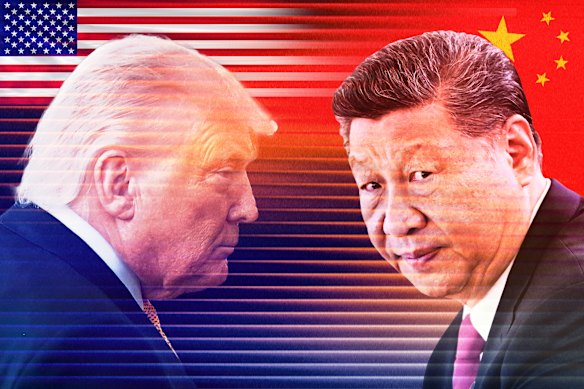
The last time Donald Trump made a state visit to Xi Jinping in Beijing, a fist fight broke out between the two security details as their leaders met in an adjoining room.
A “short scuffle” reportedly occurred as Chinese officials tried to block the entry of a US military aide carrying the nuclear football – a briefcase that enables the US president to command the nuclear codes.
Fleeting though the 2017 incident was, it is well remembered. Just this week, The Wall Street Journal’s chief China correspondent, Lingling Wei, told an Atlantic Council event that the fight had to be broken up by two US and Chinese diplomats.

The Chinese diplomat, she said, was none other than Qin Gang, then the head of protocol at China’s foreign ministry, who went on to become ambassador to the US, then China’s foreign minister, before he disappeared from public life abruptly in 2023.
Trump’s return to Beijing this week takes place in a much different world. COVID-19 has come and gone, the artificial intelligence revolution is under way, and critical minerals have taken on a new importance.
Some things haven’t changed, however. The US president is hungry for a trade deal, as he was in his first term. China’s military build-up and the future of Taiwan still loom large. And American decline, seen by China as the corollary of its own inevitable rise, hasn’t eventuated – certainly not at pace.
Against the odds
That this meeting is happening at all is noteworthy. Originally scheduled for the end of March, it was already postponed once due to the US-Israeli war with Iran, which is a strategic and economic partner of China.
At the time, analysts felt it was difficult for Trump to visit Beijing with a messy, unresolved military conflict on his hands. Today, there is a ceasefire, although there has been no peace deal to put an end to the war.
Kurt Campbell, a former US deputy secretary of state under Joe Biden, says it is interesting that Trump has still determined to go. “The countries that he has exhibited enthusiasm to engage with over all the other countries … are undeniably Russia, North Korea and China,” he says.
Campbell, co-founder of The Asia Group consultancy, says it is also notable that Beijing is prepared to host Trump in these circumstances. “I think it indicates they, too, want some stability, some predictability.”
Kelly Magsamen, who was chief of staff to Biden’s defence secretary, Lloyd Austin, says that in normal circumstances, there would be some kind of US military demonstration ahead of the summit, such as a dual carrier strike group operation in the South China Sea, as a show of strength.
“You’re not seeing any of that kind of activity – quite the opposite,” says Magsamen, who is also at The Asia Group. Indeed, the war in Iran has diverted much of the US Navy’s assets away from the Indo-Pacific to the Middle East.
Scott Kennedy, an adviser on Chinese business and economics at the Centre for Strategic and International Studies, says China and Xi go into the meeting in a much stronger position than Trump.
“China has goals that they would like – to extend the ceasefire, to reduce tech restrictions on the imports of semiconductors, and lower tariffs,” he said on a press call on Thursday (US time).

“But even if they don’t get much on any of those things, as long as there’s not a blow-up in the meeting and President Trump doesn’t go away and look to re-escalate, China basically comes out stronger.”
A convenient truce
Typically, high-level summits such as these – choreographed minute by minute, and with outcomes largely pre-arranged – are as much about avoiding calamity or embarrassment as they are about achieving something.
And despite the long-term strategic rivalry between the US and China, most analysts agree the two countries have a mutual interest in maintaining the uneasy economic truce they struck at their meeting in Busan, South Korea, last year.
“They’re both in a bit of a stalemate,” says Michael Kovrig, a former Canadian diplomat, now a China expert at the International Crisis Group.
“The Trump administration tried to use coercive trade leverage on China, and was not adequately prepared for China’s response – particularly with rare earths and critical minerals. The US is trying to get itself in a position where China no longer has that chokehold on it.”
Meanwhile, China is trying to wean itself off its dependency on the technological products over which the US places export controls, such as advanced chips.
“But while each of them works towards that greater level of autonomy, ironically, they have an incentive to try to avoid too much escalation in a strategic conflict,” Kovrig says.
Ryan Hass, a China scholar at the Brookings Institution, says the lesson from 2025 for Trump and Xi was that “they both could harm the other, but not without inviting painful retaliation”.
Most China-watchers have low expectations for this meeting, though there are still some concrete items on the agenda that could yield tangible outcomes.
The US is prioritising what Kennedy calls the five “Bs”: Boeing, beef, beans – stuff it wants to sell more of – and the Board of Trade and Board of Investment, which it wishes to establish.
Meanwhile, China has three “Ts”: Taiwan, tariffs and technology. On the latter two, it wants lower tariffs and fewer restrictions on exports of advanced US semiconductors. And on Taiwan, it would welcome the US hardening its language to formally oppose Taiwanese independence, or reducing arms sales to Taipei.
The Taiwan question
When Trump and Xi spoke in February, the Chinese leader made clear Taiwan was top of his agenda. A Chinese summary of the phone call said Xi impressed on Trump that Taiwan was “the most important issue in China-US relations”, and that Washington must handle the issue of arms sales “with prudence”.
This followed the Trump administration’s authorisation of the largest ever arms sales package to Taiwan in December, worth $US11.1 billion ($15.4 billion). It was the second such package of Trump’s time in office.
Still, some experts feel that Trump, in his search for a grand bargain with Beijing, and with his indulgence of strongman world leaders, may find cause to dial back US commitments to the island over which China claims sovereignty.
Kovrig says Beijing takes advantage of leaders who are focused on short-term business deals while it plays the long game.
“That’s the risk: a leader like Trump pursuing short-term deals and wanting to look good for the cameras, giving up on subtle strategic things that over time allow China to change the language and the way things like Taiwan are talked about, and the way China is talked about,” he says.
“It’s not just about language and influence. It’s also about using those things to increase its leverage and power through political capital with other countries.”
China knows Trump is only for now, Kovrig says, and the next president can always shift the US position again. “They’re not just interested in trying to play gotcha with Trump. They’re interested in causing a shift.”
Lisa Curtis, who served as deputy assistant to the president and as National Security Council senior director for South and Central Asia during Trump’s first term, says neighbours such as Australia will be watching carefully for any change of US position.
‘The countries that he has exhibited enthusiasm to engage with over all the other countries … are undeniably Russia, North Korea and China.’
Kurt Campbell
“Most countries are concerned that Trump, in his zeal for getting a trade deal, would compromise on Taiwan’s security,” she says. “If I were an Australian official, I would want to make sure that US policy towards Taiwan stayed firm and did not change.”
Curtis, who now directs the Indo-Pacific security program at the Centre for a New American Security, doubts Trump will shift the American position on Taiwanese independence.
“I think there would be a lot of opposition on Capitol Hill,” she says. “I am sure Republican congressional members have voiced their concerns on this issue. But I think one of the questions is what he might do on Taiwan arms sales. I’m more concerned about that.”
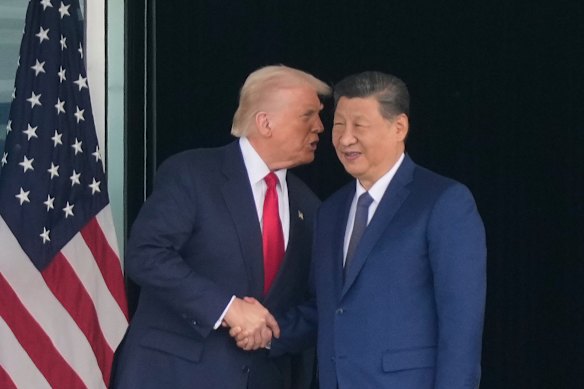
Edgard Kagan, a former US ambassador to Malaysia and now a senior adviser at the CSIS, says it is standard practice for China to position Taiwan as the critical issue before meetings of this nature. But it will also have to be careful about having Xi ask Trump for “something that they know they’re not going to get”.
The wildcard: Iran
The Trump administration, with its top-heavy approach to policymaking and its distaste for traditional structures such as the National Security Council, tends to go into summits with less preparation – which is not China’s way.
There have been trade talks in the lead-up to this meeting, led by US Treasury Secretary Scott Bessent, which is why most experts believe there will be tangible outcomes on that front. But there is far less certainty on Iran, where the situation is changing day by day – or hour by hour.

Kagan says that in his experience, Beijing tries to freeze the agenda weeks ahead of a summit. “That’s clearly not going to be the case this time. So I think that this is the wildcard.”
Trump is looking for an off-ramp to the war but he wants Tehran to make more concessions, while both he and Xi need the Strait of Hormuz to reopen and the flow of commerce to restart.
“Both sides have leverage and room for negotiation,” Kovrig says. “Trump wants a visible foreign policy win. Xi needs Hormuz open. He wants to potentially contribute to Hormuz being open, but not look like he is carrying water for the US or enforcing American demands on Iran. That would affect his credibility with other countries.”
Curtis says China may seize upon an opportunity to use its leverage with Tehran and turn it into a diplomatic coup. Iranian Foreign Minister Abbas Araghchi met his Chinese counterpart, Wang Yi, in Beijing this week. The meeting concluded with China’s call for the strait to reopen as soon as possible.
“They would relish looking like they are playing a helpful role in encouraging a resolution of the US-Israel war in Iran,” Curtis says. “They want to be seen as an influential country that is encouraging peaceful resolutions. They would like to be seen as a responsible international player.
“They also want to appeal to the global south. If they can contribute to ending the energy crisis, they believe that would enhance their international reputation and credibility.”
Get a note directly from our foreign correspondents on what’s making headlines around the world. Sign up for our weekly What in the World newsletter.
[ad_2]

