


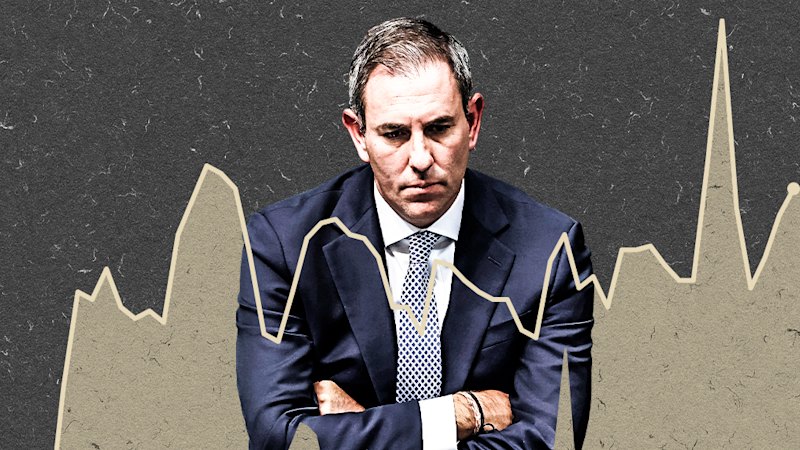
When the Reserve Bank revealed its first rate rise in two years on Tuesday afternoon, Jim Chalmers immediately rose to his feet in Parliament.
Confirming the bank had lifted the cash rate to 3.85 per cent, the treasurer acknowledged it would be “difficult news” for millions of mortgage holders. But he shifted quickly to distance the government, and himself, from any role in the decision.
Making reference to the Reserve Bank’s own statement, Chalmers said “pressure on inflation, the big contribution to growth in our economy, is coming from private demand and not public demand, and that is clear”.
In other words, it was a pick-up in household and business spending, rather than government spending, fuelling demand that contributed to the inflation spike that prompted the Reserve Bank’s decision.
Economists disagreed with this characterisation. It is an issue that will dominate the political debate as a disunited opposition seeks to pressure a government and a treasurer who know that failing to bring cost-of-living pressures to heel is electoral poison.

This financial year, Labor expects to spend $786.6 billion on goods and services. That represents 26.9 per cent of GDP, according to December’s mid-year financial update, the highest share of government spending in the economy since the depths of the pandemic in 2020 and 2021.
It’s $58 billion more than Chalmers had forecast for the 2025-26 financial year, when he delivered his first budget in October 2022. It’s $100 billion more than former Morrison-era treasurer Josh Frydenberg anticipated in his final budget from March 2022.
The extra spending, which is $9 billion more than what was forecast in Chalmers’ most recent budget in March last year, has flowed through to everything from advanced jet fighters to solar panels and energy rebates.
Some of the extra spending has been outside the government’s control. Other increases are a direct result of policy, such as lifting Medicare payments or incentives for energy transition. And then there are areas where complex cost pressures, the ageing of the population or funding holes left by the Morrison government have demanded attention.
Five big budget pressures become six
The GST handouts to the states, at more than $100 billion this year, consume almost 13 per cent of the budget.
The next largest expense is the age pension, which will this year cost federal taxpayers about $65 billion, a $10 billion increase on 2022. The pension’s long-term costs, though expensive, are well understood and have been managed by governments for some time.
The budget pressures that have erupted more recently relate to five other areas. Chalmers identified them in his first budget: aged care, the NDIS, health, defence and the interest bill on government debt. These account for much of the lift in spending.
Aged care, in the 2022 election year, cost about $27 billion. This year, the government will spend $41.4 billion on programs including nursing homes and support packages for older Australians – a rise of 54 per cent, thanks to growing demand and wage rises for poorly paid staff.
The National Disability Insurance Scheme, another bolter, is due to come in at $52 billion, swelling 43 per cent on its $36.7 billion tag from four years ago.
Both have been the target of reform: to account for the looming influx of Baby Boomers to aged care, Labor is asking wealthier people to supplement their own care with co-payments.
On the NDIS, the government is tightening the scheme’s operating rules, and it will clamp down on eligibility by moving children with mild needs to a new program. But these remain expensive, demand-driven systems.
Health costs have grown the most in raw numbers – from $108 billion to $125 billion.
The recent tussle over hospital funding is just the latest example of how this hits the budget – it ended last month with the federal government coughing up an extra $25 billion over five years to state governments.
The fourth area, defence, is up 20 per cent, from $42.9 billion to $51.5 billion. The government is again making moves to bring costs down, such as its announcement last week to sell 67 defence properties and channel an expected $1.8 billion back into the department.
US President Donald Trump’s election, including his demands for increased defence spending among allies, on top of the AUKUS agreement, has added to the imperative to lift expenditure.
One of Chalmers’ proudest boasts has been the delivery of two budget surpluses, which means gross government debt is almost $150 billion lower than originally forecast.
But the sharp increase in global interest rates has meant the cost of that debt has gone up. Interest the government must pay is up about 50 per cent, from $18.9 billion to $28.4 billion. It’s expected to become the government’s fifth-largest expense by the end of the decade.
Childcare subsidies have joined the original five spending problems. Still comparably less expensive, at $16.2 billion this year, the scheme is up 53 per cent from just four years ago as the government attempts to make childcare more accessible to families.

The programs that have blown out
Comparing the government’s spending today to what Frydenberg expected in 2022 assumes the Coalition’s forecasts were accurate. When Chalmers took over, bureaucrats informed him that a multitude of programs were headed for fiscal cliffs – no money had been put aside for them in budget forecasts.
Labor’s first budget, in October 2022, pumped about $6.4 billion extra into these so-called “zombie” measures. Many were in health, such as coronavirus vaccinations and the My Health Record system.
The following year, institutions at risk because of chronic under-funding, such as the National Gallery and the National Library, got extra money. Agencies including the National Emergency Management Agency and the Australian Radioactive Waste Agency, also on track to have no or very little funding, received top-ups.
When Chalmers is asked about his budget management, he says the government has cut down on spending in each of its budgets. In one sense, that’s true: the government has made cuts in certain areas to save about $110 billion.
That includes long-forgotten measures such as axing the “entrepreneurs’ program” ($200 million in grants for business people) and abandoning a proposed road upgrade through the Blue Mountains (a $2 billion saving).
But what that glosses over is that increased spending has cropped up elsewhere in the budget. Overall spending has lifted year-on-year, reaching its expected all-time high this year.
Some of the extra spending has been due to problems left by the former Morrison government. In his final budget, Frydenberg expected to spend $1.8 billion on veterans’ compensation claims this year. As the government clears a huge backlog, the bill will be closer to $6.6 billion.
Other surges in government spending come from policy decisions. Labor this year will spend $21.5 billion on the Pharmaceutical Benefits Scheme, which subsidises medicines – $5 billion more than Frydenberg’s $16.5 billion forecast, in part because the government has reduced consumer co-payments from $42.50 to $25 per script.
Labor has lifted spending in housing to $4.4 billion compared to $2.5 billion planned by the former Coalition government. The renewable energy transition – a key Labor policy shift that helps industry to finance and build low-emissions technology – is a $5 billion budget item this year. Frydenberg had budgeted $400 million.
What’s the impact on inflation?
The political and economic debate is now whether government spending has lifted inflation and contributed to the Reserve Bank’s interest rate hike.
When Anthony Albanese won office, prices were climbing at an annual rate of 5.1 per cent. By the end of 2022, inflation had peaked at 7.8 per cent. The Reserve Bank started tightening monetary policy a fortnight before election day 2022. By November 2023, the cash rate had hit an 11-year high of 4.35 per cent.
In February last year, the bank started easing rates. By mid-year, inflation had fallen to 1.9 per cent. But by December, it had soared to 3.8 per cent. The Reserve fears it will reach 4.2 per cent by June.
On ABS figures, overall inflation has climbed by 16.6 per cent since March 2022. That single number, however, hides some wild swings and the government’s contribution to them.
The largest increase in any sector tracked by the bureau was international travel, where airfares soared by 53 per cent. Federal government spending has almost no impact on airline fares.
Ditto when it comes to eggs, the price of which has gone up 42 per cent. The mass slaughter of hens to prevent the spread of avian flu led to a shortage, leading to expensive omelettes.
Other price spikes are more clearly linked to government policy. Tobacco prices have lifted by 44 per cent since Labor took office, pushed up by higher excise.
The government’s childcare subsidies and energy rebates reduced headline prices and the overall inflation figure. Lower prices meant consumers had more money in their pockets, influencing inflation elsewhere.
The government has also introduced income tax cuts and brought down the costs of medicines and doctor’s appointments. It has given significant pay rises to childcare and aged care workers, helping to redress historically low wages in feminised industries.
Each of these decisions has given people more spending power.
The government is trying to build more homes, aiming to take pressure off runaway prices and rents.
But trying to build more homes, alongside big-ticket state infrastructure projects, is now showing up in the official measures of inflation. Builders have abandoned the discounts they were offering early in the year to woo customers.
Deloitte Access Economics lead director Pradeep Philip says it’s a conundrum for the government. “Clearly government spending on infrastructure is needed to help expand the economy’s capacity but doing so can put pressure on prices. For example, without government spending on infrastructure like water, renewables and the grid, the current explosion in investment in data centres won’t be optimised,” he said.
“Government spending should be assessed against its ability to facilitate private investment, optimise national infrastructure, and meet social objectives.”
Shadow treasurer Ted O’Brien has consistently pressed Chalmers on the link between government spending and inflation, accusing his opposite number of being in denial about the relationship.
“The treasurer is spinning harder than a winter Olympic figure skater, trying to convince Australians that the highest government spending outside a recession in 40 years isn’t driving inflation – but they aren’t buying it,” he said.
On Friday, Reserve Bank governor Michele Bullock was peppered with questions from Liberal MPs at a parliamentary inquiry on the link between government spending and inflation.
She said other factors were involved, including the way the global economy had lifted and the unexpected increase in household spending over the final six months of 2025.
But she ultimately conceded that public spending, combined with private spending, had added to an increase in aggregate demand in the economy.
“Mathematically you’re right, public demand expenditure and private sector. All of that adds to demand. That’s logical. It’s mathematical. That’s what happens,” she said.
Chalmers, who revealed at the weekend that his May 12 budget will feature tax, savings and economic reform packages, is feeling the political pressure over inflation and the Coalition’s attacks on government spending.
Over the past three years, he said, government spending as a share of the economy had been lower than had been expected when Albanese took office.
Up to $40 billion in the extra spending was effectively “automatic” increases, such as higher payments to those on welfare, natural disasters and the sharp lift in support to veterans.
Over those years, real government spending was up 3.2 per cent. The economy, however, had expanded at twice that rate, by 6.3 per cent.
Chalmers said: “The uptick in inflation we’ve seen recently, which preceded the RBA’s interest rate decision last week, was driven by temporary pressures like holiday spending over Christmas and the end of energy rebates, as well as some longer-term price pressures like those in the housing market that we’re working to address with the states and territories.
“We’ve made a lot of progress on the budget and on the economy in the past few years, but the job’s not done. We need to do more and we will.”
Cut through the noise of federal politics with news, views and expert analysis. Subscribers can sign up to our weekly Inside Politics newsletter.
