









Examine, a free weekly newsletter covering science with a sceptical, evidence-based eye, is sent every Tuesday. You’re reading an excerpt – sign up to get the whole newsletter in your inbox.
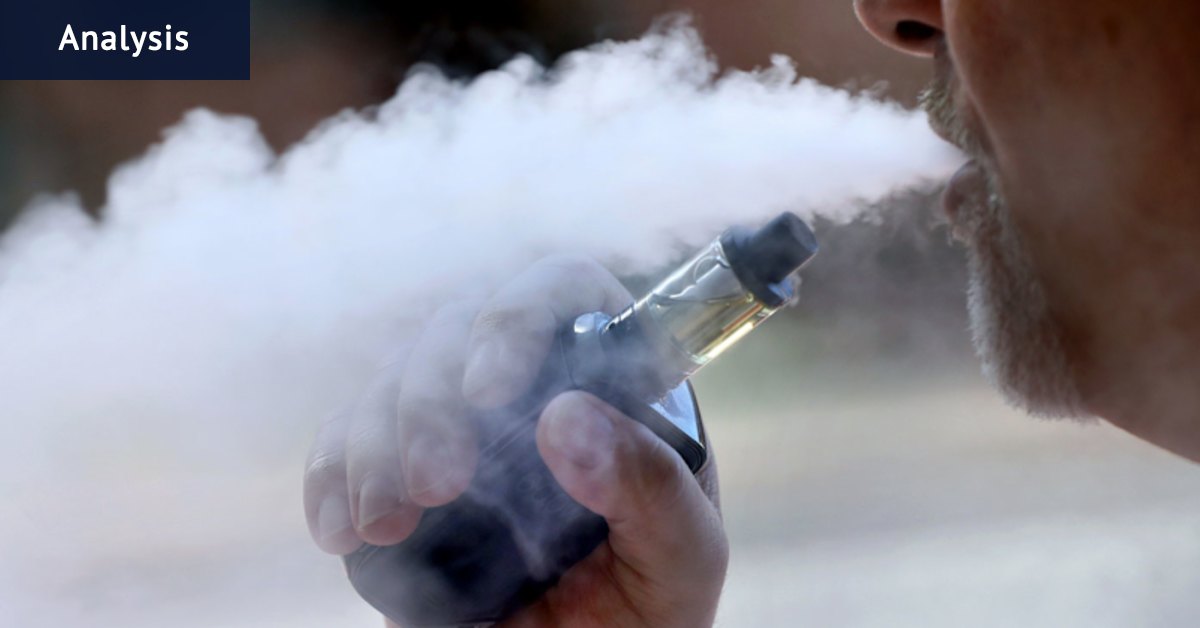
Australian researchers put out a paper last month with a conclusion that snagged national headlines: vaping probably causes lung and oral cancer.
Much of the public reaction was sardonic. Sucking fruit-flavoured vapour from an often illegally manufactured device shown to relinquish toxic metals and formaldehyde might cause cancer? Breaking news: fork found in kitchen!
But it was an important claim. Vaping went mainstream too recently to know, from a scientific standpoint, how it might impact cancer risk. Public health messaging is restricted to warning that vapes contain carcinogenic chemicals rather than drawing an outright link between vape smoke and cancer.
The Carcinogenesis study, led by UNSW public health researchers, was the first to synthesise existing evidence from animal trials and lab experiments, and make the case in the scientific press that vaping probably causes cancer.
Not many Australian scientists refuted that claim. In the UK, however, it was a different story.
A chorus of researchers put out hardline criticisms of the paper through the UK’s Science Media Centre, which compiles expert reactions to new papers and circulates them to the press.
They lashed the paper as “misleading” and “problematic”, and said it made “extraordinary claims that are not borne out by the data”.
How can one country’s scientists come out as broadly supportive of a finding and another’s broadly critical?
It turns out there are two ideological camps here. And in the crossfire, some claims get over-egged and others unfairly downplayed.
Here’s what’s going on.
The claim
It’s difficult to deny there’s a probable link between vaping and some types of cancer, even if we don’t have long-term definitive evidence to back it up yet.
What sparked particular controversy was the Carcinogenesis paper’s assertion that vaping “can no longer be caricatured as safer than smoking”.
“It over-claimed the state of the evidence,” says Wayne Hall, an emeritus professor at the National Centre for Youth Substance Use Research, who agrees with many of the UK researchers’ criticisms. “There’s no basis for [that claim] in the article.”
The consequence of such a claim, in Hall’s view, is that smokers are led to believe there’s no difference between vaping and smoking, and may see no reason to give up cigarettes for vapes. “And that’s just false. It’s misinforming people.”
Lead author of the Carcinogenesis paper, Bernard Stewart, an adjunct professor from the University of NSW, disagreed with Hall’s assessment of the paper. Stewart said comparing vapes to cigarettes was outside the paper’s focus, which was on the carcinogenicity of e-cigarettes in their own right.
Vapes generally expose people to less disease-causing chemicals because they don’t involve burning tobacco, which is a major source of toxins in cigarettes.
That’s according to a 2025 Cochrane review – considered the gold-standard form of scientific evidence – which also concluded that vapes are an effective tool for getting smokers off the darts. For every 100 people trying to quit smoking, eight to 11 using vapes stopped smoking, compared to six using nicotine replacement therapy such as patches.
Many researchers therefore support vapes as a swap-out for cigarettes, which we know are horrifically bad for you. But legal vapes can be hard to come by in Australia as major pharmacy chains refuse to stock them.
The context
The two opposing ideological camps are both evidence-backed, but they have competing public health priorities.
One camp is focused on stopping young people getting hooked on vapes. They’re concerned vapes act as a “gateway” to cigarettes and are keen to amplify early warnings in the scientific literature about the long-term health risks of vaping. Australia’s public health stance falls broadly in line with this group.
The other crew are focused on smokers. They are more supportive of vapes and promote e-cigarettes as effective smoking cessation devices because they deliver nicotine alongside much lower levels of carcinogenic chemicals. This is more in line with the UK approach.
One of the researchers who criticised the Australian vaping paper, Professor Peter Hajek of Queen Mary University of London, co-led a 2015 UK government-backed review that concluded vaping is 95 per cent safer than smoking (a figure disputed at the time and now described as a myth).
Off the back of that review, public health authorities began encouraging smokers to swap to vaping. In 2023, the UK government even provided “vaping starter kits” to a million smokers.
While the UK has a reliable coterie of oft-quoted researchers such as Hajek who defend vaping, in Australia we have the opposite trend, and Hall says those who support vapes are shut out of the debate.
He has put out papers and articles contesting the NHMRC’s critical stance on vaping, but has garnered little support or media coverage.
“You’re right that views tend to be highly polarised,” Hall says. “But there’s no acknowledgment of that in the media coverage here. It’s just uncritical coverage of the side that thinks that e-cigarettes are an evil, dangerous, tobacco industry plot and we have to do everything we can to stop anyone from using them, basically.”
Both sides of the debate are well intentioned. Both can cite different papers and datasets to back up their arguments. But claiming vapes are as bad as cigarettes may be just as untrue and unhelpful as claiming vaping is risk-free.
A nuanced paper from New Zealand
So where’s the middle ground? A study from New Zealand just dropped with a more nuanced conclusion.
Scientists looked at four different types of toxic “aldehyde” chemicals released by vapes. One of these was formaldehyde, a potent carcinogen, and cigarettes and vapes had similar levels. But looking at the four aldehydes taken together, cigarettes had much, much higher levels of the chemicals all up.
There are many more chemicals than aldehydes in cigarettes (which release sky-high levels of the tumour-inducing chemical NNK, for instance) and vapes (whose chemical profiles – and therefore disease risk – vary wildly depending on design and flavour).
But the aldehyde paper underscores what many other studies have also found: vapes do expose users to lower levels of cancer-causing chemicals than cigarettes.
“In our view this risk assessment supports the use of vaping for smoking cessation because the overall cancer risk is lower than for smoking, but does not exonerate vaping in its own right because taking up the habit introduces a new vaping-associated cancer risk,” the authors of the New Zealand Medical Journal study found.
To summarise: if you don’t smoke or vape, don’t pick up either because both increase disease risk. But if you do smoke, vaping is probably less dangerous.
Says Hall: “That’s absolutely the message I’ve been trying to get out there for about 10 years.”
The Examine newsletter explains and analyses science with a rigorous focus on the evidence. Sign up to get it each week.


