


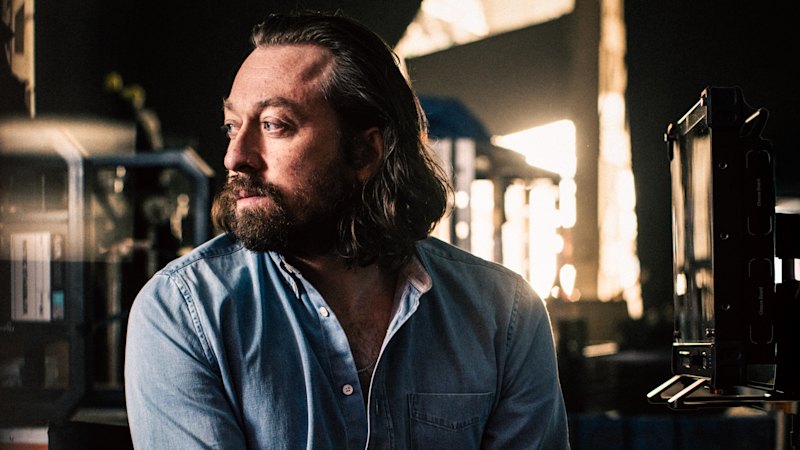
In the decade since leaving Australia, Simon Stone has become a study in perpetual motion. Sprinting between the theatres and festivals of Europe – from Amsterdam to Turin, Munich to Aix-en-Provence – writing and rehearsing, opening and touring shows, and mounting opera, he’s also built a reputation as an auteur director, staging the reimagined works of classic dramatists, from Seneca to Lorca.
There was his first big international hit back in 2014 with Medea in Amsterdam, which he later took to New York with Rose Byrne. See also his electrifying Yerma, starring Billie Piper at the Young Vic. Last year, there was his take on Ibsen’s The Lady from the Sea with Alicia Vikander, and new work included the Australian premiere of Innocence, a Finnish opera about the resurfacing trauma of a school shooting.
Like the Scarlet Pimpernel, they seek him here, they seek him there. We have been trying to arrange a meeting in London ahead of Stone’s trip to the Adelaide Festival, with his groundbreaking staging of Chekhov’s The Cherry Orchard, which he debuted in Seoul with a Korean cast in 2024. The highly anticipated South Australian engagement was ultimately (thankfully) untouched by the controversy that brought down Adelaide Writers’ Week, but still, when setting up our interview even his management seems uncertain where he is or if he can stay in one place long enough to talk to Good Weekend.
Finally the clouds part: we have a date to meet in the cocktail bar of the West End’s Marylebone Hotel, before he flies to Vienna the next morning to spend time with his wife and daughter. I find a corner seat and wait. A text from a minder warns me he is running late. I rearrange the cushions and think about ordering sparkling water, which I’ve read is his tipple of choice. (He doesn’t drink alcohol.)
Then he’s here, a tall figure looming at the table: wild hair, blue eyes, a tiny bit dishevelled, explaining that a medical appointment took longer than expected. He is about to start a new film, his fourth, and the investors want iron-clad proof of his fitness before shooting begins.
It’s called Elsinore and is the true story of a young actor called Ian Charleson, who took on the part of Hamlet at the National Theatre and died from AIDS eight weeks later. “It’s about the gay scene in London in the ’80s. Soho, Derek Jarman,” he says. “Andrew Scott plays Ian, Olivia Colman is Margaret Johnson who, to this day, is head of the ward at the Royal Free hospital which was named after Charleson.”
Filming starts here in a few days, then there is Adelaide followed by six weeks in New York for Innocence at the Metropolitan Opera with renowned mezzo-soprano Joyce DiDonato. Ivanov, his next Chekhov iteration at London’s Bridge Theatre, opens in July.

The waiter shimmies along and Stone orders an iced latte and a large bottle of San Pellegrino. He keeps a house in London but the family home is in Vienna where his Austrian wife, dramaturg Stefanie Hackl, lives with their three-year-old daughter close to her parents, sisters and friends. “I am so often absent with work,” he explains, “and a lot of new mothers suffer from being located where their partner is during those vulnerable early years. We have managed to mitigate that by having extended family nearby. If I were more patriarchal I’d insist my family were with me, but it’s more comfortable for them there.”
He has moved house often – as a child from Switzerland to Germany to Cambridge then Melbourne with his scientist parents, and then later from Sydney back to Switzerland. Home, he has said, was always where his books were. So where are they now? He grins: “The plays are in London, the novels in Vienna.”
Stone was 12 when he witnessed his father’s death from a heart attack in a swimming pool. They had argued that morning and the boy’s grief was mingled with feelings of guilt. He was subsequently brought up by his mother and sisters. His plays often have a woman as the central character: Yerma wrestles with infertility; his contemporary Medea, a brilliant biochemist with a cheating husband and a career sidelined by motherhood, kills her children by setting fire to the family home. His Phaedra is a politician consumed by post-menopausal lust for the son of an ex-lover.
Stone said once that his preferred characters were “pretty much mad people who represent the extreme version of who we could become”. I think he means that we all have trauma and hurt that we don’t talk about, and good drama tells us we’re not the only person who’s been through that.
As a child, he carried the private trauma of his father’s death with him on a scholarship to Melbourne Grammar, where he was bullied for his Pommy voice. “My first bit of acting was to develop an Aussie accent and I’ve never got rid of it, because it’s an advantage in England to be freed from class politics; people can’t place me.” He read voraciously, watched “thousands” of movies, acted at school and afterwards, then at 23 founded the Hayloft Project, developing what would become his stock in trade: updating classic drama for modern sensibilities. Tagged variously as a wunderkind and enfant terrible, his work attracted both praise and censure: “Write your own plays and stop effing around with everybody else’s,” admonished playwright Andrew Bovell.
After his adaptation of Ibsen’s The Wild Duck at Sydney’s Belvoir Street transferred overseas and his reputation grew, he made the move to Europe. “I was always leaving,” he says. “One year I did 16 long-haul flights. Apart from destroying the planet, there’s the dislocation.”
He was following the same route as successful expat Australian directors Barrie Kosky in Berlin and Benedict Andrews, a process once described by Kosky as “dreaming in Australia and doing in Europe”.
“What a powerhouse of innovation Australia has become,” marvels critic Nick Curtis, who also co-hosts The London Theatre Review podcast: “Andrews, Stone, Kip Williams – each is different stylistically and in their approach to text, but what they share is the ability to make you see the classics with completely fresh eyes.
“Stone’s plays don’t always work,” he demurs. “He can be prolix – his Phaedra was baggy and too long – but he’s radical and bold and the glamour is not to be underestimated. The way he creates a buzz around things, he’s a force for good and London theatre is the better for having him.”
It seems that Korean theatre, too, has taken Stone to its heart: at Seoul’s magnificent LG Arts Centre, liberally subsidised by the electronics giant, his Cherry Orchard was packed every night. “The dominant age of the audience in Seoul was under 33,” reports its producer, Stone’s long-time collaborator Wouter van Ransbeek. “If it’s true that Korea is a predictor of the future, a force for modernity, then it’s very reassuring that a young generation is vividly engaging with theatre as if going to a pop concert. People were lining up for Simon’s autograph.”

I ask Stone why he chose The Cherry Orchard, and we’re off to the races as he unleashes an eloquent analysis of Korean history and culture, its resemblance to late-19th-century Russia, and the ease with which Korean films, like Chekhov plays, shift between comedy and drama. “Everyone was so astonished by Parasite but I’d been watching [director] Bong Joon Ho movies since I was about 20 and I thought, ‘Yeah, it’s about f—ing time you noticed this guy’s making the best films in the world.’ ”
Stone’s voice could carry to the back of a 2000-seat theatre. The filmmaker David Lam once noted: “I couldn’t tell you what’s driving the guy but something is that makes it necessary for him to be the biggest person in the room or in the restaurant or on the street.” I glance at the tables around us but people continue calmly chatting over their cocktails.
Chekhov’s Cherry Orchard is the story of old Russian aristocracy losing out to a new merchant class. The equivalent in South Korea, explains Stone, are the chaebols, family-controlled business conglomerates – generations of wealth and privilege – challenged by what he calls “turbocharged change” in the shape of a rising middle class, self-made entrepreneurs and a younger generation refusing to defer to authority.
‘Rich people born into ease struggle to connect with their humanity.’
Simon Stone
In Stone’s adaptation, the central character is Do-young, a woman in her 50s faced with having to sell the mansion given to her by her father on her 16th birthday. Unsettled, she drinks too much, dances and kisses her daughter’s boyfriend. The script slyly references a real-life incident on Korean Air in which the daughter of the airline’s chairman, furious at being offered packaged nuts by a steward, made the plane turn back to the gate. The audience got the joke, says Stone.
Do-young is played by Korea’s most famous film star, Jeon Do-yeon, who confessed that she was embarrassed by her character’s entitled behaviour. “She was worried about being unlikeable,” says Stone. “I told her if you are honest about the fact that you have been awful, you will get empathy.” Is Do-young like she is because she has been thoroughly spoilt? “That’s the answer: rich people born into ease struggle to connect with their humanity. Look at Paula Yates and her poor daughter [Peaches Geldof, who died at age 25]. The self-destructive child of privilege is an incredibly common story.”

He pauses a moment. “I’m worried about my daughter in that respect,” he admits, somewhat surprisingly. “I didn’t have the privileges she is growing up with. I came from a family of scientists, I had no connections in the arts; the need to prove myself has been an engine for my life. I look at my daughter and think, ‘If you ever want to do what I do, it’s going to be an uphill battle to tell your story: being the child of a successful director isn’t much of one. Or if you choose the opposite …’ ”
Don’t worry about her yet, I say, she’s only 3. Have another one, I add (he laughs), and also, just because someone is successful it doesn’t mean their children will be ruined for life. Stone nods, mollified.
His Korean cast is drawn from the country’s top echelon of actors including Park Hae-Soo from Squid Game. How did he pull that off? “I think my reputation preceded me,” he says, frankly.
Designer Mel Page has worked with Stone since their early years in Melbourne. “At the beginning of the process there is usually no text,” she explains. “In the first week with the cast, we sit around and get to know each other, tell stories, so when rehearsals start without a script, a strong bond of trust has been formed. Then scene by scene it feels like reality television, Project Runway or something: what’s going to happen next?”
Australian composer Stefan Gregory says he and Stone rarely talk much about the music for a show: “With The Lady from the Sea, we met in a hardware store where he was choosing paint for his bedroom; we did have a conversation and I got a tiny bit of feedback but he was concentrating more on paint colours. Then he introduced music to the cast for the first time at tech [technical rehearsal]. He is ruthless; he knows what he wants in the moment and he’s not apologetic or polite if he doesn’t like something. Everyone has to be heroic, all the actors and creatives, because he sets up conditions that are ideal for him and we all have to scamper around to serve that.”
Why do they put up with it? “It’s very challenging but we all keep going back to him.” It sounds like an addiction. “There is an adrenaline rush,” Gregory admits. “It’s liberating and exciting, like being in wartime or something.”
There are some amusing moments in The Cherry Orchard. Asking Stone how humour went down in Seoul elicits a bark of laughter. “I was told by the actors: ‘Humour is different here.’ And I went, ‘Sure, sure, but I promise you they will laugh at this.’ They said, ‘You’re laughing because you wrote it and you’re Australian,’ and I said ‘No, they will laugh’ – and they did – laughed at a joke written by an Australian in his kitchen in Vienna translated into Korean then into subtitles for a Singapore audience; then in Hong Kong they laughed at the Chinese translation. The point is, there is way more that unites us internationally; things that are universally funny and universally sad.”
He has said there are similarities between Korea and Australia; what are they? “The willingness to get drunk for one thing – Koreans drink a lot – irreverence for dogma and a strong sense of community and social responsibility. If you look at how incredibly quickly Ahmed Al Ahmed interrupted that [Bondi Beach] shooting – so many more people would have died if not for him. And that was an inherently Australian act despite the fact he is Syrian; if you think the place where you are is an ideal as opposed to a skin colour or a language, you sacrifice for it.”
Often it is the first generation that is sacrificed, I suggest. “Totally, totally. I just had my medical with an Indian doctor; his father who immigrated here had just passed and had never had a holiday, but he was so proud of him, a son who worked for 30 years in the National Health Service. That’s what you get when you invite people to live here.”
Does Stone, a serial immigrant, miss Australia? “I wish a city as magical as Sydney wasn’t so far away,” he concedes. “I’m happy to revisit that miracle every now and then.”
The Cherry Orchard runs from February 27 to March 1 at Adelaide’s Festival Theatre.
Get the best of Good Weekend delivered to your inbox every Saturday morning. Sign up for our newsletter.
