









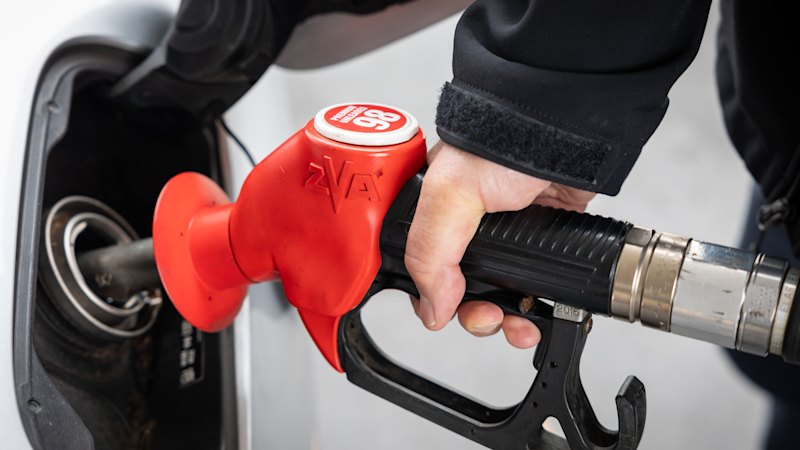
Shane Wright soundly crushes the silly notion that when market forces suddenly push fuel prices up, the government should instantly rescue everyone from the pain by cutting fuel excise or making public transport free (“Don’t rush to drongo economics to fix browser prices, it’s already in hand”, March 27). Yet when market forces push the price of fuel down, consumers expect the full savings to be passed on to them, or they accuse the government of being greedy. People can’t have it both ways and, as Wright makes clear, quick fixes for the current fuel price rises only make things worse. If people have to vent their anger about their wounded finances, aim it at the culprits who caused the bleeding in the first place and stop expecting our government to always put a Band-Aid on it and kiss it better. Adrian Connelly, Springwood


Opposition leader Angus Taylor seems to pride himself as being sharp when it comes to the economy, and yet he calls on the PM to cut the fuel excise? Economics 101 says this measure dampens the price signal, sends people out to buy more of a scarce resource (fuel), which in turn pushes up prices, negating the cut in price due to the excise and diminishing supply further. It also pushes more money into the economy, pushes up prices further (possibly encouraging the RBA to increase interest rates) and reduces revenue to the government. If this is the best and brightest the opposition has, Labor could enjoy several more terms in government. Paul Bugeja, Varsity Lakes
Shane Wright says cutting the fuel excise to ease pain at the bowser is a terrible idea promoted by people who should know better. The Opposition Leader is a well-credentialed economist, now calling for this drongo policy. Is Angus Taylor in the category of people who should know better? Or perhaps he is from a different school of economics to Shane? Or more than likely, he is a political leader under pressure who cannot let a political opportunity go by. Brenda Kilgore, Red Hill (ACT)
One of the most obvious solutions to the fuel shortage is to make public transport free. The large passenger capacity of trains and buses can take many cars off the road, and there are huge energy efficiencies compared to cars. For those in more rural areas, bus and train usage in cities will reduce overall petrol and diesel demand, leading to lower prices at the pump. The purchase of more electric buses will be essential. Of course, making public transport free isn’t really free – governments will have to borrow money to fund it. But in the short to medium term, free public transport will help offset the current pain. Neil Cameron, Blackstone Heights
Well done, Shane, particularly for mentioning those with either poor or non-existent public transport in the rural and regional areas. Free? Ridiculous. Could our federal and state pollies please understand that the cities thrive only because of the work done in the bush? Bring back The Great Northern Line from Sydney to Wallangarra and, while you’re at it, continue up to Brisbane as no one in northern NSW (or Sydney) can get there except by car. GNR ticks all the boxes. Deni McKenzie, Armidale


Correspondent Carlo Ursida is entirely correct that the shortages of fuel is attributable not to under-delivery at the distribution points, but to naked fear and greed (Letters, March 27). Fuel hoarding has led to what could well become known as TPS (toilet paper syndrome), encouraged by the Coalition and One Nation. Were we ever the land of the fair go? It’s difficult to be sure, but today, no way. We should now be known as the land of “beggar thy neighbour”. As someone who spent 22 years in Defence, 11 in uniform and 11 in civvies, I am disgusted and ashamed. Ian Usman Lewis, Armidale
Travelling across South-East Asia, I’m witnessing the lived consequences of Donald Trump’s Middle East actions and the blocking of the Strait of Hormuz. In Thailand, fuel shortages are causing long queues at service stations around the country, while fishing boats sit idle. The human cost extends far beyond any battlefield. Even Australian farmers, already battling drought and floods, are under pressure from rising costs. Amid “peace talks” with Iran, the global decline in quality of life is stark. No Trump smoke and mirrors can take the edge off the real-life suffering being endured. It feels like a donkey leading lions to war. Alas, the only fact immune to fabrication will be the numbers of civilian and military lives lost. The lessons of Richard Nixon’s misadventures in Vietnam have not been learnt by this sabre-rattling president. Joseph Ting, Brisbane
World compo claim
Hooray for Germany’s defence minister, Boris Pistorius, for his forthright criticism of Donald Trump’s attack on Iran, stating that there was “no consultation” with allies, “no strategy, no clear objective and no exit strategy” (“Germany’s blunt candour about Trump highlights how timid Australia has become”, March 27). Trump’s capricious and vindictive behaviour, coupled with his mendacity and his disdain for expert advice, has brought a series of bizarre, unilateral announcements and actions, many of which have been reversed within days. However, this time his actions have created serious worldwide disruptions and economic damage as countries risk grinding to a standstill as they run out of petrol and gas. Will the US and Israel be paying compensation for all the damage and loss of livelihood they have caused to all affected countries? And why have all the other world leaders, apart from Canadian PM Mark Carney, remained tight-lipped instead of calling out the inept president for his unhinged decisions? Our government must stand firm against becoming involved in Trump’s Operation Epic Folly, and the sooner we distance ourselves from a Trump-led US, the better. Alan Marel, North Curl Curl

Boris Pistorius in Canberra.Alex Ellinghausen
We need some balance in our discussion of the war in Iran. The German defence minister is right, there was no strategy, no warning, no consultation or exit plan. That’s why some of us call a hammer an American screwdriver. But it is also true that the Iranian regime is brutal to its own people, has hopelessly messed up the economy and is the major source of instability in the region. Regime change is necessary but how that should be achieved is the core issue. Donald Trump and Pete Hegseth want a quick fix, but their solution has caused massive damage already. We can only hope wiser heads prevail in Washington. Trump appears to be increasingly erratic and discombobulated. Fingers crossed. Garry Feeney, Kingsgrove
Republicans self-wedged
Cory Alpert says Trump’s ill-considered war on Iran has led to US Republican representatives in swing states being caught in the bind of either speaking out against the war and risk losing their careers at Trump’s vengeful hand, or supporting the war and losing at the midterm elections because of a disillusioned electorate (“Trump feels the pain as his war becomes a liability in the heartlands”, March 26). I cannot feel sorry for them. If you elect a narcissistic showman with the emotional stability of a two-year-old and the reasoning capacity of a seven-year-old as your leader, then you deserve what you get. Redemption now lies in putting the good of one’s country and the rest of the world first. These Republicans should take note of John F. Kennedy’s famous exhortation: “Ask not what your country can do for you — ask what you can do for your country.” The answer right now is obvious. Paul Casey, Callala Bay
One of Trump’s stated aims for attacking Iran was to achieve regime change. Could it be the ultimate irony that it achieves a regime change in America instead? Fingers crossed. Ellie Fitz-Gerald, Orange

Abundance of caution
Having stuffed his clothes with electoral bounty, there’s now a hole in Anthony Albanese’s pocket through which the public’s confidence, goodwill and, disturbingly, trust is trickling (“Albanese’s caution is fuelling unease”, March 27). James Massola’s analysis of the prime minister’s frustrating softy-softly approach to certain decision-making is an insightful wake-up call as we once again find ourselves navigating uncertain times. While we observe the unfathomable harm that the wastrel in the White House is inflicting on the world, it is long past time for Albo to act definitively. Crisis management is about preventing the need for a cure, not waiting to see how grim the situation becomes. No wonder the non-Labor forces are making mischief at the expense of the nation’s fragile cohesion. Bradley Wynne, Croydon
Mind your preferences
It’s ironic that One Nation may benefit from NSW’s system of optional preferential voting (“Hanson offers Coalition preference deal in Farrer as Abbott warns of Liberal wipeout”, March 27). Bob Carr’s government brought this electoral rule in for NSW when it was at risk of losing a 2001 by-election for the usually safe Labor seat of Auburn. At the time, the premier’s office was being accused of dog-whistling against Muslims and migrants generally, after the major parties were spooked by Pauline Hanson’s success at the 1998 Queensland election. The migrant communities in Auburn heard the government’s dogwhistle quite clearly; the independent candidates were mostly migrants themselves and were preferencing against Labor. Labor won with the new election rule in place. But that rule change could now help One National win a swag of seats in NSW at the next state election, as making preferences optional helps the party that gets the highest primary vote. Chris Minns might consider whether it’s a good time to restore compulsory preferential voting in NSW. Paul Mortimer, Marrickville
Paul Sakkal and Rob Harris, in their article about Hanson’s preference deal, refer to “left-wing groups such as Climate 200”. The organisation’s website says Climate 200 is a community crowd-funded initiative that supports political candidates committed to its shared principles. It further states that these are a science-based response to the climate crisis, restoration of integrity in politics, combating corruption and advancing equality and respect for women. What’s left-wing about that? Joe Atkinson, Balmain

Tony Abbott should not be lecturing the folk of Farrer on how to win the upcoming by-election or save the Liberal Party. The fact that most Australians are not using renewable energy for their homes, cars, trucks and farm equipment, which would have insulated them from the current energy crisis, could be largely traced to “this man’s” irresponsible climate denial and his infamous line that “climate change is crap”. He and other hardline climate deniers have contributed significantly to the big parties’ demise and neither the LNP, nor One Nation, are in a position to be offering solutions. Rob Firth, Red Hill (ACT)
Guns need control
Correspondent Bill Irvine says firearms are tools, much in the manner of chainsaws or cars and are harmful if used inappropriately (Letters, March 27). However, this argument doesn’t recognise the intended purpose of these tools. A chainsaw’s role is to cut wood. A car’s purpose is to transport people and goods. A gun’s purpose is to kill. Surely, anything that exists solely to take life demands rigorous control and oversight. William Galton, Hurstville Grove
In justifying someone’s need to own multiple guns, Bill Irvine suggests the dangers of firearms in the hands of their owners are similar to those of cooking utensils in the hands of chefs. I don’t recall the last time criminal gangs or terrorists used frying pans to harm people. Brenton White, Mosman
So, Bill Irvine, what you are saying is that as long as people don’t write on their firearm licence application that they want a gun to shoot people, then they must be law-abiding citizens with no ill intent? If it sounds too good to be true, then maybe it is. Charmain Brinks, Newcastle
I find the opposition to the proposed new gun laws perplexing as I have not seen any plausible explanation for why a farmer or indeed anyone would need 10 guns. They can use only one at a time, and while I understand the need for different calibres to shoot rabbits, snakes and larger animals, I cannot see the need to own even four firearms, let alone 10. There is simply no need for anyone to own an arsenal. David Clark, Avalon Beach
Big Tech should pay
The tech giants are in discussion with our government requesting, as a trade-off for building water-hungry data centres in our parched land, a weakening of our copyright law to allow easier access to mine our local creative content to train their AI (“Government split over AI, copyright and art economy”, March 27). With an average annual earning of $23,000 for our local actors, writers, painters and musicians, surely these behemoths could dip their bony fingers into their moth-eaten wallets and come up with fair and adequate compensation. After all, Amazon (worth $US2.23 trillion), Google ($US3.5 trillion), Microsoft ($US2.72 trillion) and Anthropic (a paltry $US380 billion) aren’t short of a quid. Why is the creative arts industry being asked to subsidise these entities? Bill Young, Killcare Heights

The adage “art is in the eye of the beholder” seems to be morphing into “art is in the AI of the shareholder”. Thoreau reflected that “it’s not what you look at that matters, it’s what you see”. AI in its interpretations is indeed clever, but human creativity is spectacular. Steve Dillon, Thirroul
Water first, buildings second
There have been at least four major pipe bursts recently, affecting thousands of people (“Sydney residents told to save water after major main bursts”, March 27). Sydney Water infrastructure already has problems, and its ability to accommodate the massive impact of transport-oriented development towers and unfettered development on the north shore is, at best, questionable. Construction of units is clearly preceding installation and/or upgrade of critical infrastructure. Gas, electricity and traffic face the same challenges. Self congratulations on completing the buildings will be followed by disappointment as suburbs are disrupted by digging up streets to backfill and remedy the lack of preparation for the increase in demand. Foresight is not NSW planning’s strong suit. A wholesale rush to meet speculative targets is shocking and an insult to the public, whose lives are being affected by a three-person panel with unprecedented powers to build rather than improve. Robert Caraian, Crows Nest
Seeing as the authorities are asking residents to save water by taking short showers and not washing cars for the forseeable future, I assume that means all these water-gobbling data centres will be on restricted usage and all new builds and approvals will be on hold until all infrastructure is restored? After all, it won’t just be residents paying the price, right? Right? Allan Kreuiter, Roseville
Plug-in parks
It’s a good time for caravan park owners to promote their facilities as EV-friendly (“Road trips abandoned amid fuel panic”, March 27). On our travels we often stay at caravan parks in rural and remote areas because they are perfectly set up for EVs with their powered campsites. We book a cabin, plug our EV into a caravan socket and can leave in the morning with a greatly topped-up or even full EV. We’ve never had a caravan park owner refuse us permission to charge our EV, and yet very few promote this. Many EV drivers even seem oblivious to this fantastic option. Brendan Jones, Annandale
Too much Tom
It has been great to see the flood of letters in support of the ABC (Letters, March 27). I’m a fan too. And yes, I know money is tight there, which explains the essence of the strike and the pay rise claims. And yes, I like Tom Gleeson, but it has been more than two years since The Drum was axed and I’m heartily sick of replays of Hard Quiz while I prepare dinner. Couldn’t just a little bit of money be found to give us a slightly more cerebral lead-in to the news? Ian Morris, Strathfield
Any attempt to axe the ABC would be the TV equivalent of axing the Herald. These are the only two sources of news that are truly honest, reliable and independent. Fake news, misinformation and disinformation are growing exponentially. Don’t you dare! Chris Robinson, Guyra
Melania, right
Interesting photo of the First Lady and the humanoid robot (“Robot joins Melania Trump at White House event”, March 27). It would have helped if the caption told us which one was which. Matt Petersen, Randwick
- To submit a letter to the Sydney Morning Herald, email letters@smh.com.au. Click here for tips on how to submit letters.
- The Opinion newsletter is a weekly wrap of views that will challenge, champion and inform. Sign up here.


