


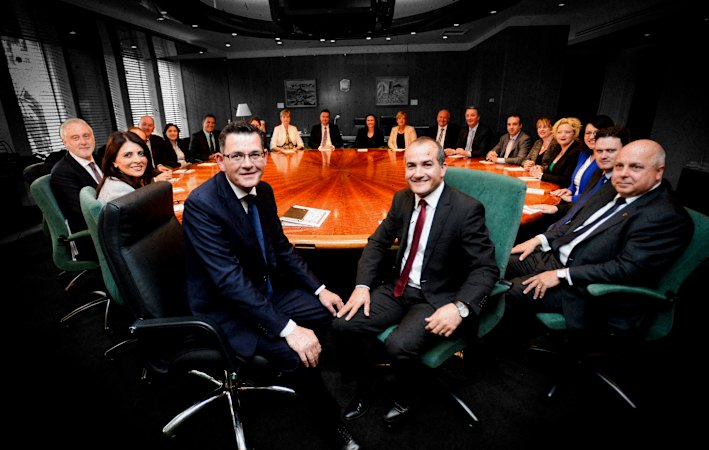
In early December 2014, newly sworn-in state employment minister Jacinta Allan briefed cabinet colleagues on how she would help create 100,000 jobs in a sluggish Victorian economy, at no extra cost to taxpayers.
Her confidential written submission to the fledgling Daniel Andrews government cabinet highlights the economic and social benefits of helping businesses hire workers from the then growing army of young unemployed.
It reminds cabinet of Labor’s promise to fund its commitments, including the $100 million Back to Work plan, “through savings and reprioritisation of existing funding”.
This was the Andrews/Allan government in its modern Labor phase – a government intervening to boost employment in tough economic times while keeping its belt tightened.
The submission is among 800 pages of cabinet documents from the weeks following Labor’s victory over a lacklustre, one-term Coalition government, obtained by The Age through a rarely used provision of the Freedom of Information Act.
Briefs, submissions and draft bills from the time provide an insight into the deliberations and early priorities of the Labor administration and the high-level, confidential advice it received.

They tell a story of a disciplined and hard-working Labor team, keen to build and reform but with horizons limited by lack of funds and led by a premier eager to expand them.
As a now uncertain-looking government burdened by record debt, poor polling and leadership chatter faces its third election, the documents are a reminder of what the government was, has achieved, and has become.
The 2014 setting
When Victoria’s top bureaucrats welcomed the new government in the final days of 2014, they painted a less than rosy picture of the state, speaking frankly under the cover of cabinet confidentiality.
Their briefs to cabinet highlight “modest” economic growth driven mainly by rapid population, “poor” productivity, “weak” private investment, and “structural dislocation” including the decline of traditional manufacturing, automotive especially, at that time.
“Business investment has been subdued, and unemployment has steadily increased to a 13-year-high,” notes then public service head, Andrew Tongue, in an introductory letter to “Premier-elect” Andrews.
While the budget was in operating surplus, Treasury was concerned about weak revenue growth and “significantly higher net debt than in the 2000s”.
The briefings reveal frustration with the outgoing conservative government on multiple fronts, including a rising crime rate – despite a big increase in police and prisons spending – a lack of planning for a rapidly growing population, and lack of action on climate change.

Five years before the lethal Black Summer of 2019/2020, then emergency management commissioner Craig Lapsley put the new cabinet on red alert over the fire threat.
Speaking notes provided to Andrews for a meeting with emergency services and police chiefs warn of the local impacts of the siege at the Lindt Café in Sydney the week before, including an increased threat of terrorism and on “the state’s social cohesion”.
Losing was not in Daniel Andrews’ thinking
A triumphant Andrews team exuded a quiet confidence about tackling at least some of the major policy challenges of the time. It had many things going for it.
For starters, it came to power knowing how government worked.
Labor had only been out of office four years. Senior players including Andrews, deputy James Merlino, treasurer Tim Pallas and Allan had all served as ministers during the Bracks/Brumby years of 1999-2010.
But many of them had also had a sobering stint in opposition, an experience that hones the skills of good politicians, putting them back in touch with the community, the media and constant campaigning.
“Proximity to opposition”, explains one of Andrews’ first-term ministers, was a major advantage in those early, nose-to-the-grindstone, years.
And Labor had a true leader – a canny political animal who, after taking the reins in 2011, grew to believe he could win back power after just one term.

“Losing was never in his thinking,” says a minister from that time who describes a positive energy in the cabinet room underpinned by Andrews’ sense of mission.
RMIT emeritus professor of public policy and keen observer of state politics, David Hayward, recalls a determined Labor team, open to ideas and eager to govern. “You could see the effort that they put in trying to get there.”
Once they did, Andrews insisted they deliver what they had promised, and then pushed for more.
The policies
The cabinet documents show that just days after the election, Andrews’ team was working hard to realise its platform, from jobs and training (“saving” TAFE, in particular), improving ambulance services and response times, building more schools, slashing carbon emissions, and establishing a royal commission into family violence.
Infrastructure was important, including the removal of 50 level crossings, and building the proposed Western Distributor, to provide a second Yarra River crossing, and the Metro rail tunnel.

“The policy architecture was very neat,” observes Hayward. “It wasn’t too expansive, but it was bold and distinctly Labor in its values.”
Clearly appealing to those values, the public servants encouraged reform in policing, corrections and sentencing, calling for action on the “causes” of crime including “a lack of stable housing and employment opportunities”.
As the cabinet documents repeatedly show, Labor in 2014 was imbued with Bracks/Brumby-era frugality, itself a legacy of the dark economic and fiscal days of the late Cain/Kirner era.
In 2014, Andrews promised to deliver a $100 million annual operating surplus, at least, and maintain Victoria’s Triple-A credit rating. The level crossing removal program was to be paid for, in part, from the promised leasing, or privatisation, of the Port of Melbourne.
An ever shrewd Andrews even hired Jeff Kennett’s fiscal guru, Professor Bob Officer, to scrutinise and tick off Labor’s 2014 election costings.
The Age has spoken to four ministers from that time, who are unauthorised to comment publicly on cabinet matters, who fondly recall how policy detail and implementation were openly thrashed out under a confident leader who encouraged debate.
“In policy, he always took you on the journey with him,” says one cabinet insider. “It felt like there was transparency in the process.”
It didn’t always remain the case.
Push on and push through
Early in 2015, Labor weathered the storm that came with tearing up the Coalition’s East West Link road contract and a $1.1 billion compensation payout to the contracted consortium, a payout that Labor in opposition had insisted would not be necessary.
One minister from the time recalls Andrews being emboldened by the experience and a political climate that seemed conducive to a strong leader who could “crash through” controversy, Whitlam-like, with bold ideas and actions. “Push on and push through” became Andrews’ mantra.
After years of infrastructure inertia and worsening congestion, level crossing removals quickly proved popular, despite the traffic disruption. Andrews grew more confident in his own decision-making and in Victorians’ appetite for big, if costly, transport improvements.
After an early period of modest policy ambition, one minister recalls the premier encouraging his team to “think big”. He certainly had been.
The 90-kilometre Suburban Rail Loop was Labor’s surprise trump card at the 2018 election, Andrews spruiking it as the biggest public transport project in Australian history. His estimate at the time for the three-stage orbital loop was $50 billion; more recent assessments put it at more than $200 billion for the first two stages alone.
Unlike the 2014 projects, however, the SRL was cooked up in secret; most ministers, transport department heads and the wider community were kept in the dark until its announcement ahead of the election. One minister from the time recalls first seeing details of the project in a press release.
That MP also notes that while close cabinet consultation continued in most policy areas, it was less the case for the “Big Build”, the massive infrastructure program initially announced in 2015 that grew to include an expanded (to 110) level crossing removal project, the now $26 billion North-East Link (pitched for $10 billion in 2016), and the $12 billion West Gate Tunnel deal with tollroad behemoth Transurban (it replaced the Western Distributor originally pitched as a $500 million project).
Increasingly frustrated by financial constraints, and at odds with the Morrison government over lack of federal funding to Victoria, Andrews announced ahead of the 2018 poll that he would borrow more than $25 billion to help pay for transport projects, doubling Victoria’s then debt level from 6 per cent to 12 per cent of gross state product.
There had been no major extension to the public transport system for decades, interest rates were low, and Victorians seemed keen for major infrastructure improvements.
When he defeated a crime-focused Coalition at the 2018 poll, Andrews claimed a mandate for spending on projects including the SRL. By then, his approach was more akin to the nation-building of Henry Bolte than the fiscal caution of his own administration circa 2014 when Treasury advised him that a strong budget position would provide the “flexibility to respond to unexpected events”.
The unexpected
After the COVID-19 pandemic hit in early 2020, money poured out of Spring Street to shore up an economy under siege from extended lockdowns. Decision-making was further centralised and greater secrecy normalised.
All the states and Canberra spent big, but Victoria especially. By December 2020, the first pandemic year, Victoria lost its Triple-A credit rating.
By budget time 2023, Victorians were facing a $31.5 billion COVID-19 debt repayment bill for emergency funds borrowed at the height of the global pandemic.
When Andrews resigned in September 2023, Victoria had the lowest credit rating and the highest debt in the nation.
In mid-2023, the cost of the “Big Build” had blown out by $20 billion, made worse by a post-pandemic scarcity of labour and materials, by inflation, and, likely, the impacts of corruption in the building industry.
Yet, Andrews had retained a rare political capital reinforced by his routing of the Coalition for the third time at the 2022 election, his trump card this time was his promise to resurrect the State Electricity Commission (SEC).
In another notable shift from his own rhetoric from 2014, Andrews railed against privatisation, promising “power for people, not for profit”. The SEC rebirth plan lacked substance and felt populist, especially compared to the 2014 platform. But Dan was still the man, and he could pull it off.
Andrews exited the political stage in September 2023 having achieved much including a massive infrastructure program, big cuts to carbon emissions and a pathway to renewables, dying with dignity laws, real progress towards an Australian-first treaty with First Nations people, action on domestic violence and the criminalisation of wage theft.
“I have no comment other than Victorians passed their judgement in 2014, 2018, and 2022,” he told The Age. “I’ll let them have the last word.”
He left a gaping political hole for Labor, some big promises still to be realised, and some big bills.
Life after Dan
Compared to the united, eager administration so evident in the cabinet documents of 2014, the Allan government often looks tired, defensive and reactive. Allan’s deep unpopularity as premier, and leadership murmurings, do not help.
If proximity to opposition is a real political advantage, it is worth noting that only a handful of Allan’s ministerial team have had that experience, and it was a long time ago.
Years after Labor’s early frugal phase, the books are in poor shape; the inflationary impacts of another “unexpected event” – the US/Israel war on Iran – will not help fiscally, or politically, especially among outer-suburban and rural/regional voters warming to One Nation.
In a December 2014 brief, Treasury warned Andrews about growing net debt when it was sitting about $21 billion. It is now forecast to be $192.6 billion by June 2029, a nine-fold nominal increase.
The equivalent figure for NSW is $133.8 billion.
While the December 2025 budget update forecasts the state’s first operating budget surplus (estimated at $700 million) since the pandemic, once the government’s massive capital works program is considered, Victoria remains in the red, with a cash deficit of nearly $10 billion.
Still, commentators, including the fiscally cautious former Labor premier Steve Bracks, have argued we should not be too alarmed by the state’s debt because it is providing economic infrastructure like public transport, roads, hospitals and schools – the benefits of which should pay back the spend over time.
Some basic figures do indeed point to Victoria travelling much better than the doomsayers would have us believe: economic growth is at 2.7 per cent for the December quarter 2025 (it was 1.7 per cent in 2014), unemployment at 4.7 per cent in December (6.8 per cent in October 2014), rapid population growth continues.
As Andrews was buoyed by the popularity of level crossing removals, Allan will be hoping the reality of the now operating Metro rail and West Gate tunnels will help allay voter concern about debt, especially given the fallout from the corruption scandal centred on the government’s “Big Build” program.
But apart from what has already been built or promised – and with the exception of the working-from-home policy – the government looks to be struggling to offer a positive Labor narrative ahead of this year’s election.
As Andrews found soon after taking office, it is difficult to be a visionary when there isn’t the money to pay for it.
Twelve years ago, Labor campaigned on the old basics of health and education. Last month’s images of thousands of the country’s lowest paid public school teachers on strike and on the streets, felt like one of those defining political moments in this, “the Education State”.

On crime, Labor looks more rattled even than Andrews was when he transformed Victoria into one of the most heavily policed jurisdictions in the country. Allan’s “adult crime, adult time” laws allowing the jailing of 14-year-olds, are a far cry from the December 2014 cabinet brief calling for a “whole-of-government strategy to divert vulnerable young people from the youth justice system”.
Labor’s biggest project since Andrews has been delivery of his contentious 2023 Housing Statement, centred on fast-tracking planning to get more homes in established suburbs.
While Victoria is tracking better than other states on housing delivery, the figure is way short of Andrews’ target, as is the proportion of new homes in existing neighbourhoods.
The decision to demolish Melbourne’s 44 high-rise public housing estates and effectively withdraw from public housing left some true believers gobsmacked.
“The housing statement is not recognisably connected to Labor values,” says Hayward. “They don’t have a story that ties an agenda back to Labor values and that’s why they look to be drifting on the back of what was done before.”
Premier Allan begs to differ, telling The Age that her government is “a strong united team that is focused on delivering new solutions that are about making life easier, safer and more affordable for Victoria”.
Allan points to the government’s free public transport for the month of April “to provide immediate relief for Victorians at the bowser”, the free Virtual Emergency Department operating since 2021, and protecting the right to work from home.
“The biggest threat to Victoria’s economy is Jess Wilson’s $11.5 billion budget black hole which will mean one thing,” says Allan: “cuts”.
In December 2014, then employment minister Allan confidentially acknowledged to her cabinet colleagues that getting Victorians back to work would be “in the context of a challenging economic outlook and weak labour market”.
As she focuses on getting herself back to work as premier in November, the economics is again challenging, but so are the fiscal and political outlooks.
Start the day with a summary of the day’s most important and interesting stories, analysis and insights. Sign up for our Morning Edition newsletter.
