




Opinion


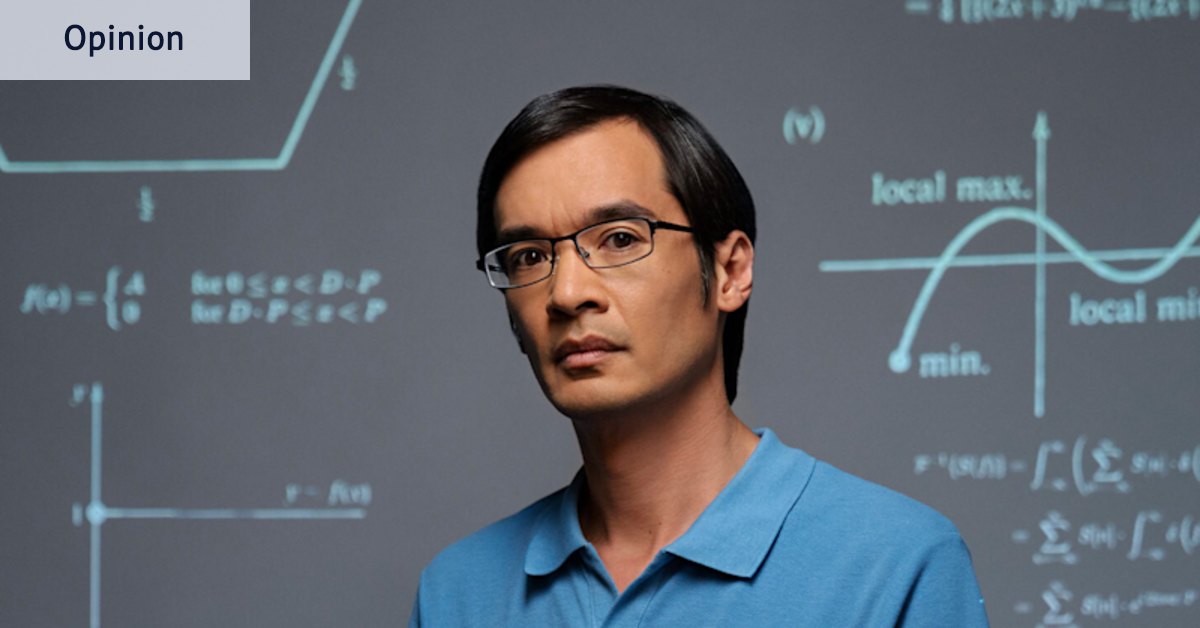
I never need an excuse to talk about the great mathematician Terence Tao.
So when the governor-general, Sam Mostyn, on Monday named Terence Tao a Companion of the Order of Australia in the 2026 King’s Birthday Honours, the highest grade in the civilian list, I was immensely proud.
Let’s celebrate Terry’s eminent service to the mathematical sciences, to the global mathematics community, and to tertiary education and academia, by checking out one of his most famous discoveries. Even better, it’s a discovery you will understand.
Tao was born in Adelaide in 1975, could count and read by age two, was sitting in on Flinders University maths lectures by 11, enrolled full-time at 14, had bagged a Princeton PhD by 21 and has won more awards than you can point an abacus at.
Most impressively, he scored the Fields Medal (maths’ closest thing to a Nobel) in 2006. He works at UCLA and is, by fairly broad agreement, the finest mathematician currently drawing breath. The greatest maths minds in the world regularly seek him out just to get his advice.
Among many achievements, Tao has given us an incredibly simple but mindblowing insight into the structure of numbers.
Recall prime numbers? Well, 6 is not prime because we can break it into factors and write 6 = 1 x 6 and 6 = 2 x 3. But 7 is prime. We can write it as 7 = 1 x 7, but we can’t break it into smaller factors like we did for 6. In that sense, primes are the building blocks of all counting numbers. But for such important pieces of the jigsaw puzzle, we know surprisingly little about them.
Every time we gain even a small insight into the dark infinity that is prime numbers, they laugh at us and disappear again into the shadows. As another brilliant Aussie mathematician, the University of Sydney’s Geordie Williamson puts it, “The primes go on forever, but it is very hard to discern any structure to them. Terry Tao has given us an incredible insight into these numbers.”
You see, one of the most amazing things we know about prime numbers is called the Green-Tao theorem. Props to Terry and his colleague, the Englishman Ben Green. And this is how it goes. Let’s have a look at some “chains” of numbers. First up 3, 5, 7 (a chain that is three numbers long with a common step of two). Now consider the chain 5, 11, 17, 23, 29 (length five, step six). You’ll notice that all these numbers in these chains are prime. So let’s call them prime chains.
If you like a bit of maths yourself, or have a maths-curious kid around the house, ask this question. What’s the first prime chain we encounter of length six? (Answer at the end of this article). In 2004, Green and Tao proved this amazing fact.
If you want a prime chain of length 100, it has to be out there somewhere. A chain of one million primes – yep, it exists somewhere. A billion. A trillion. Want a chain a million, billion, trillion primes long? The infinity of counting numbers will contain one. The deliciously maddening part is this: The proof tells you these runs exist, but it does not tell you where to look. It speaks to the pure existence of these chains, not their location.
In fact, the longest chain we have yet found is a mere 27 primes long. In case you’re wondering (and I’d be a little bit disappointed if you were not), it starts at 224,584,605,939,537,911 and goes up in steps of 18,135,160,562,604,430. All 27 numbers in this chain are prime.
For me, this is pure beauty. Despite knowing that the primes thin out as we count higher and despite our greatest supercomputers finding no chains longer than 27, a brilliant Aussie has proven that no matter how long a chain you seek, it must exist.
Sit for a second, let that wash over you and join me in saying “bloody well done, Terence Tao, Companion of the Order of Australia”.
* The prime chain 7, 37, 67, 97, 127, 157 is length six.
Adam Spencer is the University of Sydney’s ambassador for mathematics and science and writes about AI, mathematics and general geekery at adambspencer.substack.com.