







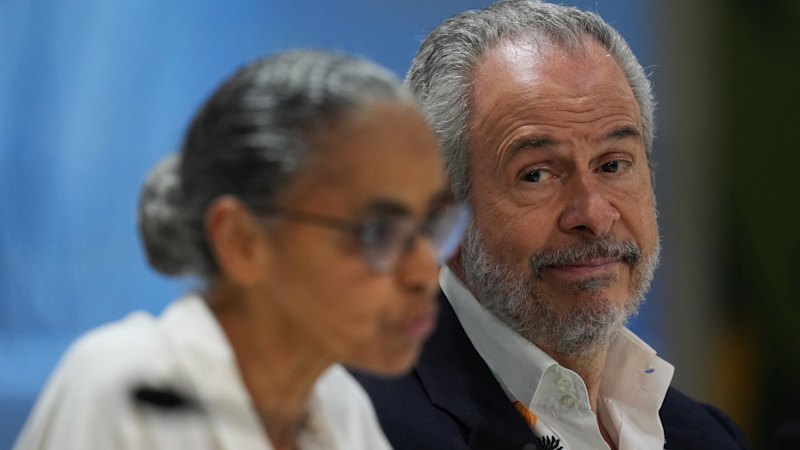
Brazil, host of the climate conference known as COP30, was trying to get them to co-operate on the toughest issues like climate-related trade restrictions, funding for climate solutions, national climate-fighting plans, and more transparency on measuring the progress of those plans.
More than 80 countries tried to introduce a detailed guide to phase out fossil fuels over the next several decades. There were other to-do items on topics including deforestation, gender and farming.

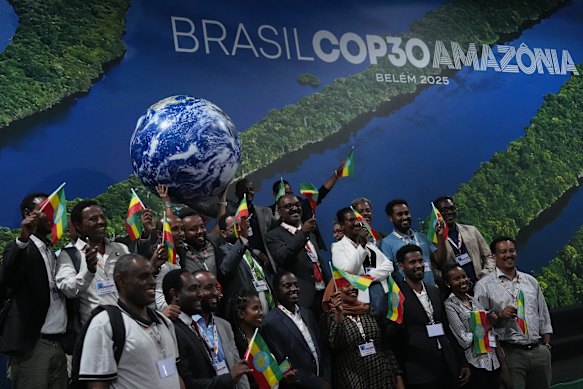
Delegates from Ethiopia, host of COP32, pose for a photo at the COP30.Credit: AP
Countries reached what critics called a weak compromise
Nations agreed to triple the amount of money promised to help the vulnerable countries adapt to climate change. But they will take five more years to do it. Some vulnerable island countries said they were happy about the financial support.
But the final document didn’t include a road map away from fossil fuels, angering many.
After the agreement was reached, COP president André Corrêa do Lago said Brazil would take an extra step and write its own road map. Not all countries signed up to this, but those on board will meet next year to specifically talk about the fossil fuel phase-out. It would not carry the same weight as something agreed to at the conference.
Also included in the package were smaller agreements on energy grids and biofuels.
Responses ranged from happy to angry
“Given what we expected, what we came out with, we were happy,” Alliance of Small Island States chair Ilana Seid said.
But others felt discouraged. Heated exchanges took place during the conference’s final meeting as countries sniped at each other about the fossil fuel plan.
Loading
“I will be brutally honest: the COP and the UN system are not working for you. They have never really worked for you. And today, they are failing you at a historic scale,” a Panama negotiator, Juan Carlos Monterrey Gomez, said.
Sierra Leone’s Environment and Climate Change Minister, Jiwoh Abdulai, said: “COP30 has not delivered everything Africa asked for, but it has moved the needle.” He added: “This is a floor, not a ceiling.”
The real outcome of this year’s climate talks will be judged on “how quickly these words turn into real projects that protect lives and livelihoods”, he said.
Talks set against the Amazon rainforest
Participants experienced the Amazon’s extreme heat and humidity and heavy rains that flooded walkways. Organisers who chose Belem, on the edge of the rainforest, as the host city had intended for countries to experience first-hand what was at stake with climate change, and take bold action to stop it.
Loading
But afterwards, critics said the deal showed how hard it was to find global co-operation on issues that affected everyone, most of all people in poverty, Indigenous people, women and children around the world.
“At the start of this COP, there was this high level of ambition. We started with a bang, but we ended with a whimper of disappointment,” said former Philippine negotiator Jasper Inventor, now at Greenpeace International.
Indigenous people, civil society and youth
One of the nicknames for the climate talks in Brazil was the “Indigenous peoples’ COP”. Yet some in those groups said they had to fight to be heard.
Protesters from Indigenous groups twice disrupted the conference to demand a bigger seat at the table. While Indigenous people’s rights weren’t officially on the agenda, Taily Terena, an Indigenous woman from the Terena nation in Brazil, said so far she was happy with the text because for the first time it included a paragraph mentioning Indigenous rights.
She supported countries speaking up on procedural issues because that was how multilateralism worked. “It’s kind of chaotic, but from our perspective, it’s kind of good that some countries have a reaction,” she said.
AP


